



How Can Fungi Teach Us New Ways of Inhabiting the World?
The fungi looks at itself
Maya Minder, 2024-2026
Video single channel, stereo sound
Fungi Cosmology is an international research program born from a collaboration among curators, artists, and scientists from Brazil, Switzerland, and Chile. The initiative brings together CAB Patagonia (Chile), Labverde (Brazil), Artist-in-Labs at Zurich University of the Arts and foodculture days. Curated by Lilian Fraiji, María Luisa Murillo, Irène Hediger and Margaux Schwab, with artists Jorgge Menna Barreto, Maya Minder, Seba Calfuqueo, Valentina Serrati and scientists Juli Simon, Patricia Silva Flores, Martina Peter, Benjamin Dauphin. Together, these institutions developed a three-year research and three field trips to collectively reflect on fungi and their role within the ecosystems they inhabit.
As part of this phase of process-sharing and public engagement, the project has unfolded in one exhibition in Switzerland (Hall ZhdK Toni Areal Campus, 2024), two exhibitions in Chile (Suizspacio Gallery and Museum of Contemporary Art from Santiago, 2026) and a digital editorial developed for Boca a Boca website. They are conceived as autonomous yet interconnected spaces in dialogue through relations of interdependence.
This expanded editorial brings together diverse documentation from across the project, creating a web-based narrative of the research process especially designed for Boca a Boca platform.
Fungi Cosmology Collective records, Chile / Switzerland / Brazil,
Valentina Serrati Sisa, 2024
Three-channel video installation, stereo sound
The Fungi Cosmology archive brings together materials generated throughout the research process, including photographs, videos, field recordings, and conversations. Rather than documenting events, it reveals the relational, affective, and territorial dimensions that informed and shaped the investigation.
The project is not offering definitive answers about the fascinating fungi kingdom, but Fungi Cosmology is rather proposing a transdisciplinary research process that intertwines art and science, inviting us to reconsider our place within a more-than-human community and to imagine other ways of coexisting in the world.
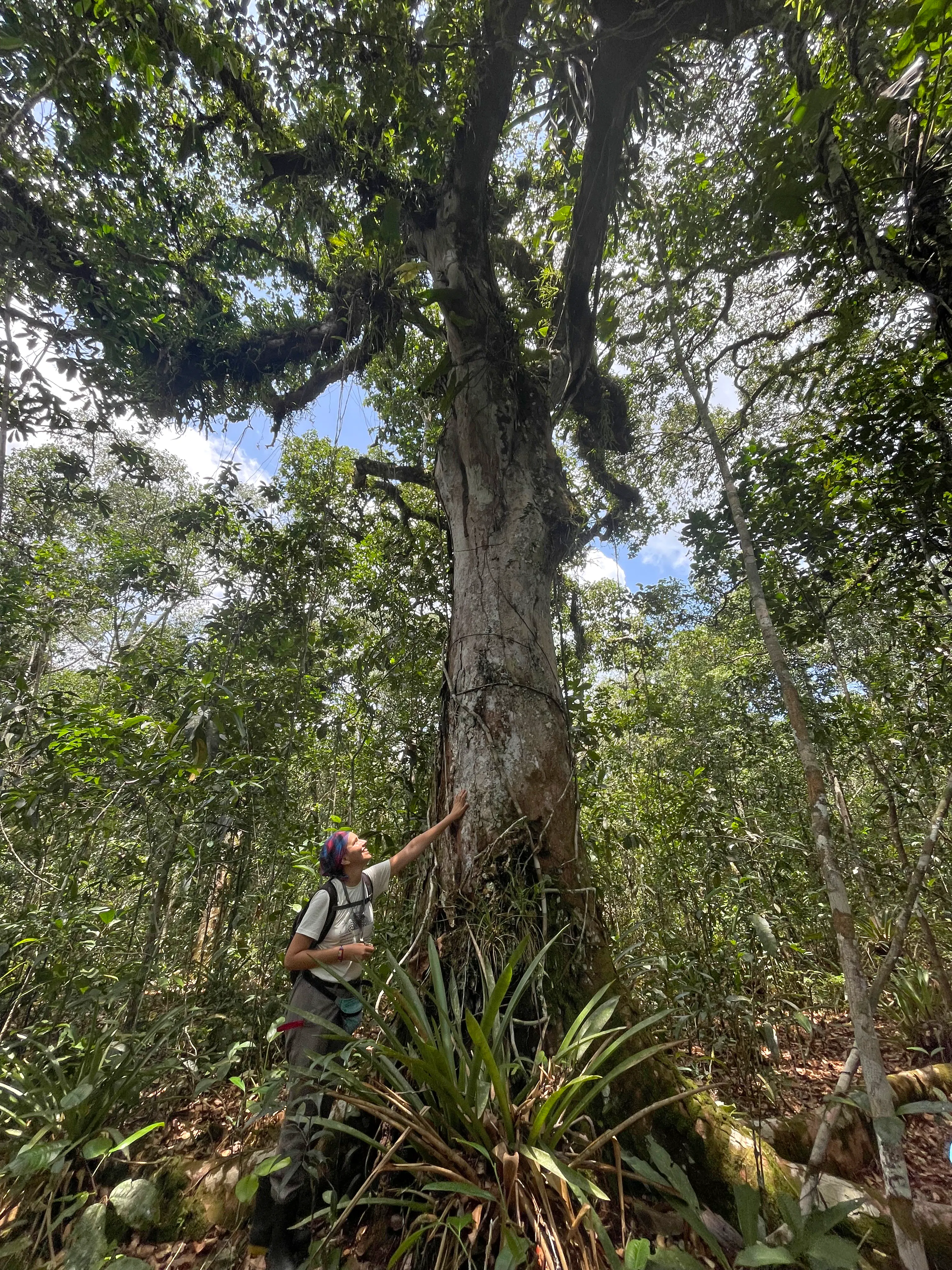
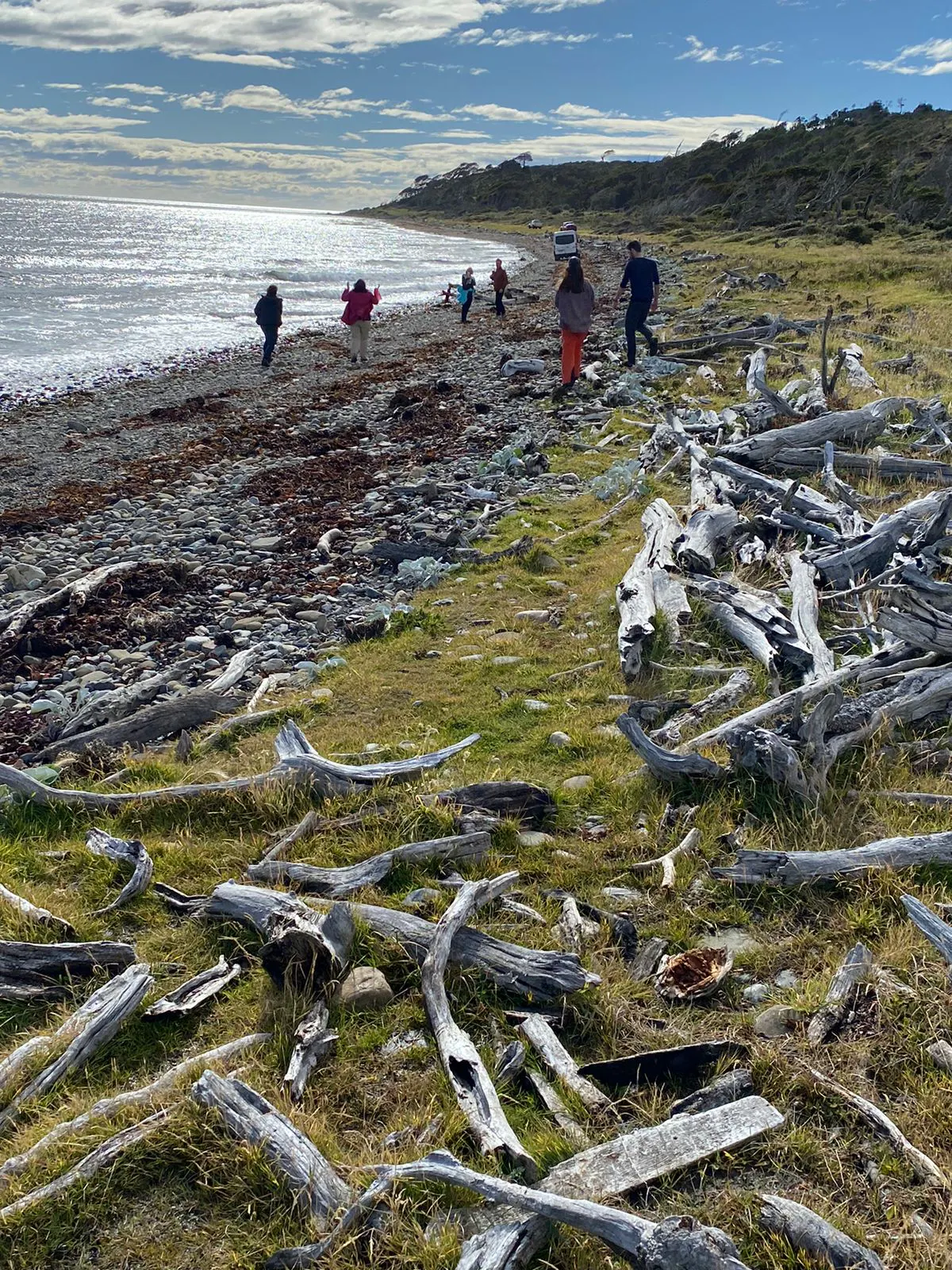
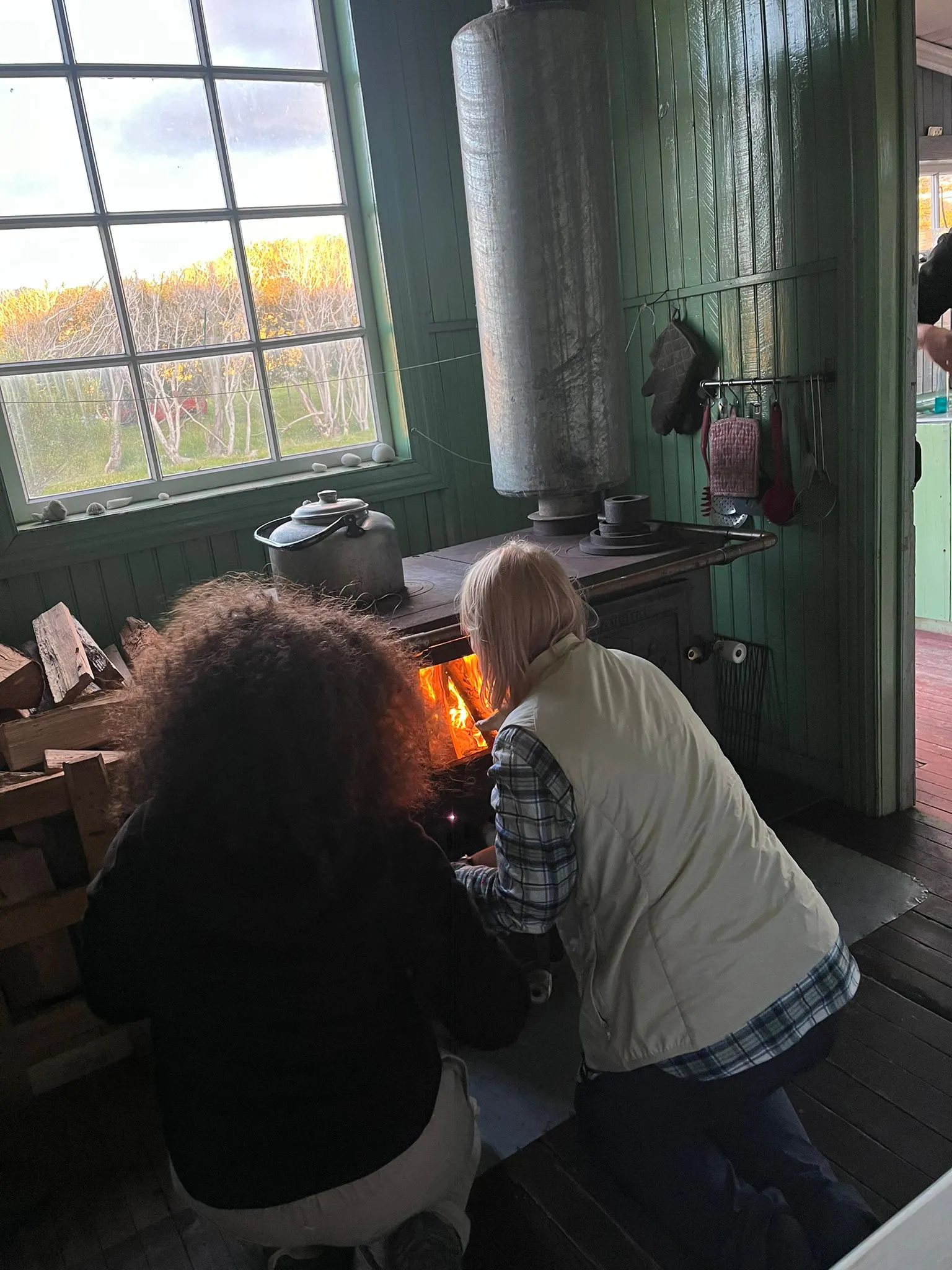
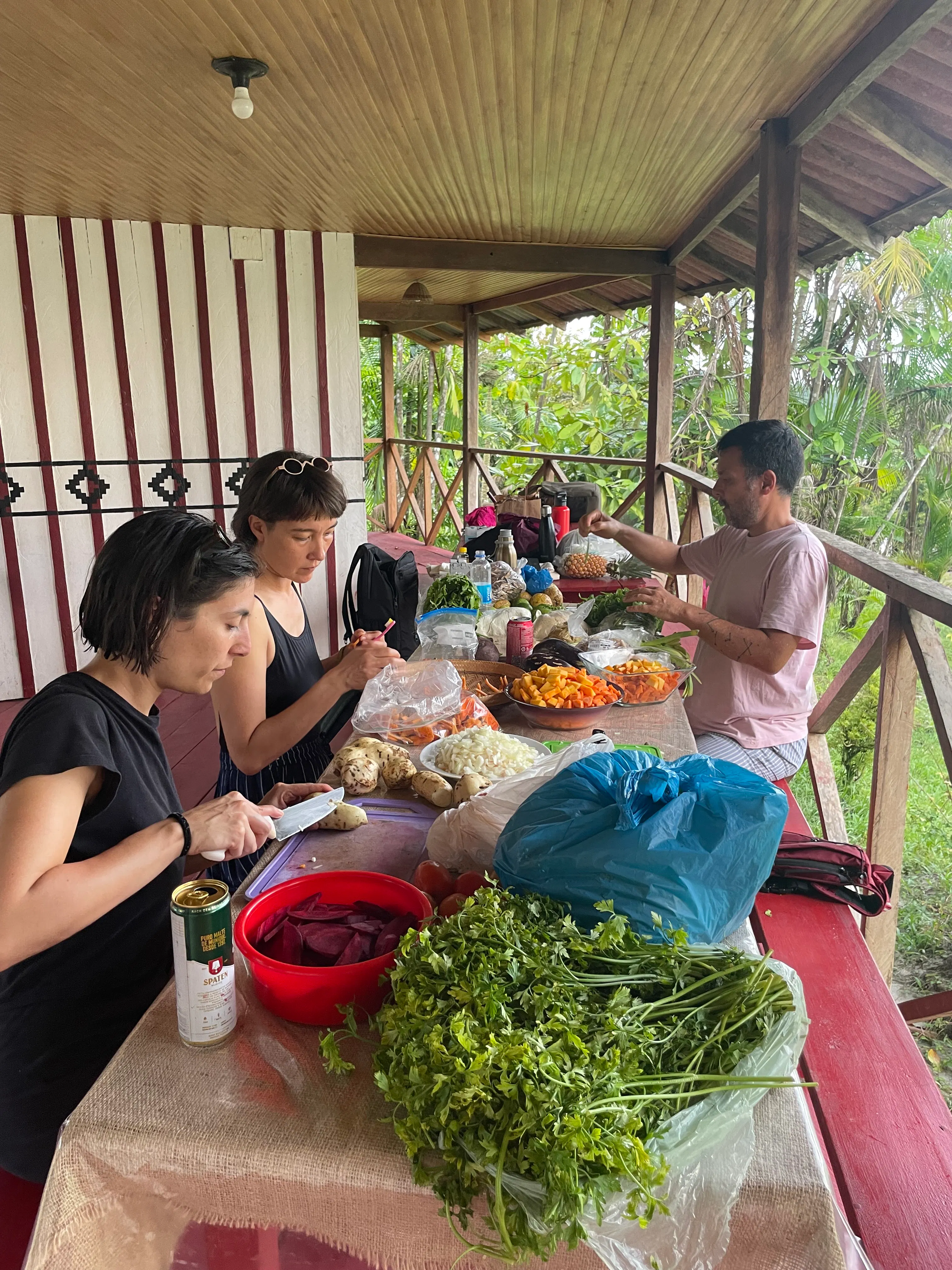
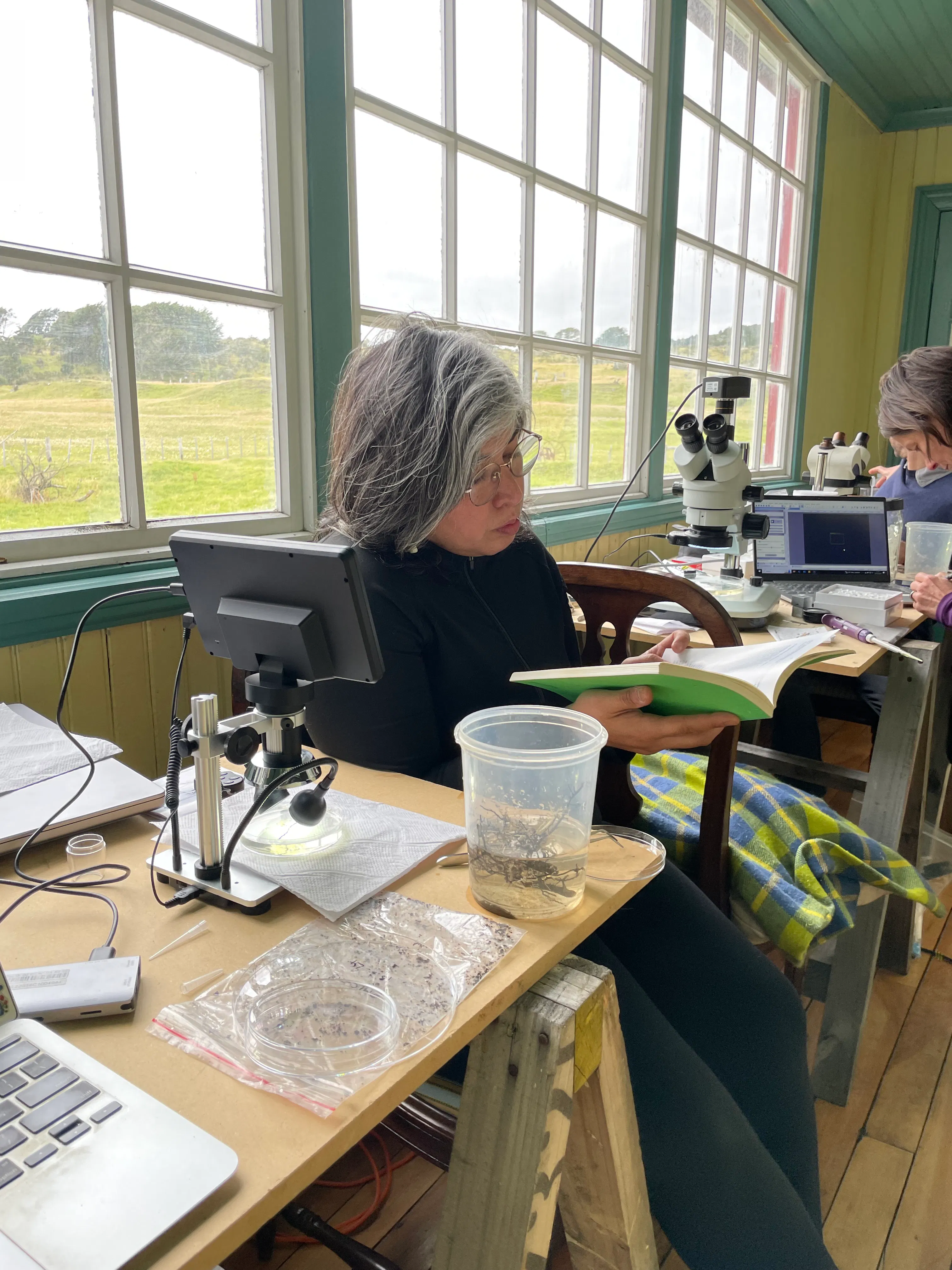
While the need to observe, analyze, and understand the biodiversity of Patagonian, Amazonian, and Alpine territories constitutes a central axis of this research, we conceive this project as a living network of relationships, interdependencies, and processes in constant transformation.
Drawing on contributions from ecology and multispecies anthropology, the project approaches art as a transdisciplinary contemporary practice and as a space for sensitive mediation between scientific, territorial, and cultural forms of knowledge. In this sense, what is presented here does not seek to represent nature from an aesthetic distance; rather, it proposes itself as an ecosystem in its own right: a dynamic space that invites the activation of physical, temporal, and affective relationships with what surrounds us and what remains unknown to us.
How Can Fungi Teach Us New Ways of Inhabiting the World?
The fungi looks at itself
Maya Minder, 2024-2026
Video single channel, stereo sound
Fungi Cosmology is an international research program born from a collaboration among curators, artists, and scientists from Brazil, Switzerland, and Chile. The initiative brings together CAB Patagonia (Chile), Labverde (Brazil), Artist-in-Labs at Zurich University of the Arts and foodculture days. Curated by Lilian Fraiji, María Luisa Murillo, Irène Hediger and Margaux Schwab, with artists Jorgge Menna Barreto, Maya Minder, Seba Calfuqueo, Valentina Serrati and scientists Juli Simon, Patricia Silva Flores, Martina Peter, Benjamin Dauphin. Together, these institutions developed a three-year research and three field trips to collectively reflect on fungi and their role within the ecosystems they inhabit.
As part of this phase of process-sharing and public engagement, the project has unfolded in one exhibition in Switzerland (Hall ZhdK Toni Areal Campus, 2024), two exhibitions in Chile (Suizspacio Gallery and Museum of Contemporary Art from Santiago, 2026) and a digital editorial developed for Boca a Boca website. They are conceived as autonomous yet interconnected spaces in dialogue through relations of interdependence.
This expanded editorial brings together diverse documentation from across the project, creating a web-based narrative of the research process especially designed for Boca a Boca platform.
Fungi Cosmology Collective records, Chile / Switzerland / Brazil,
Valentina Serrati Sisa, 2024
Three-channel video installation, stereo sound
The Fungi Cosmology archive brings together materials generated throughout the research process, including photographs, videos, field recordings, and conversations. Rather than documenting events, it reveals the relational, affective, and territorial dimensions that informed and shaped the investigation.
The project is not offering definitive answers about the fascinating fungi kingdom, but Fungi Cosmology is rather proposing a transdisciplinary research process that intertwines art and science, inviting us to reconsider our place within a more-than-human community and to imagine other ways of coexisting in the world.
While the need to observe, analyze, and understand the biodiversity of Patagonian, Amazonian, and Alpine territories constitutes a central axis of this research, we conceive this project as a living network of relationships, interdependencies, and processes in constant transformation.
Drawing on contributions from ecology and multispecies anthropology, the project approaches art as a transdisciplinary contemporary practice and as a space for sensitive mediation between scientific, territorial, and cultural forms of knowledge. In this sense, what is presented here does not seek to represent nature from an aesthetic distance; rather, it proposes itself as an ecosystem in its own right: a dynamic space that invites the activation of physical, temporal, and affective relationships with what surrounds us and what remains unknown to us.

About Fungi Cosmology
Fungi continuously transform the world around us by creating vast networks of relationships with other living beings. Their lives are deeply intertwined with plants, bacteria, animals, and soils, forming invisible systems that sustain ecosystems across the planet.
Fungi encompasses a vast kingdom that includes mushrooms, molds, and yeasts. Most of a fungus life unfolds beyond our sight in the form of mycelium: a network of microscopic filaments that grows underground or within plants and many other organisms. When environmental conditions are favorable, the mycelium produces the visible fruiting body—the mushroom or sporocarp—which releases spores for reproduction. These spores can remain dormant for years, awaiting the right combination of temperature and humidity to give rise to new life.
Fungi perform a remarkable diversity of ecological functions through their multiple modes of existence. As mycorrhizal symbionts, they weave underground networks that connect plants to soils, enhancing nutrient exchange, resilience, and growth. As lichens, they form intimate partnerships with algae and/or cyanobacteria, contributing gradually to soil formation and opening pathways for life in some of the most extreme environments on Earth. As parasites and pathogens, they shape population dynamics and ecological balance by regulating host organisms and redistributing energy and resources.
By observing and recognizing fungi and their ways of organizing life, we invite you to imagine more interconnected, resilient, and cooperative ways of inhabiting the world.
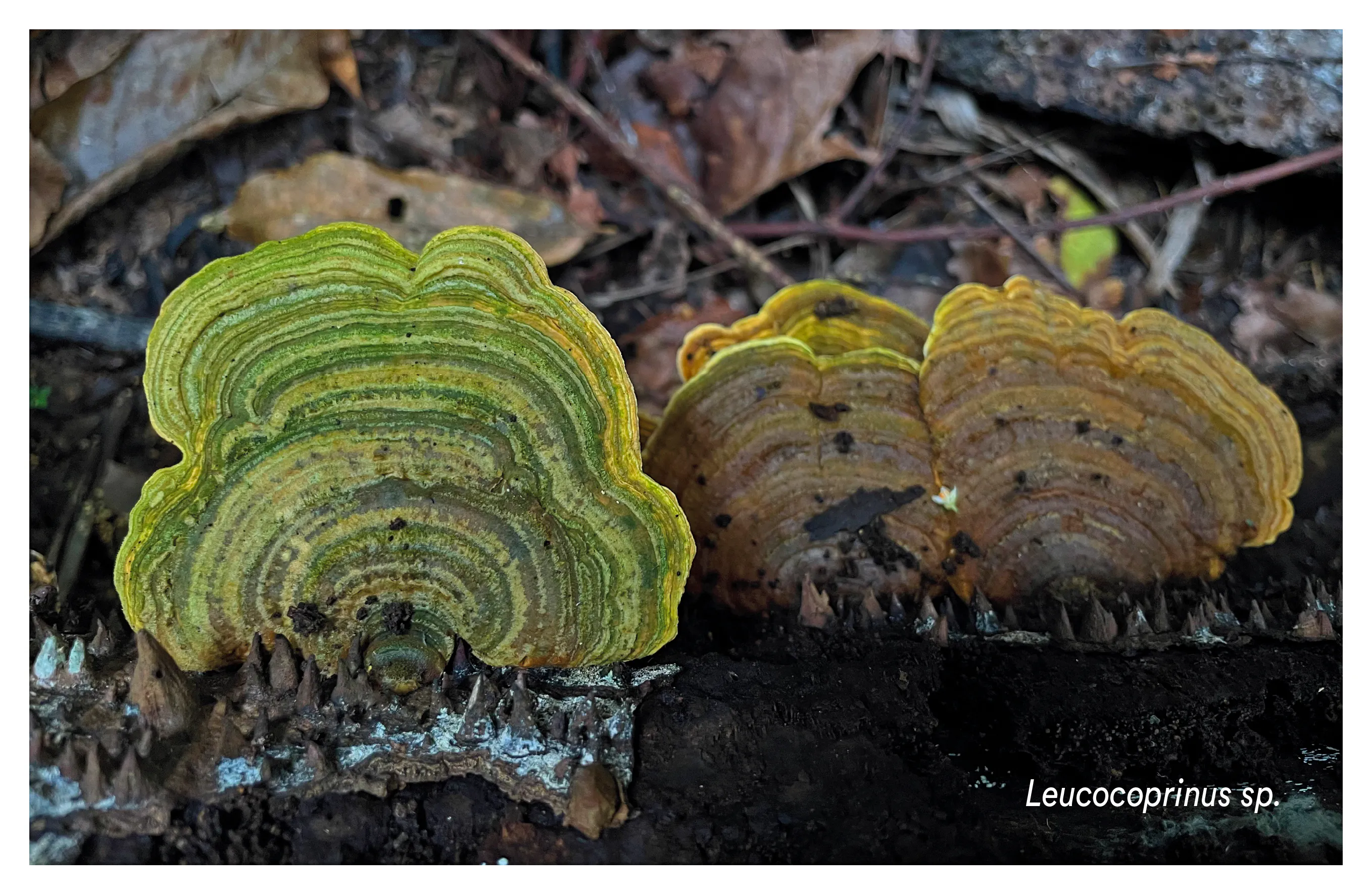
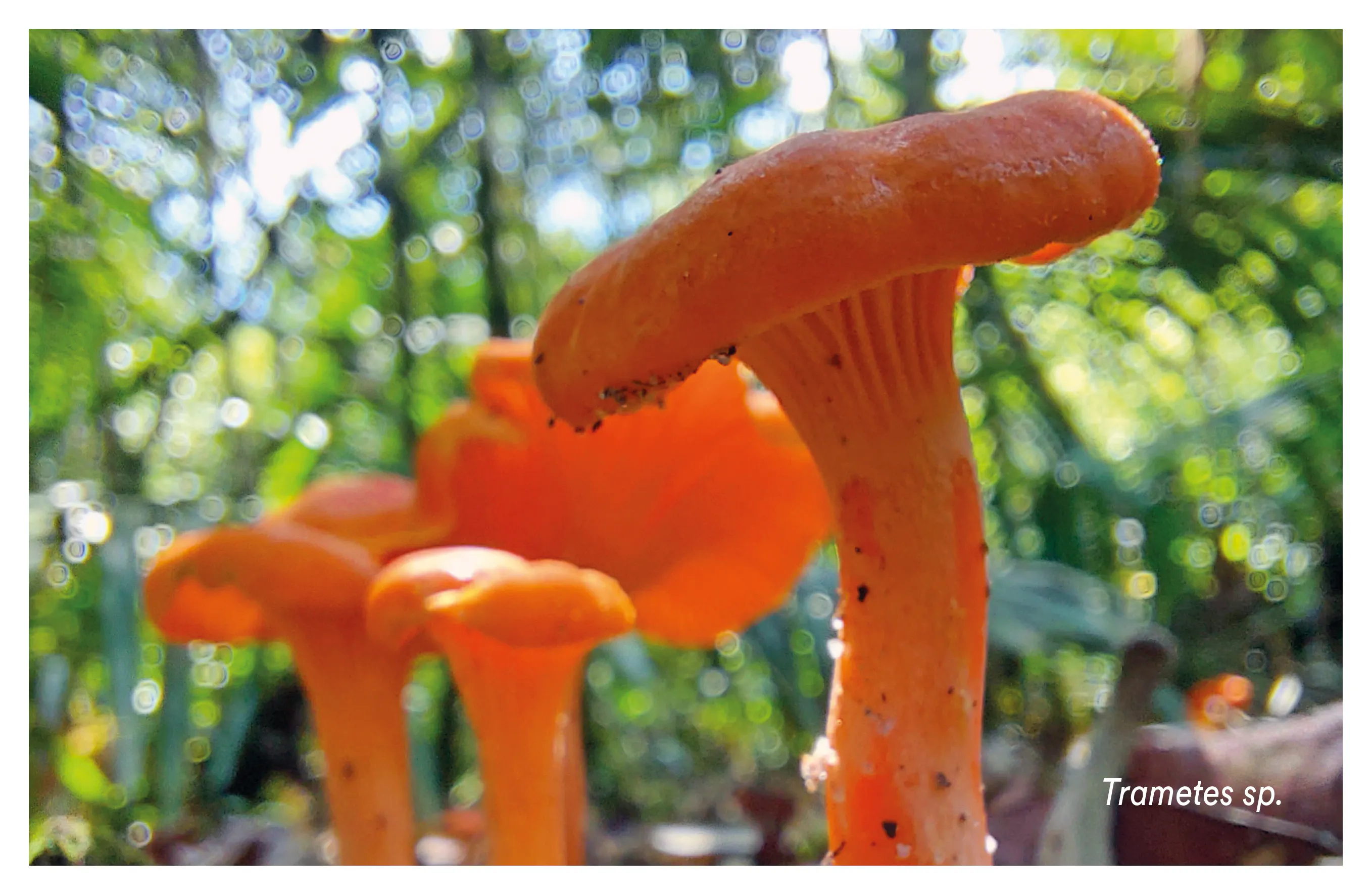
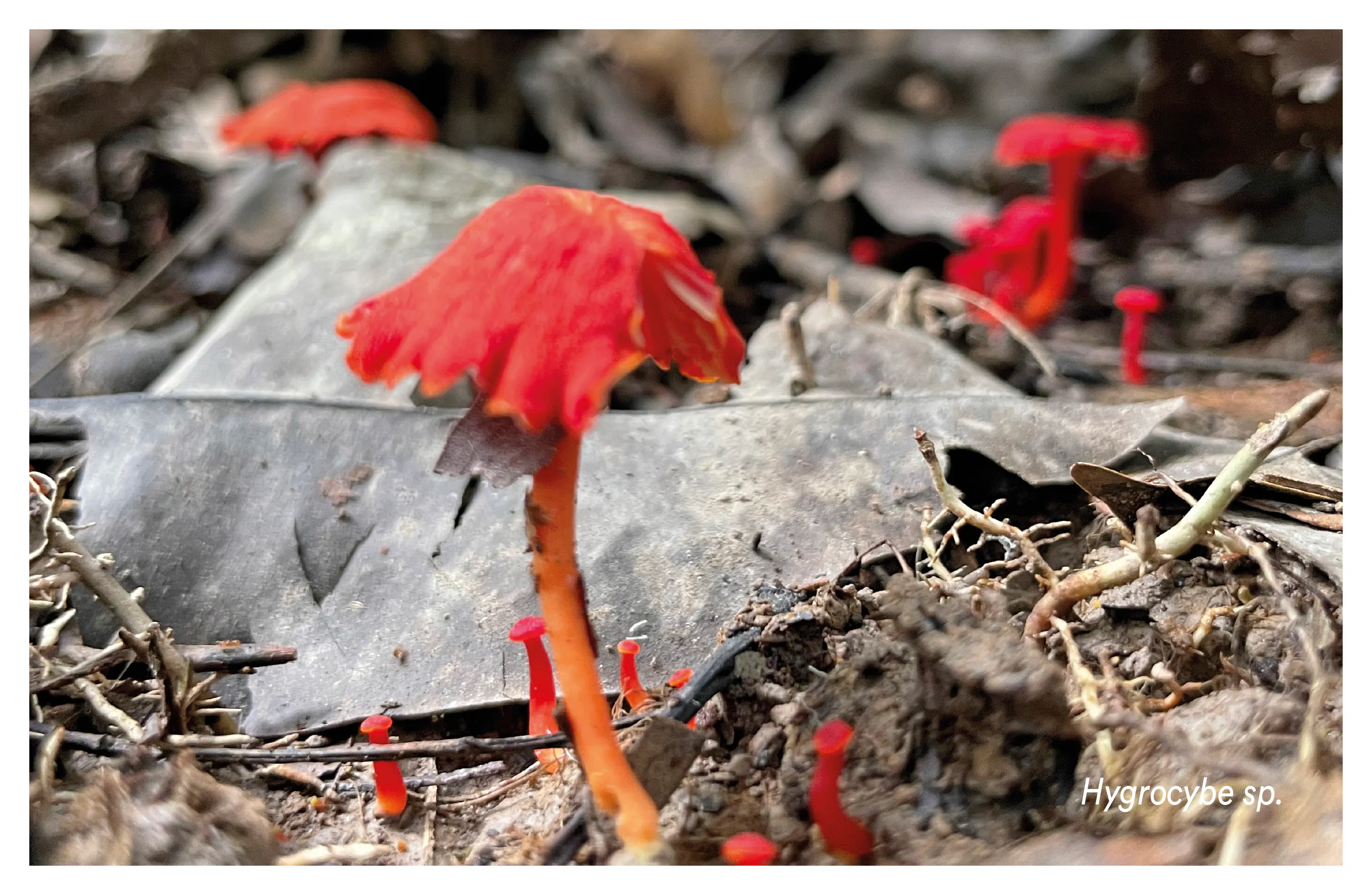
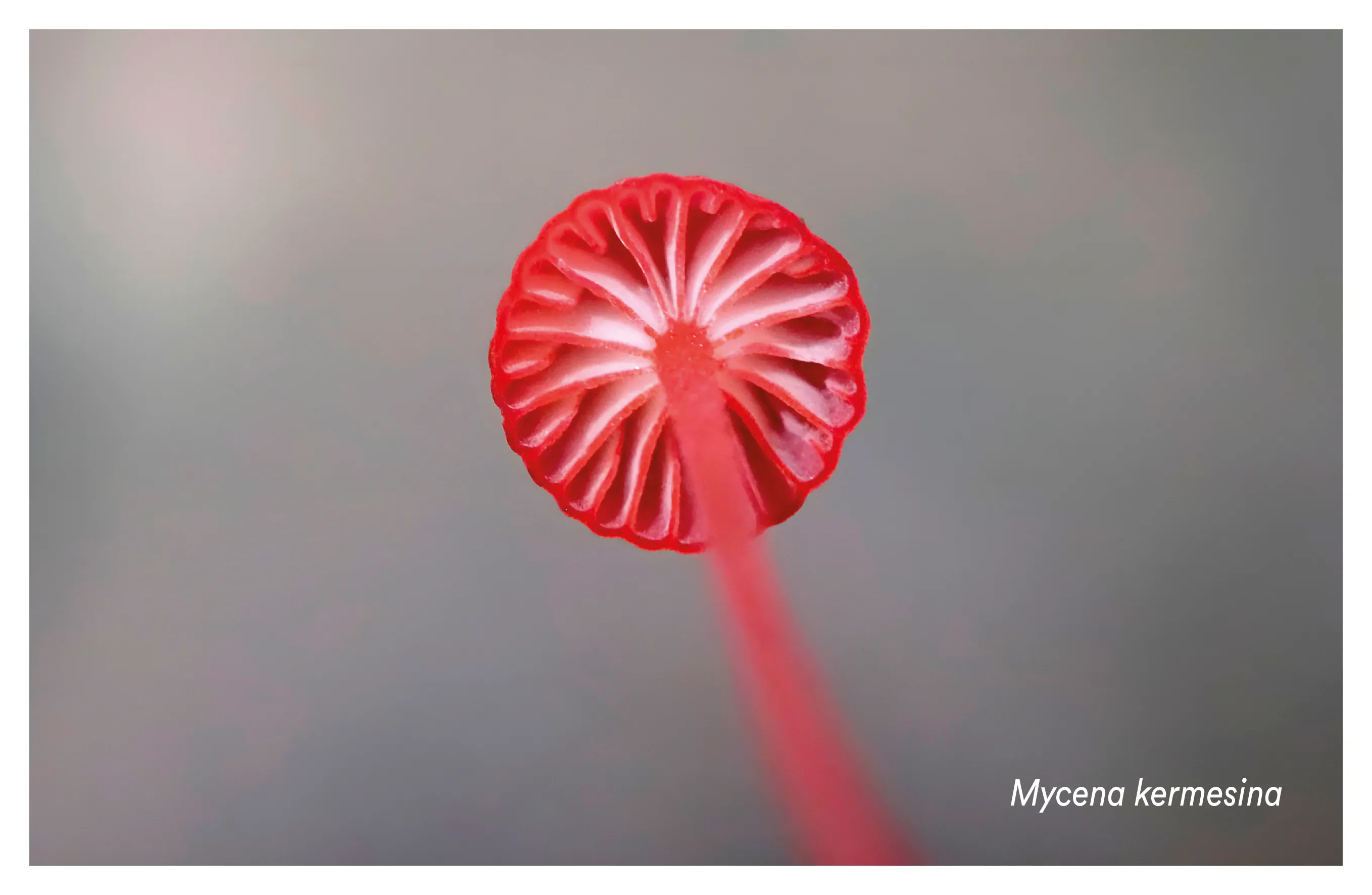
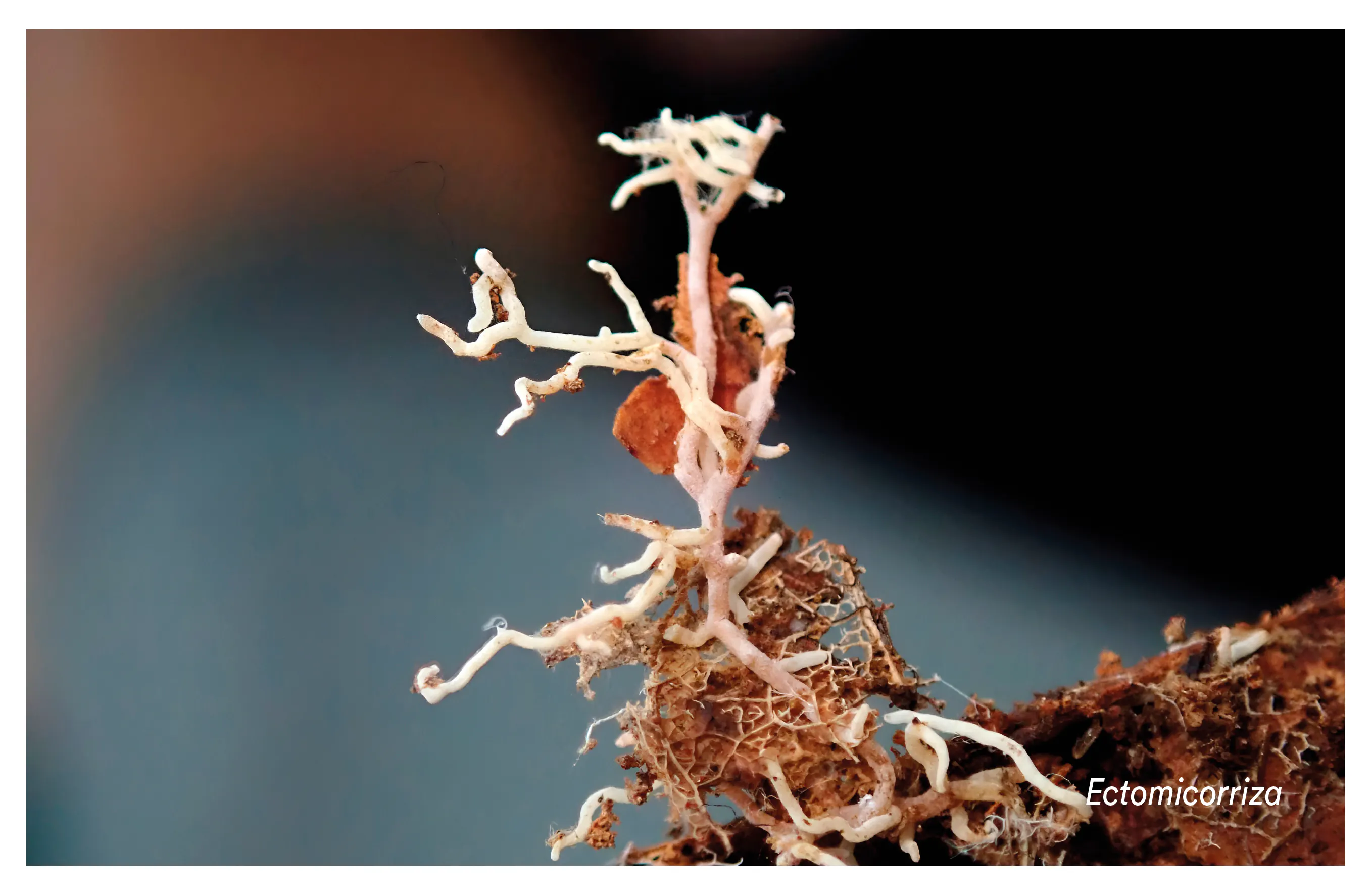
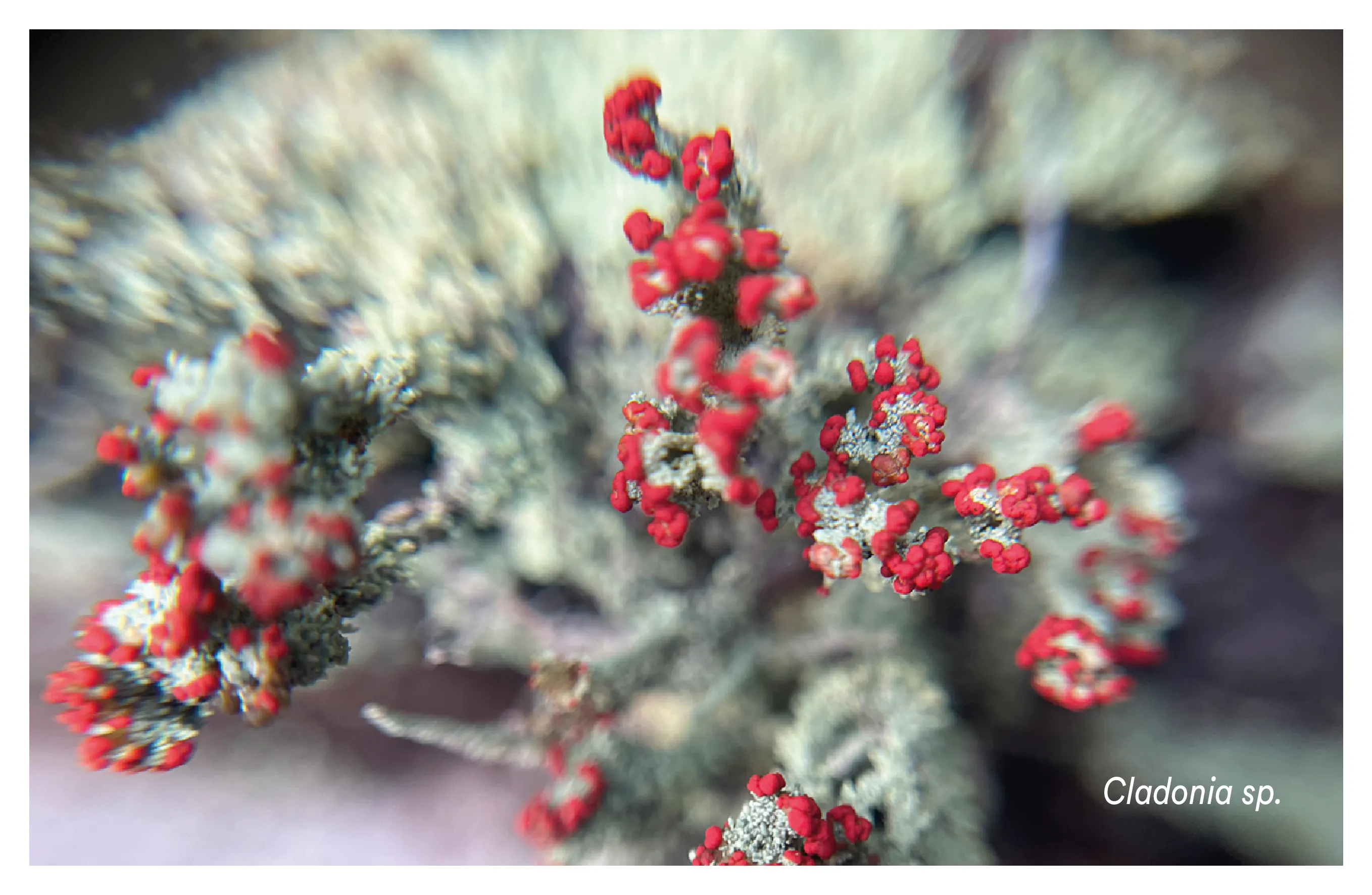
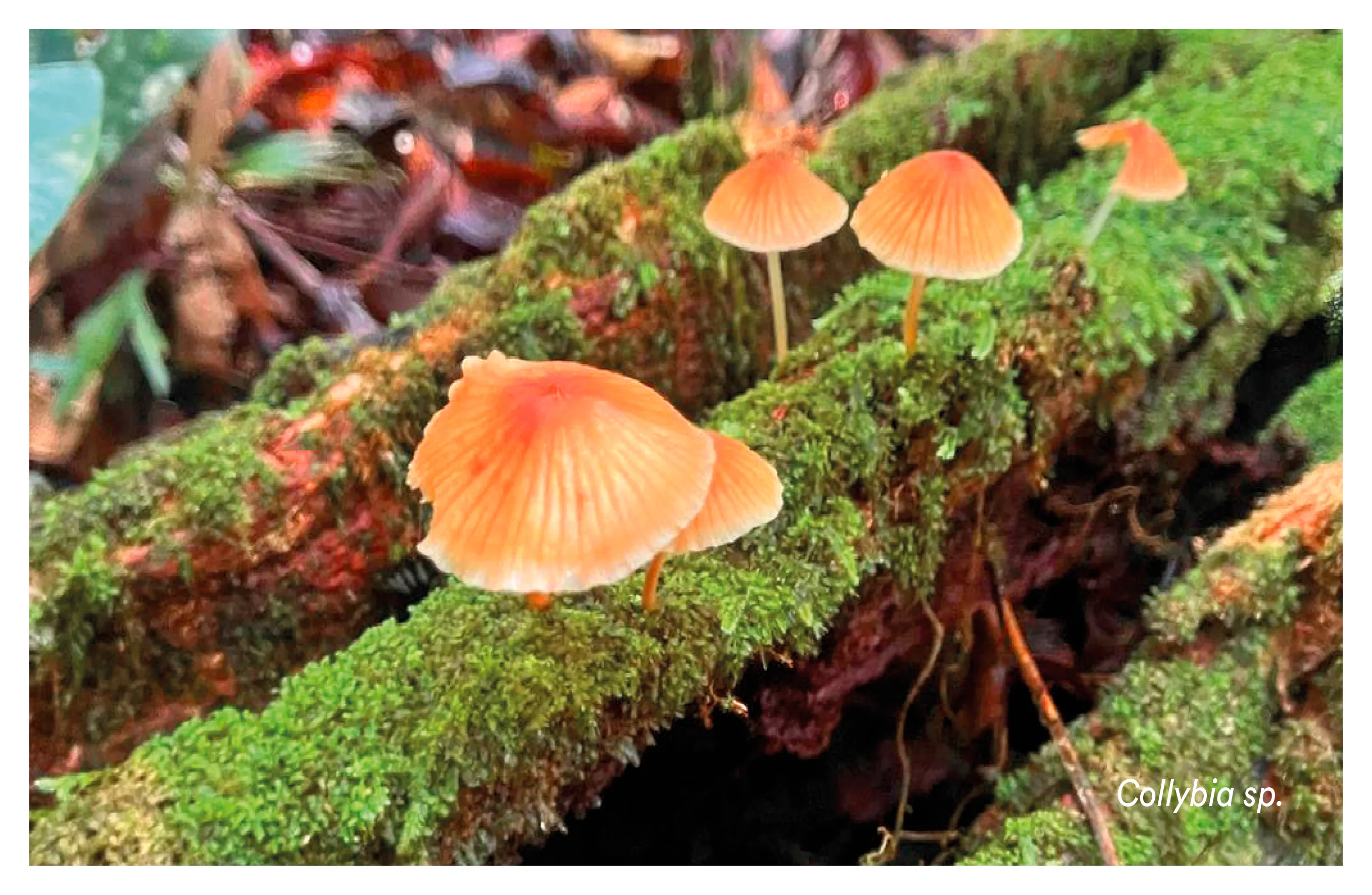
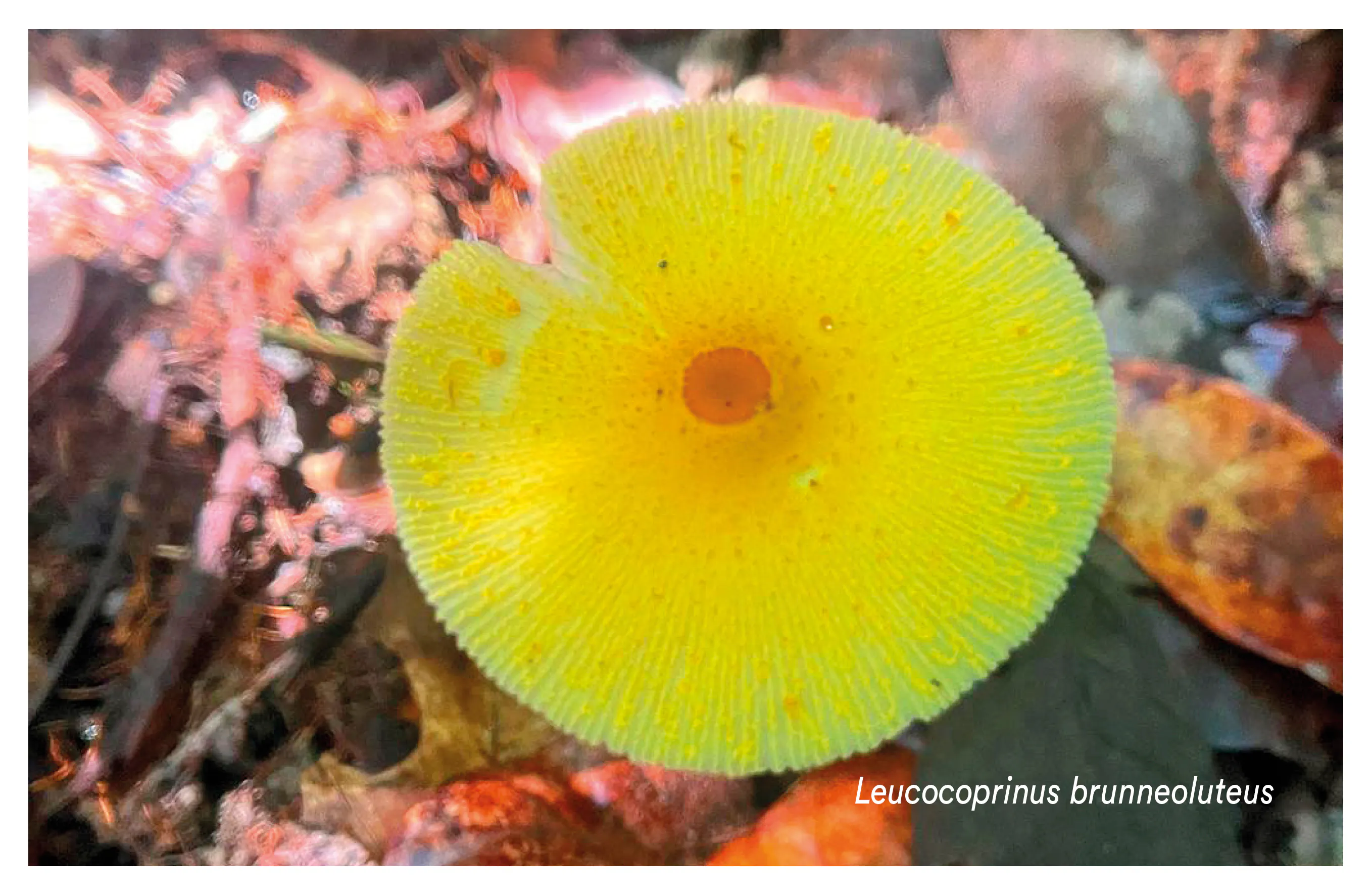
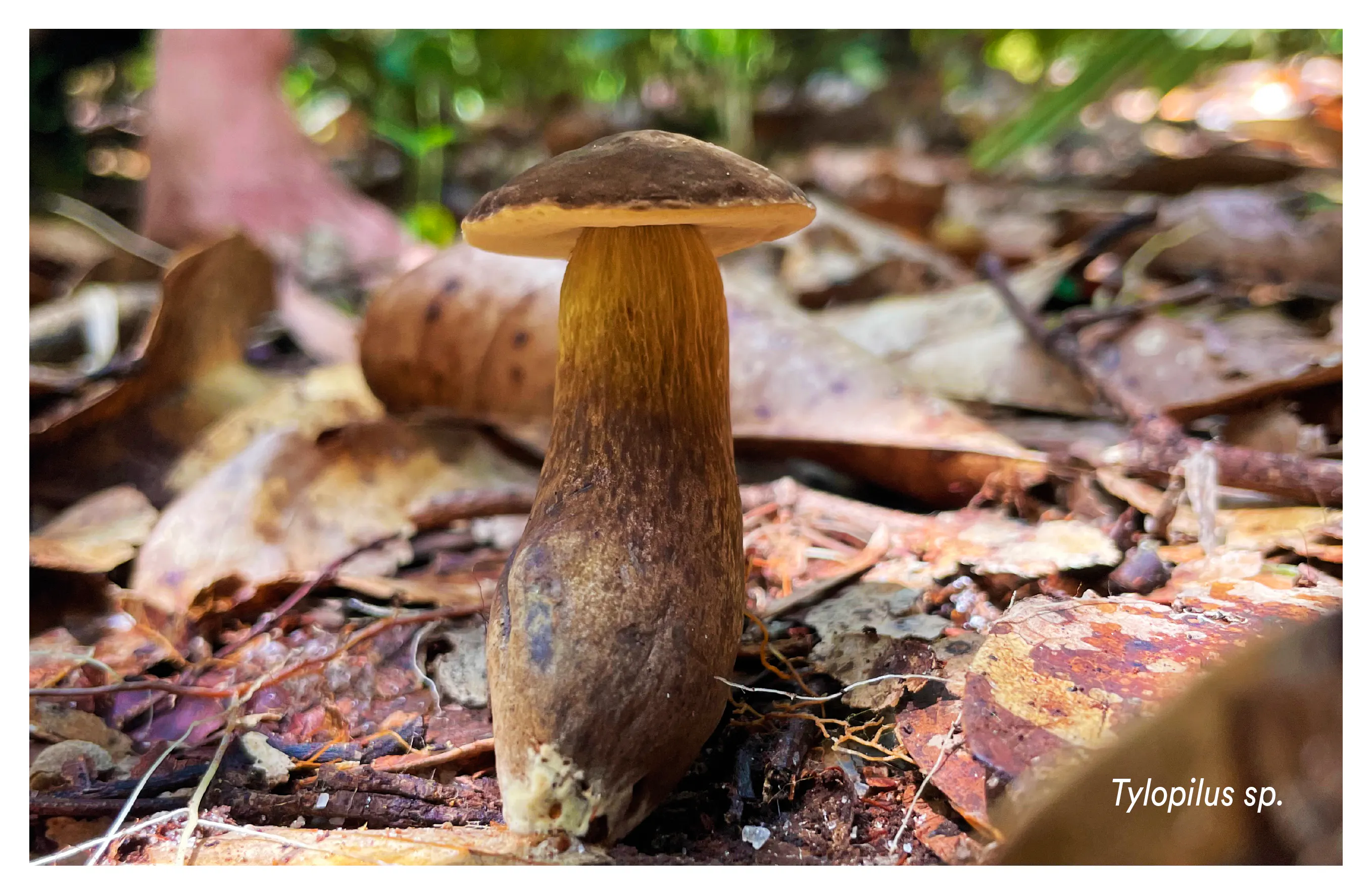
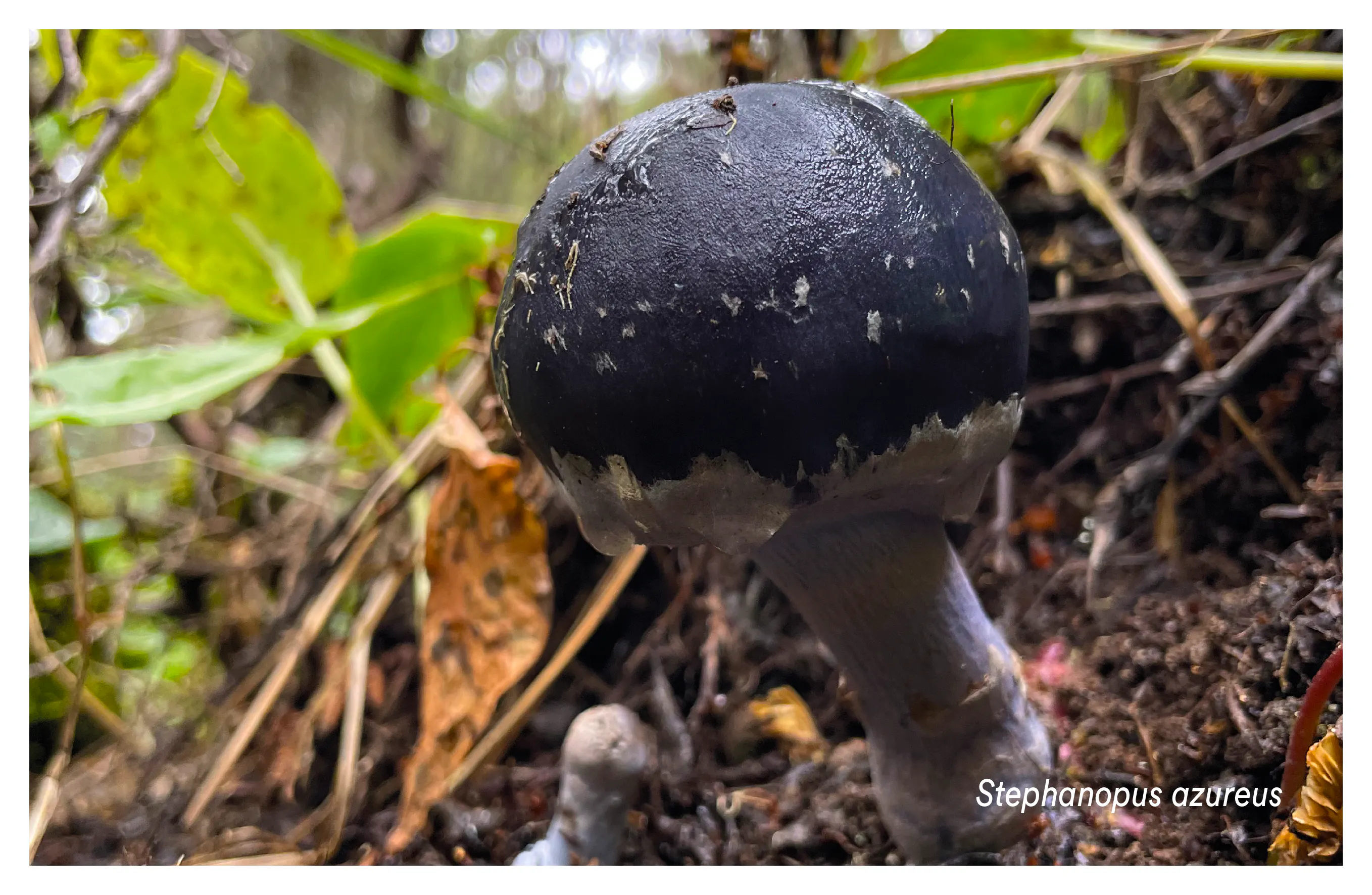
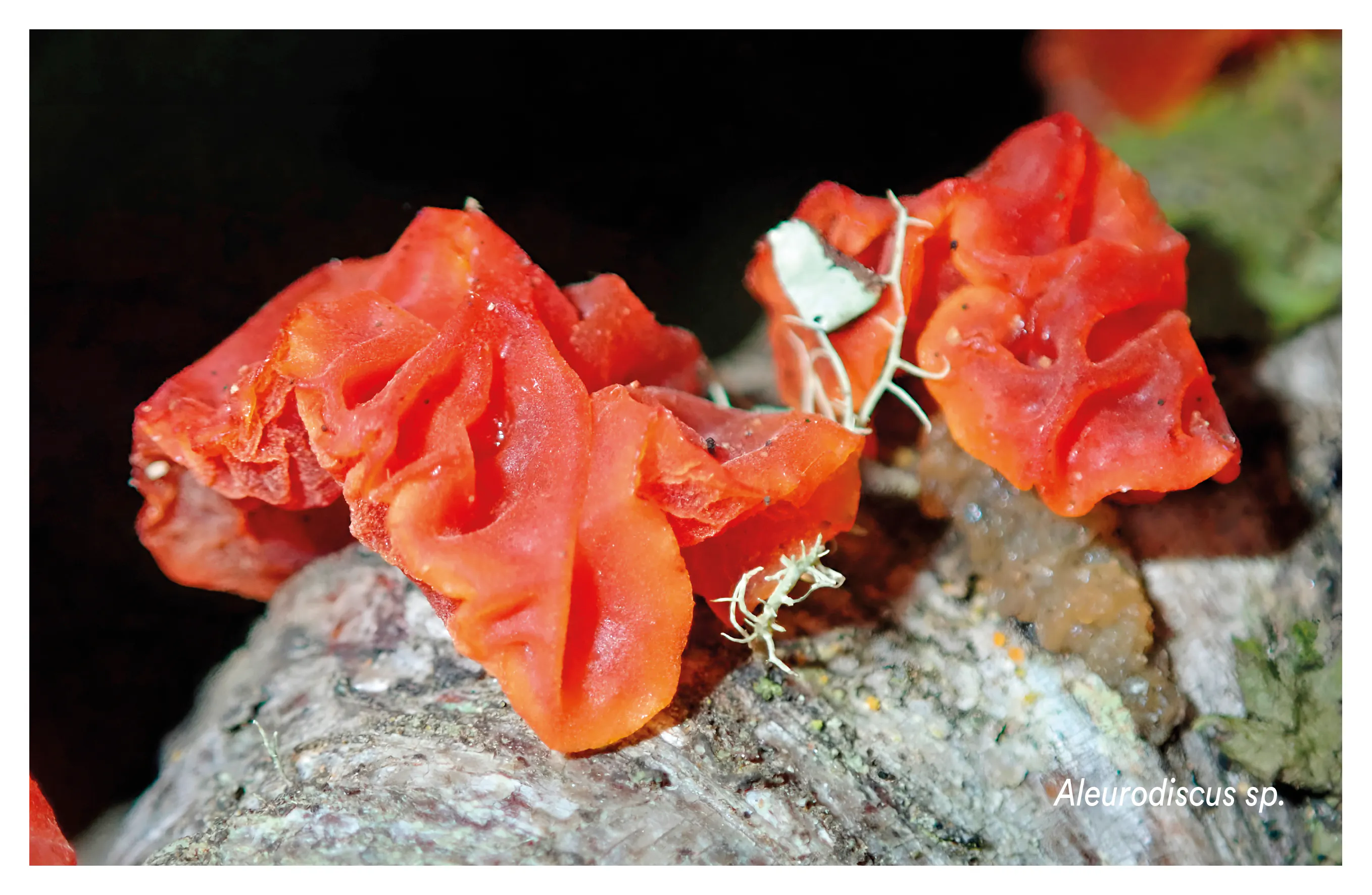
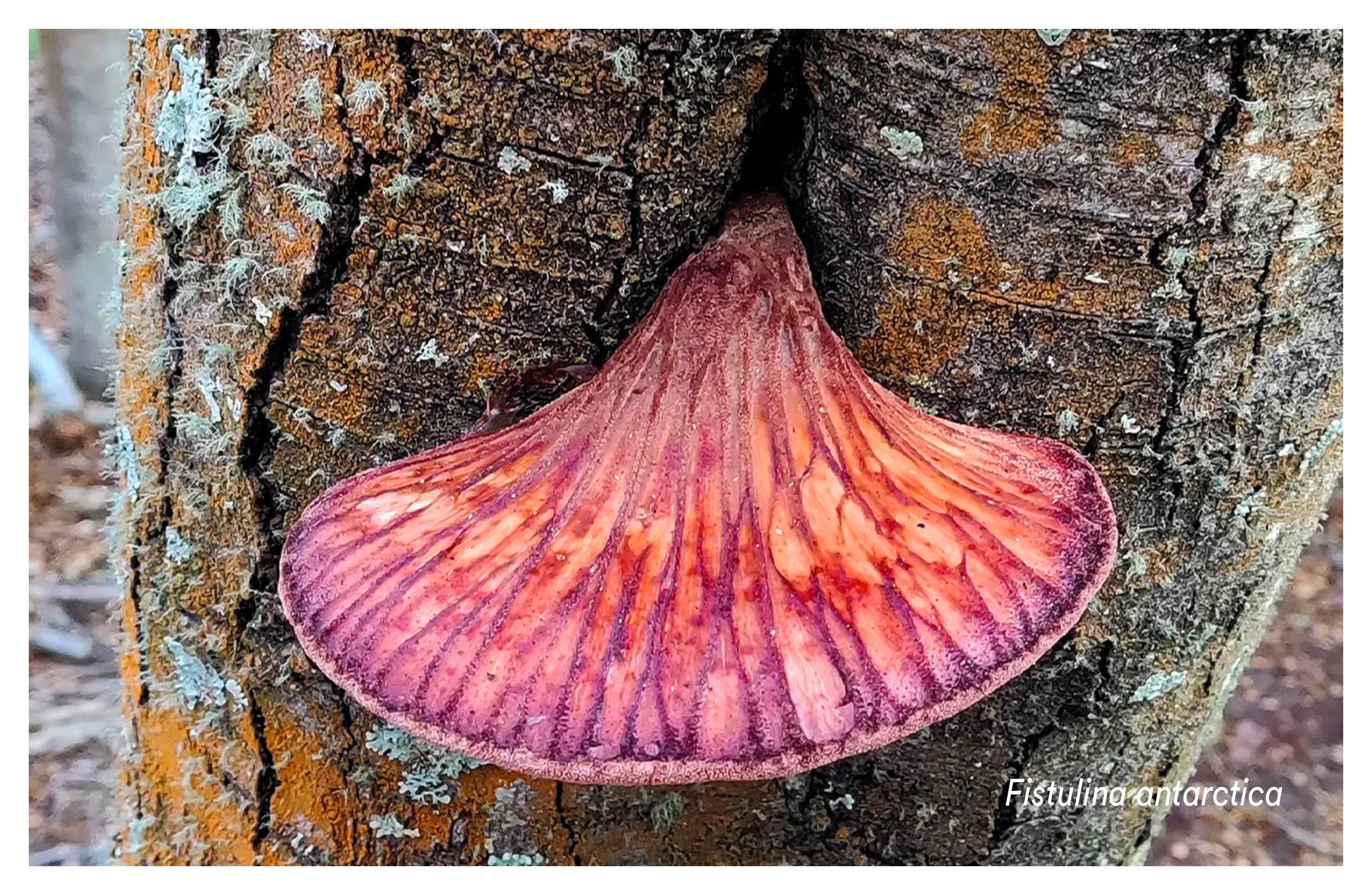
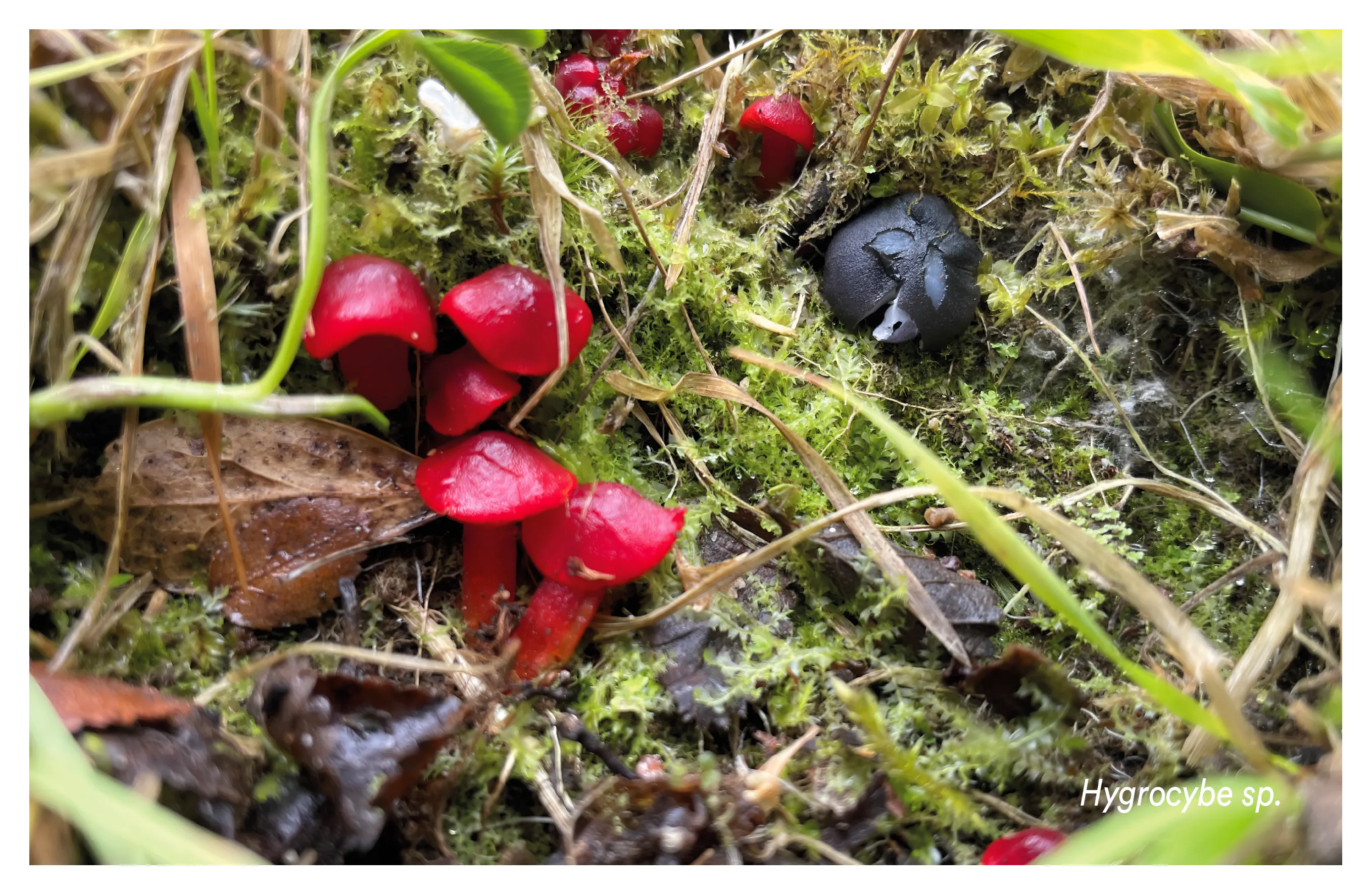
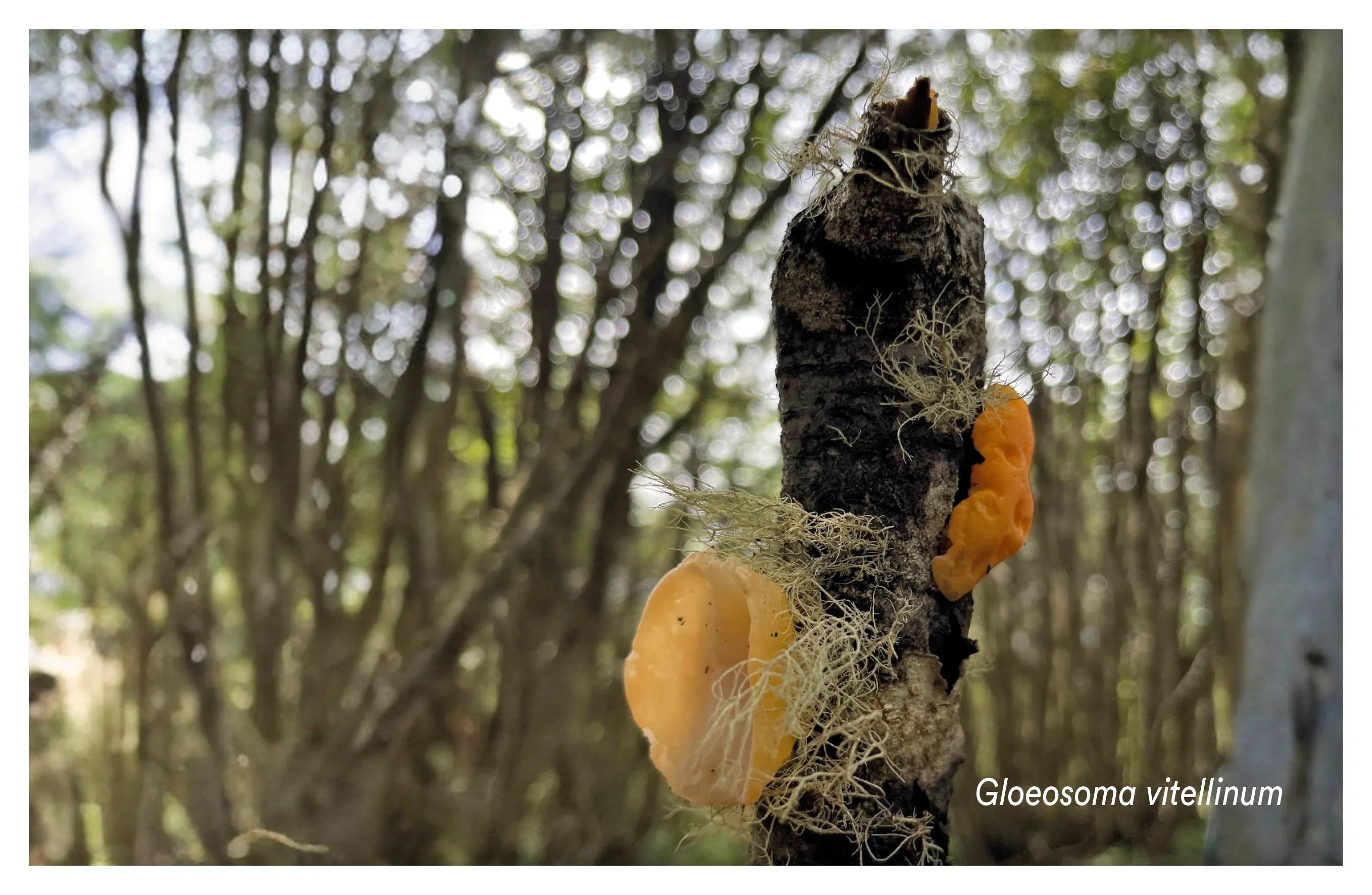
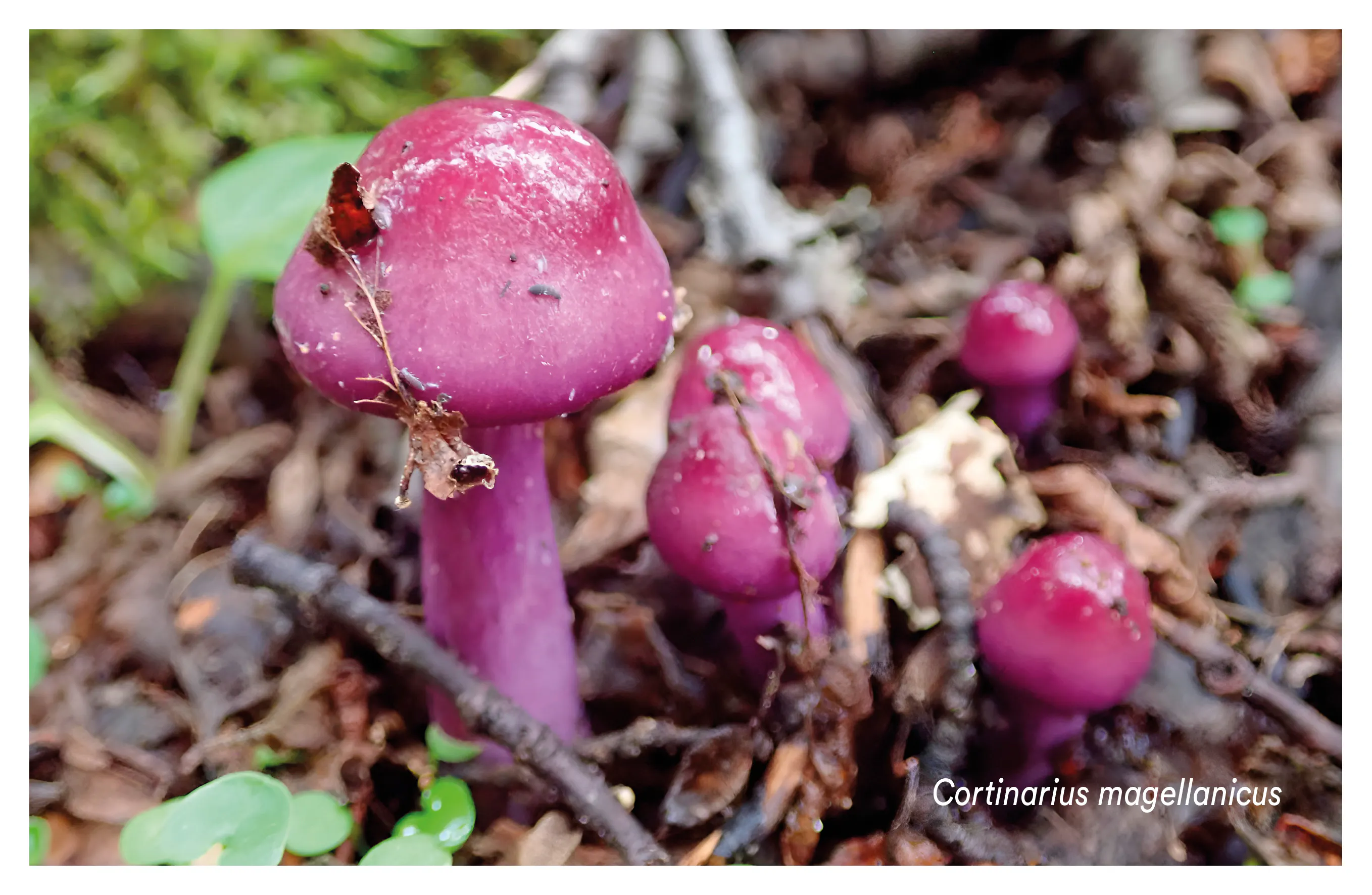
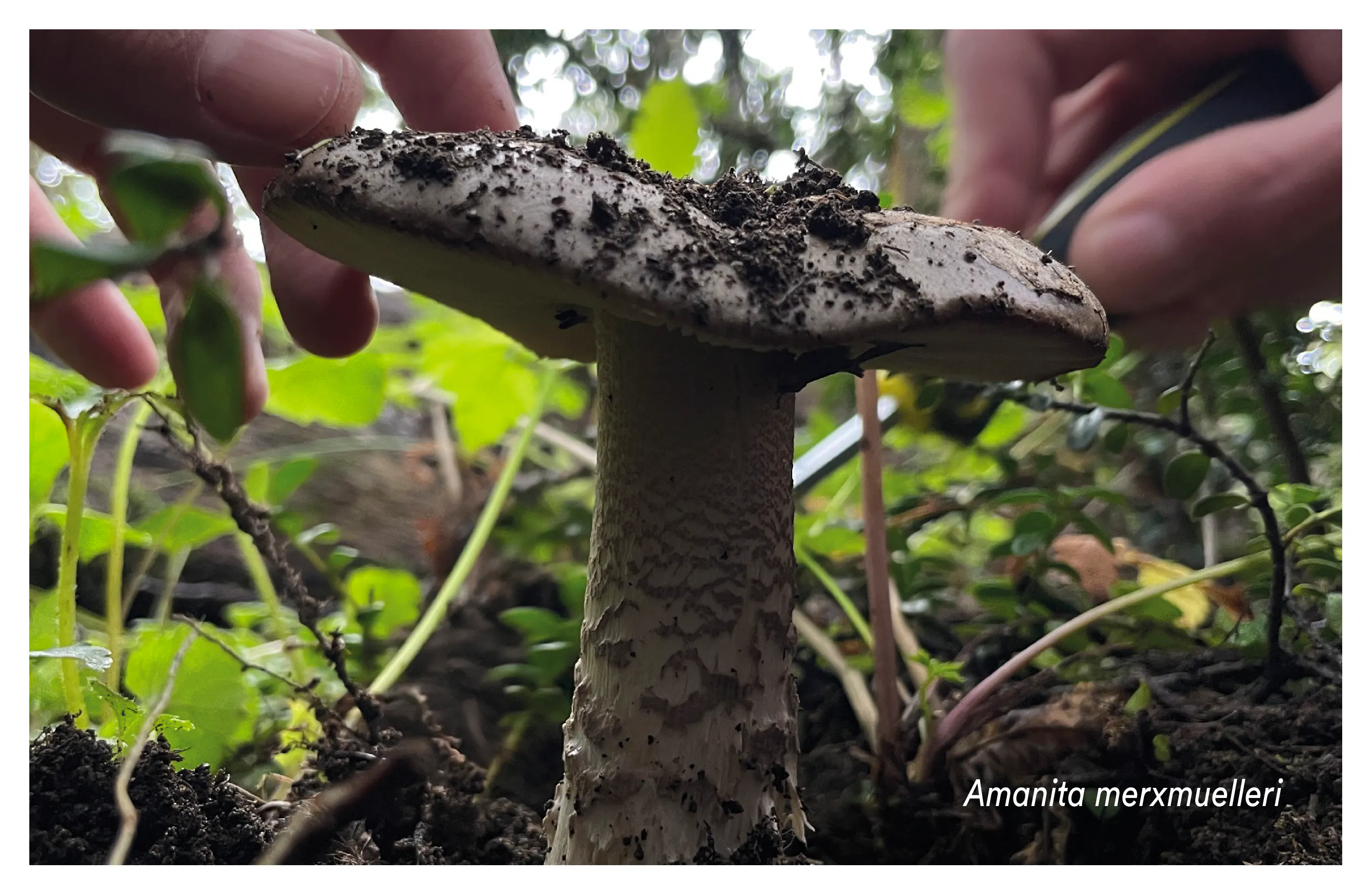
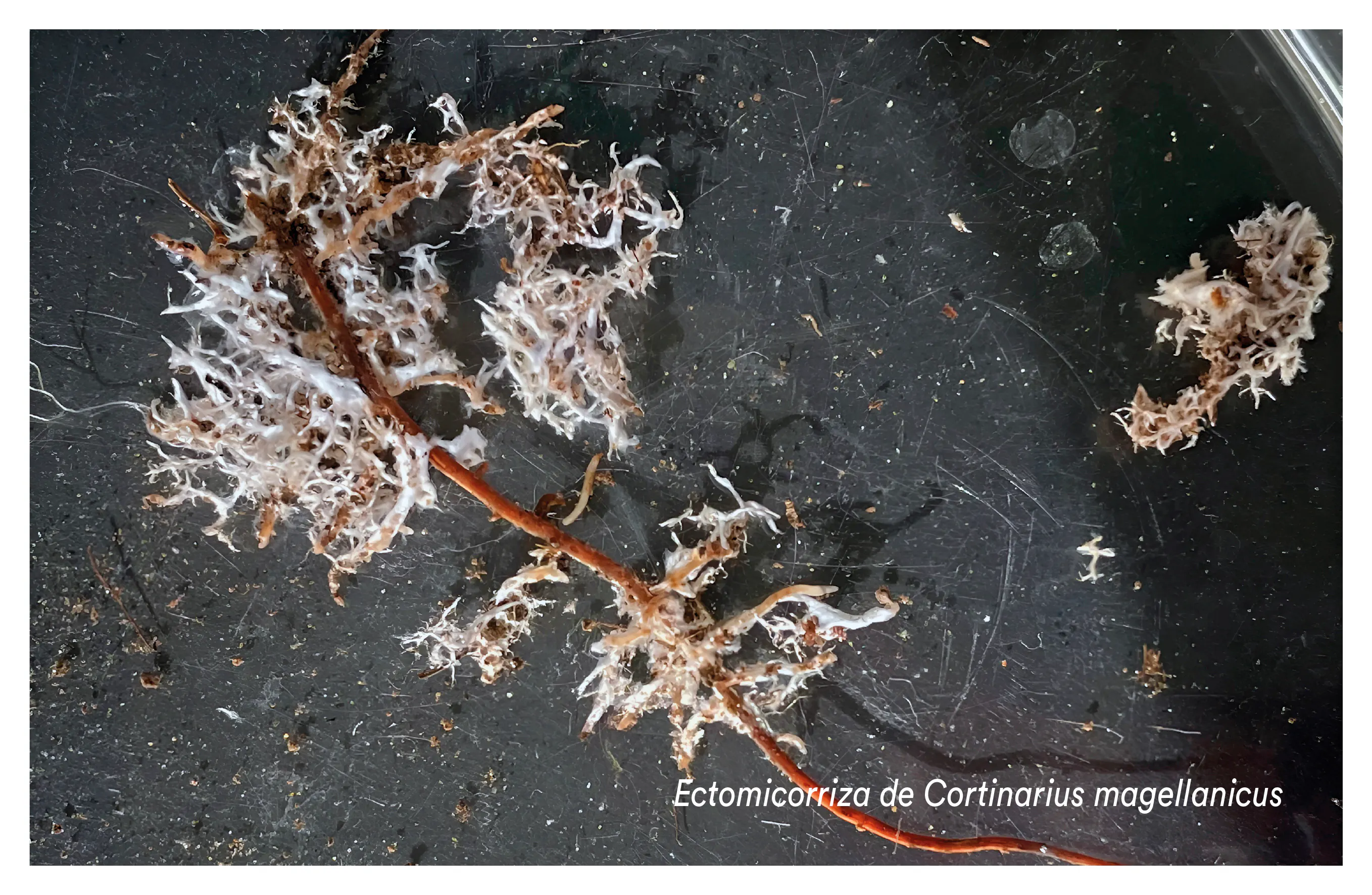
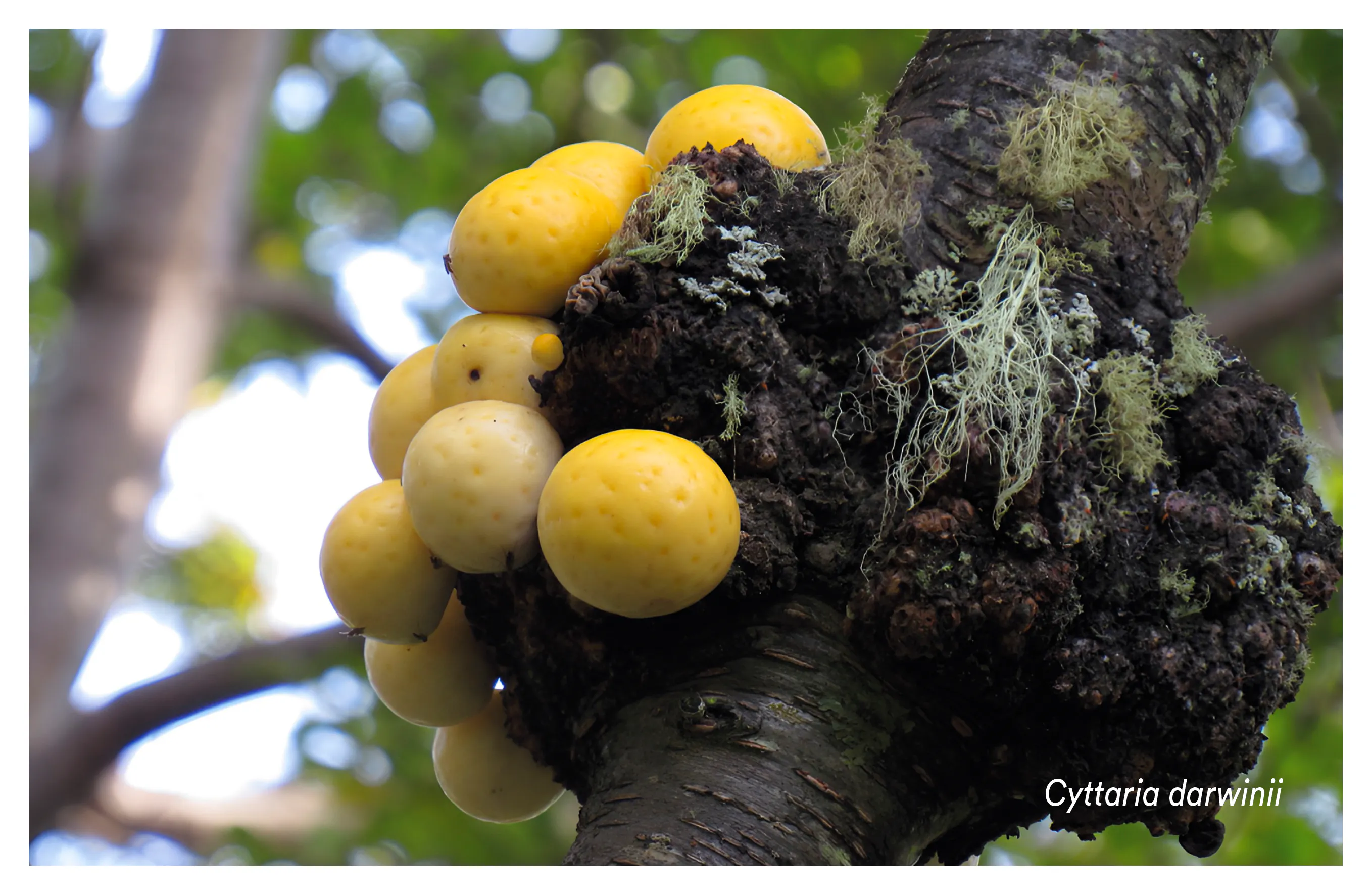
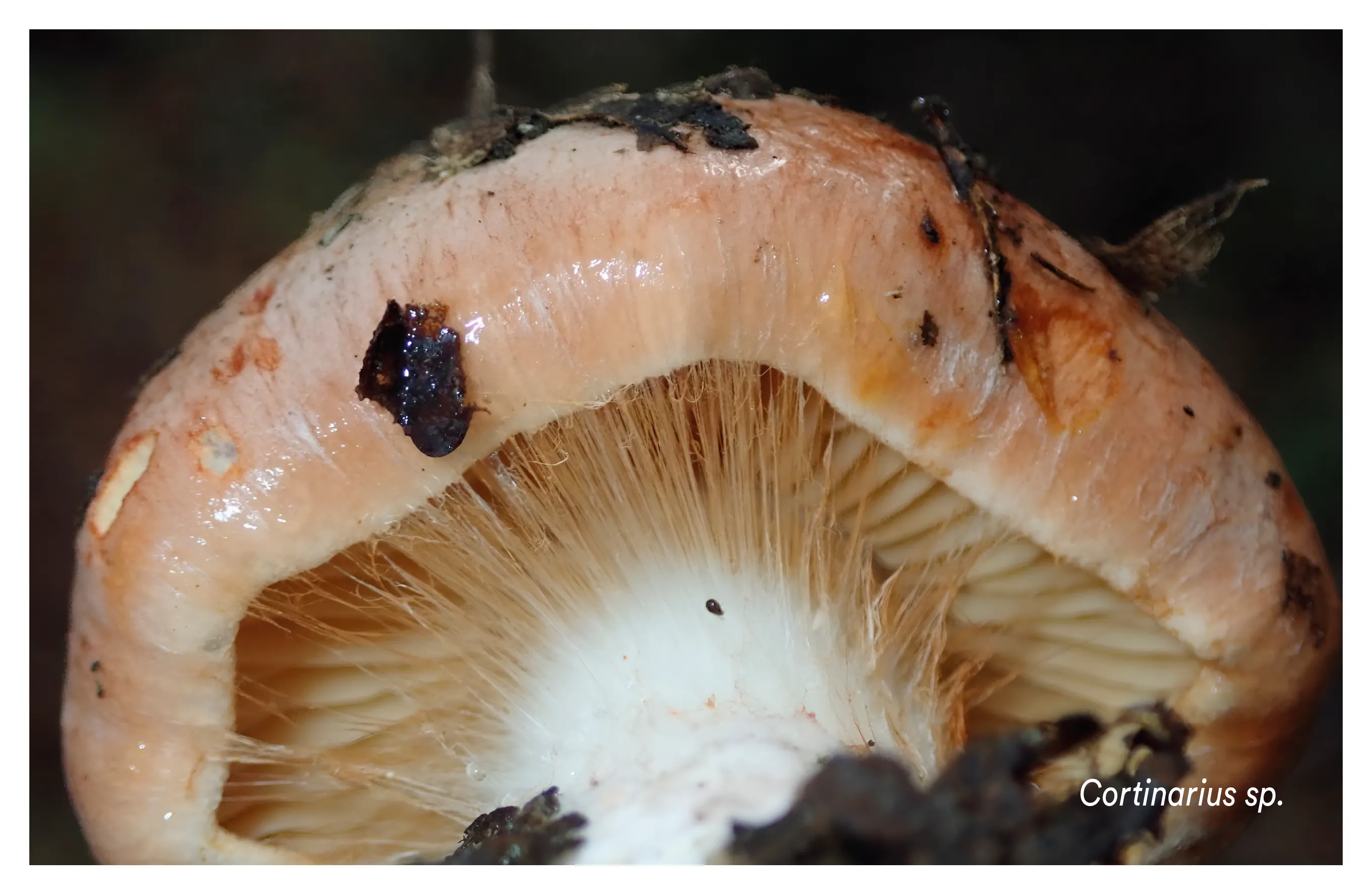
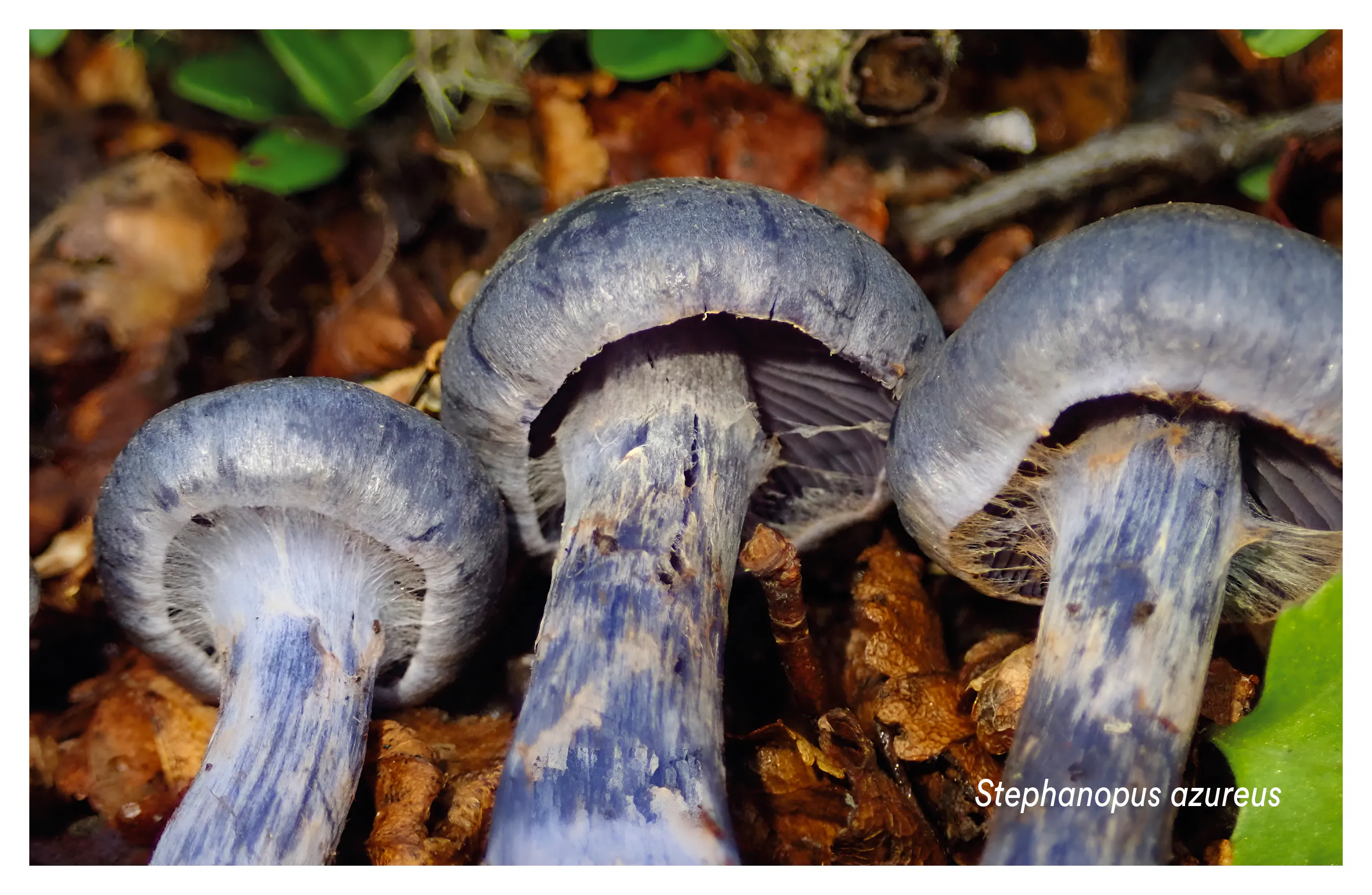
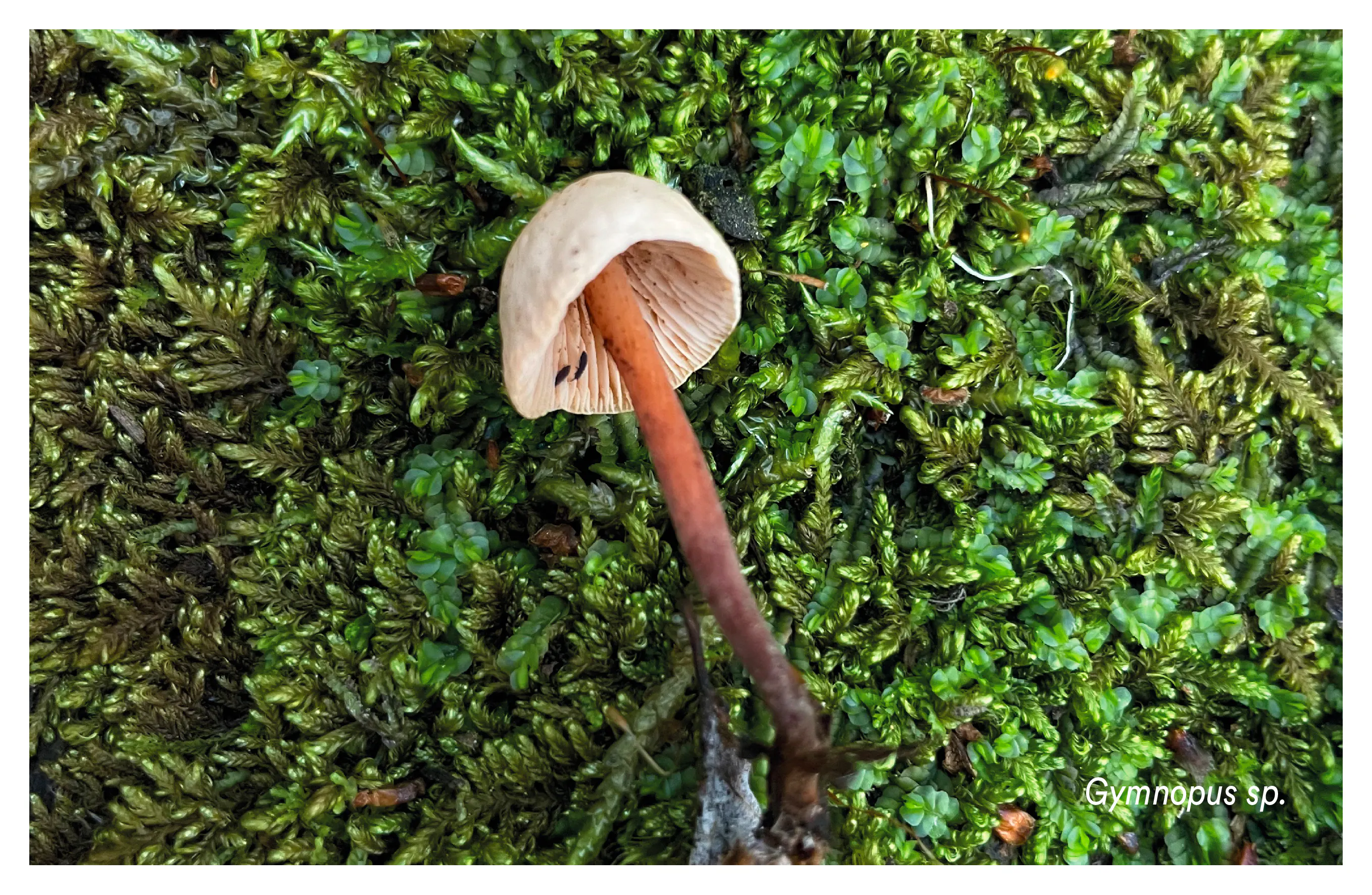
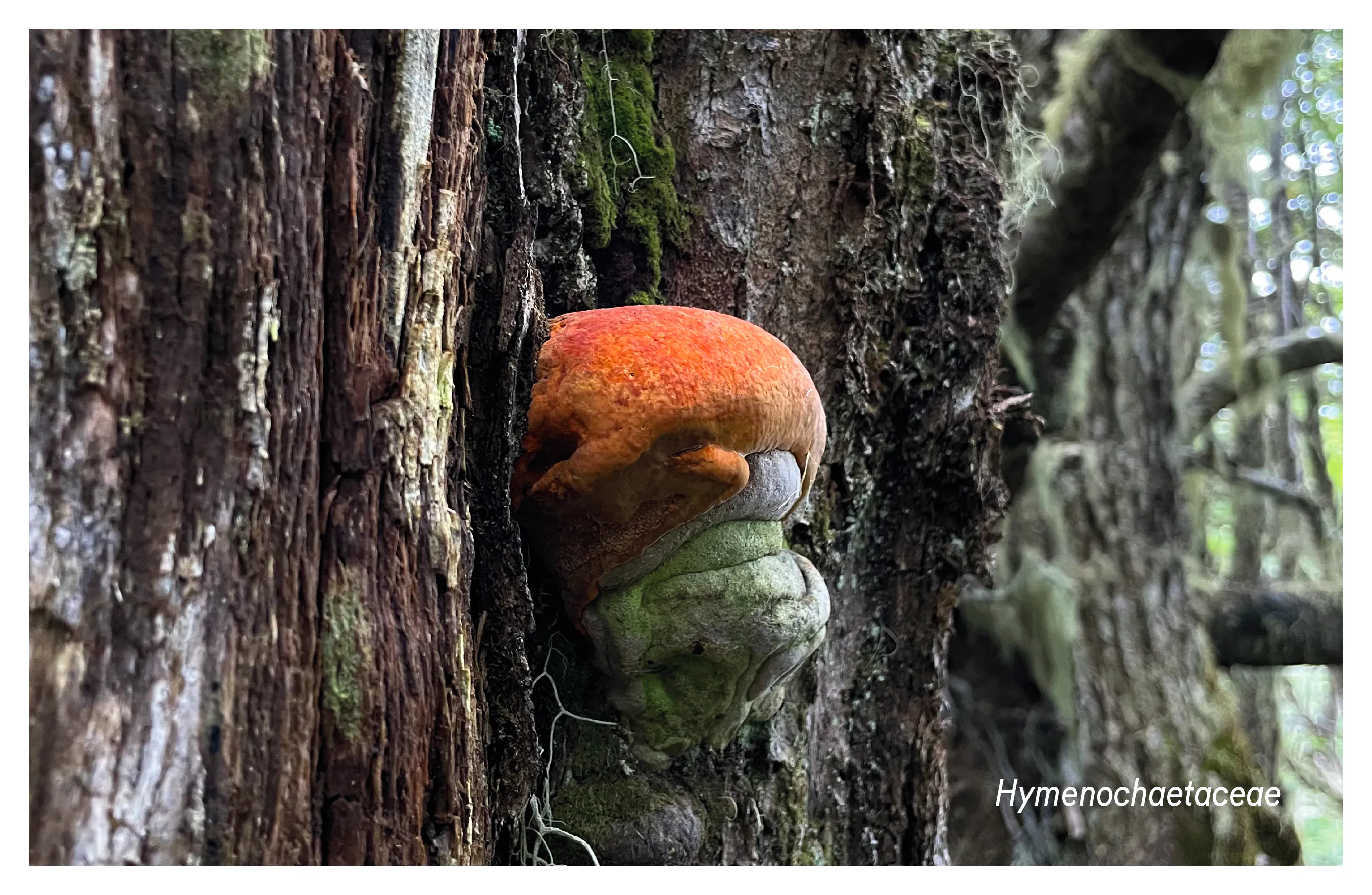
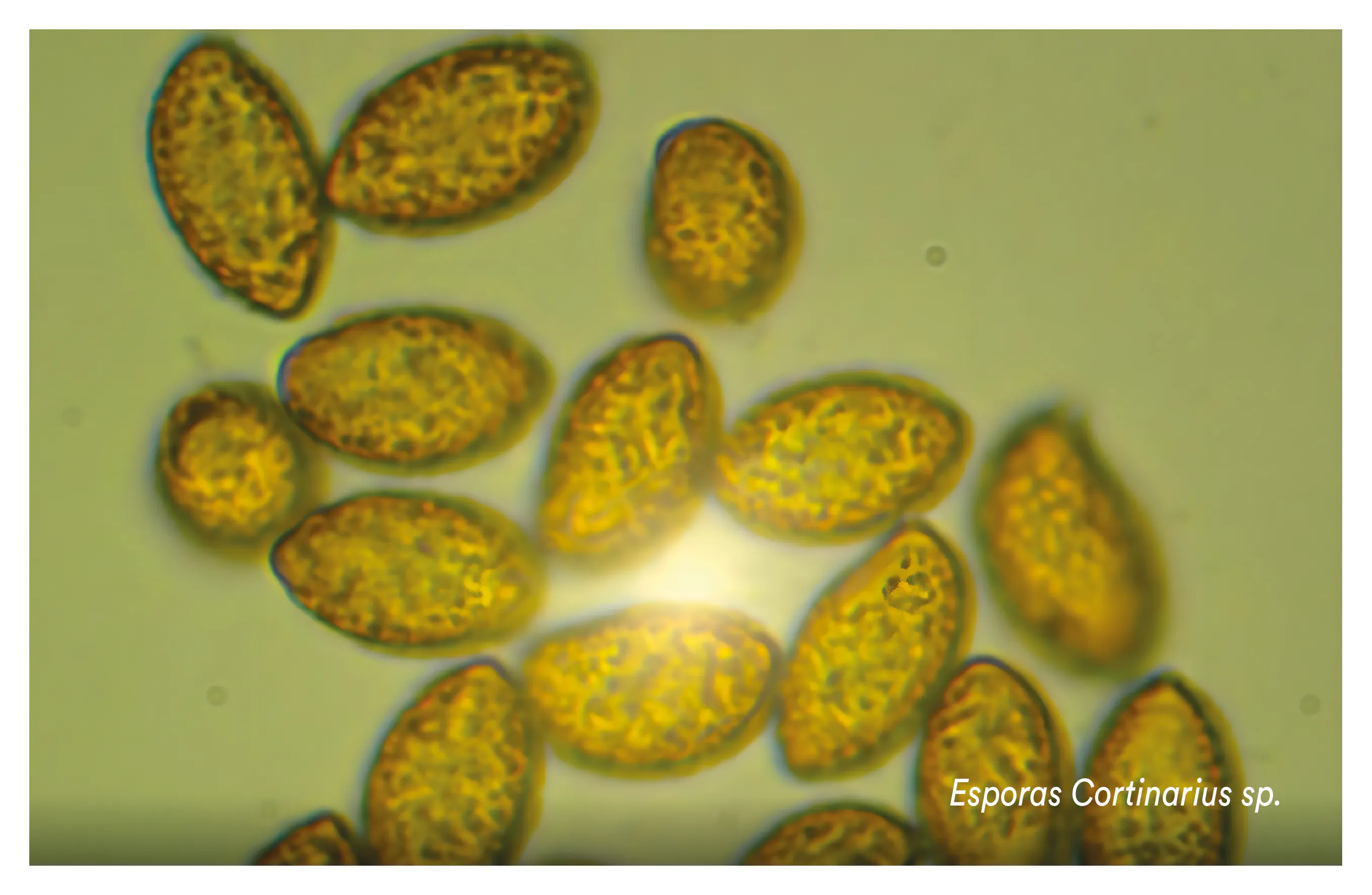
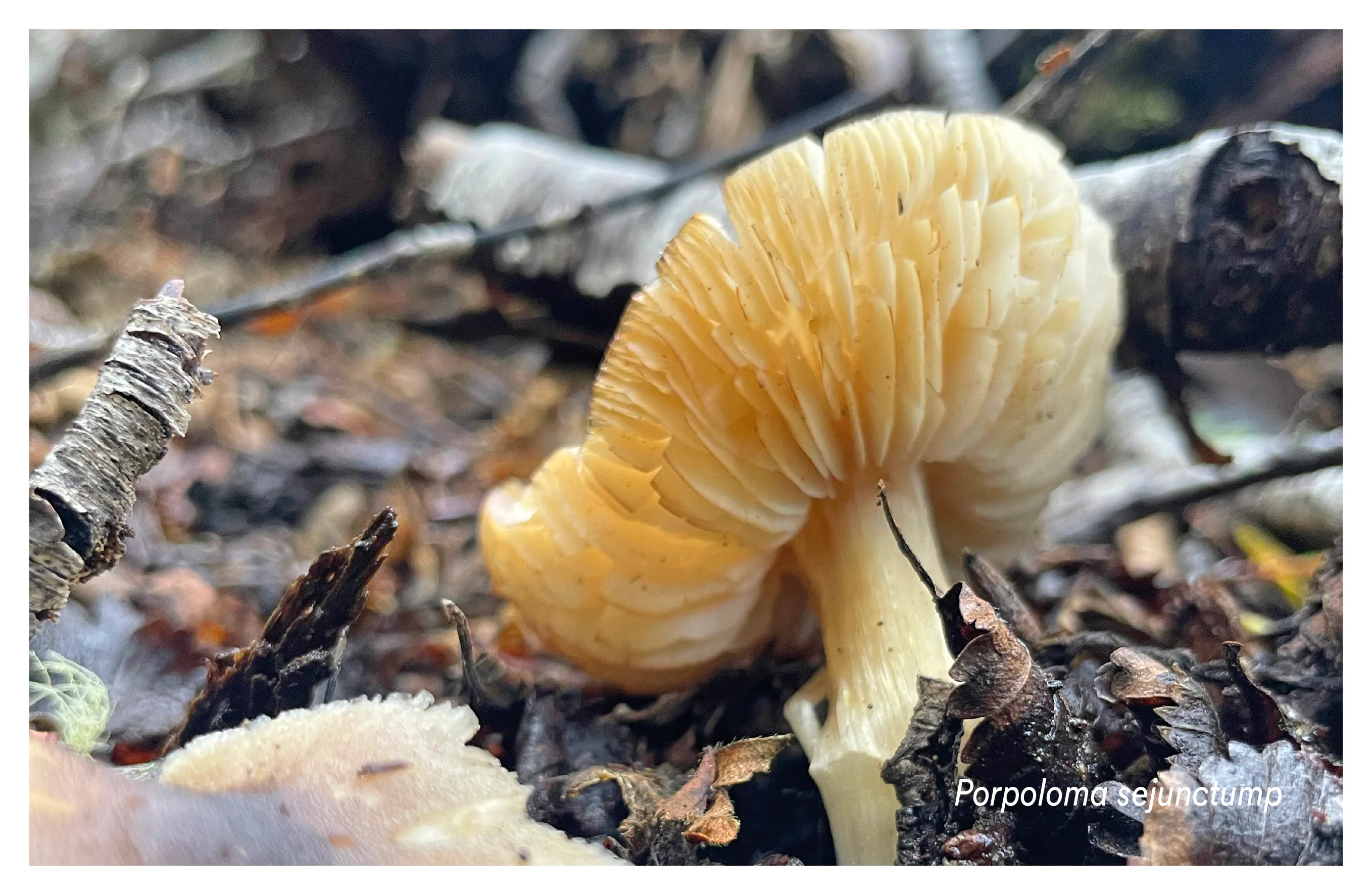
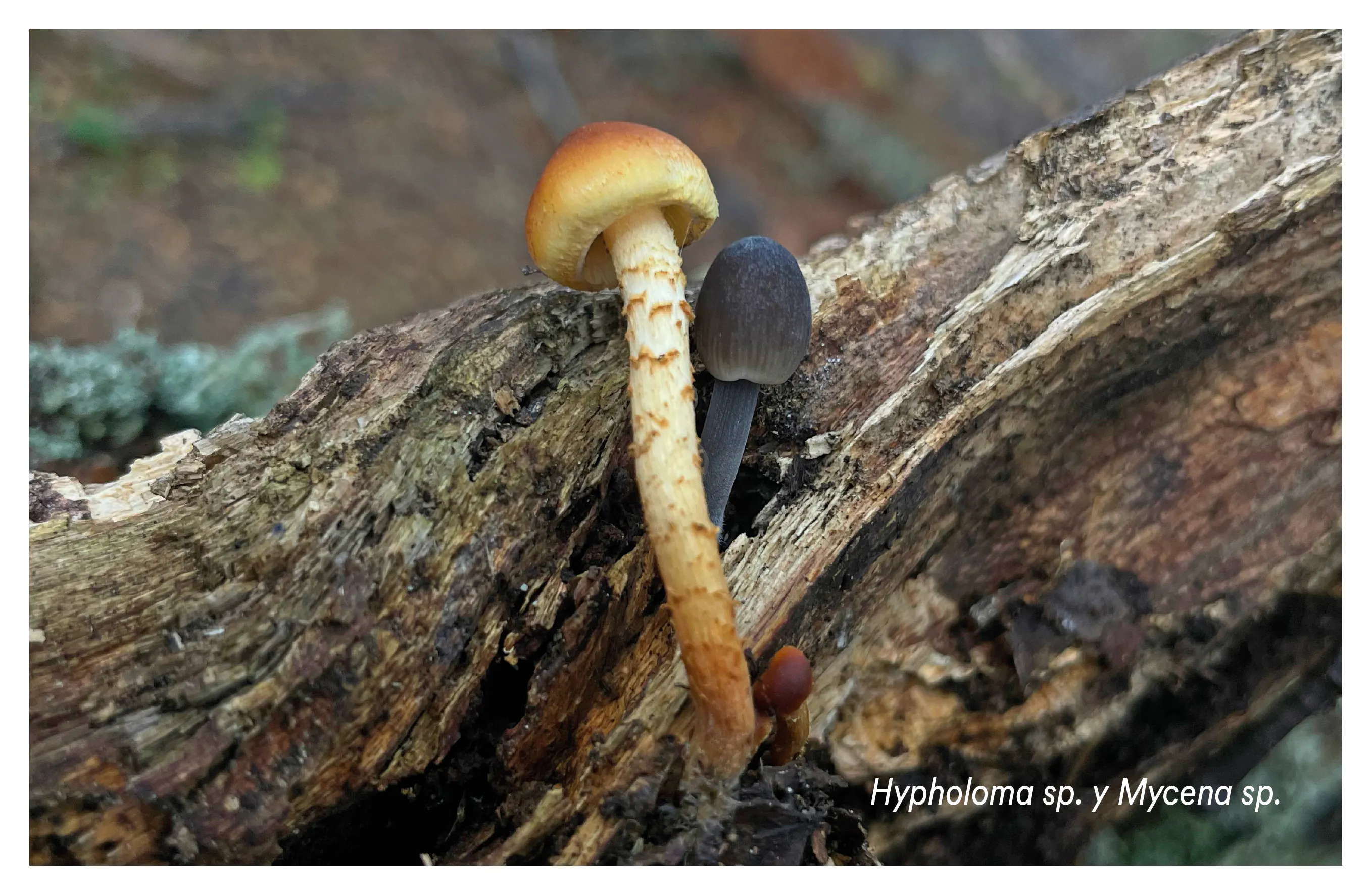
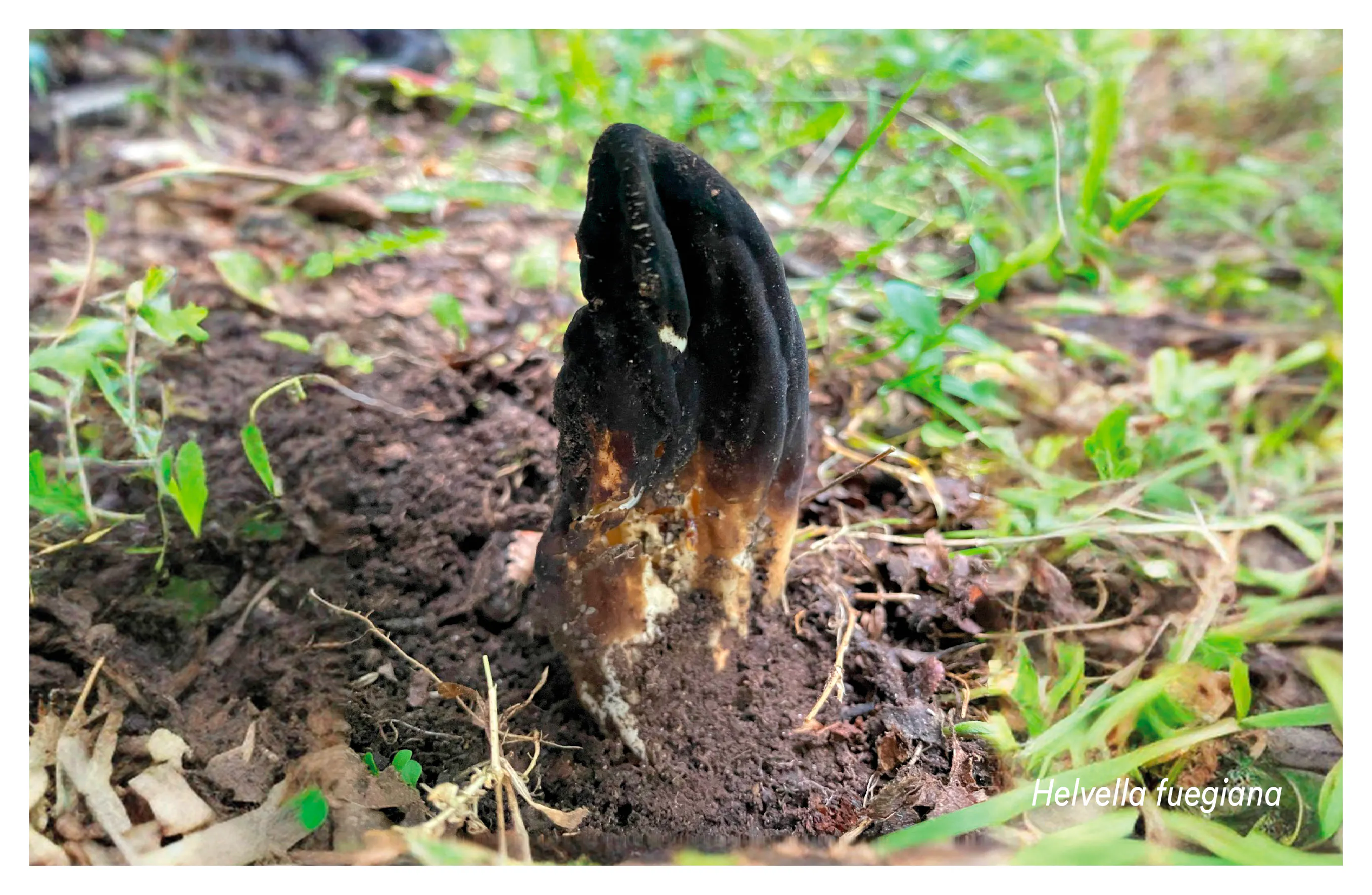
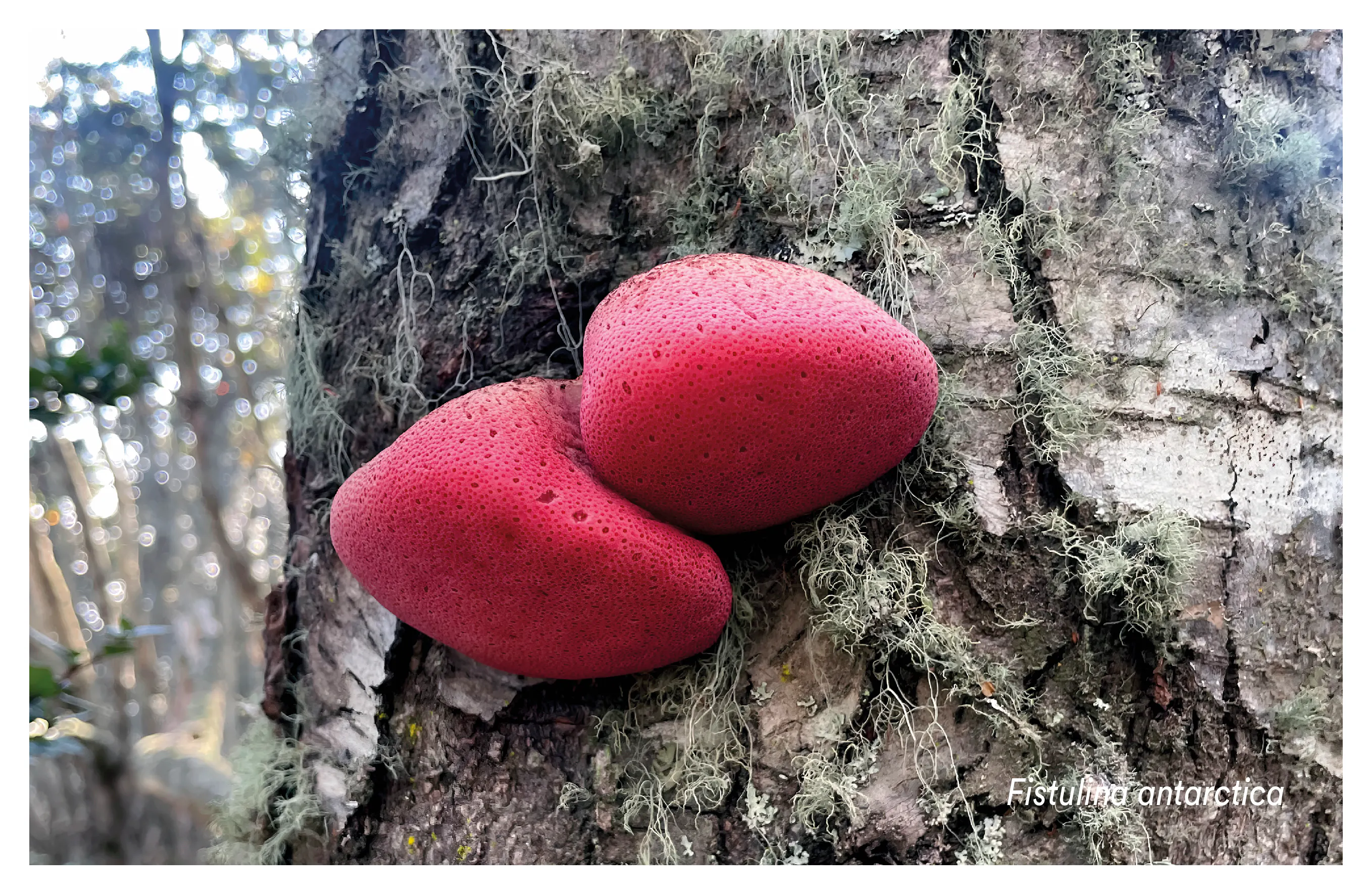
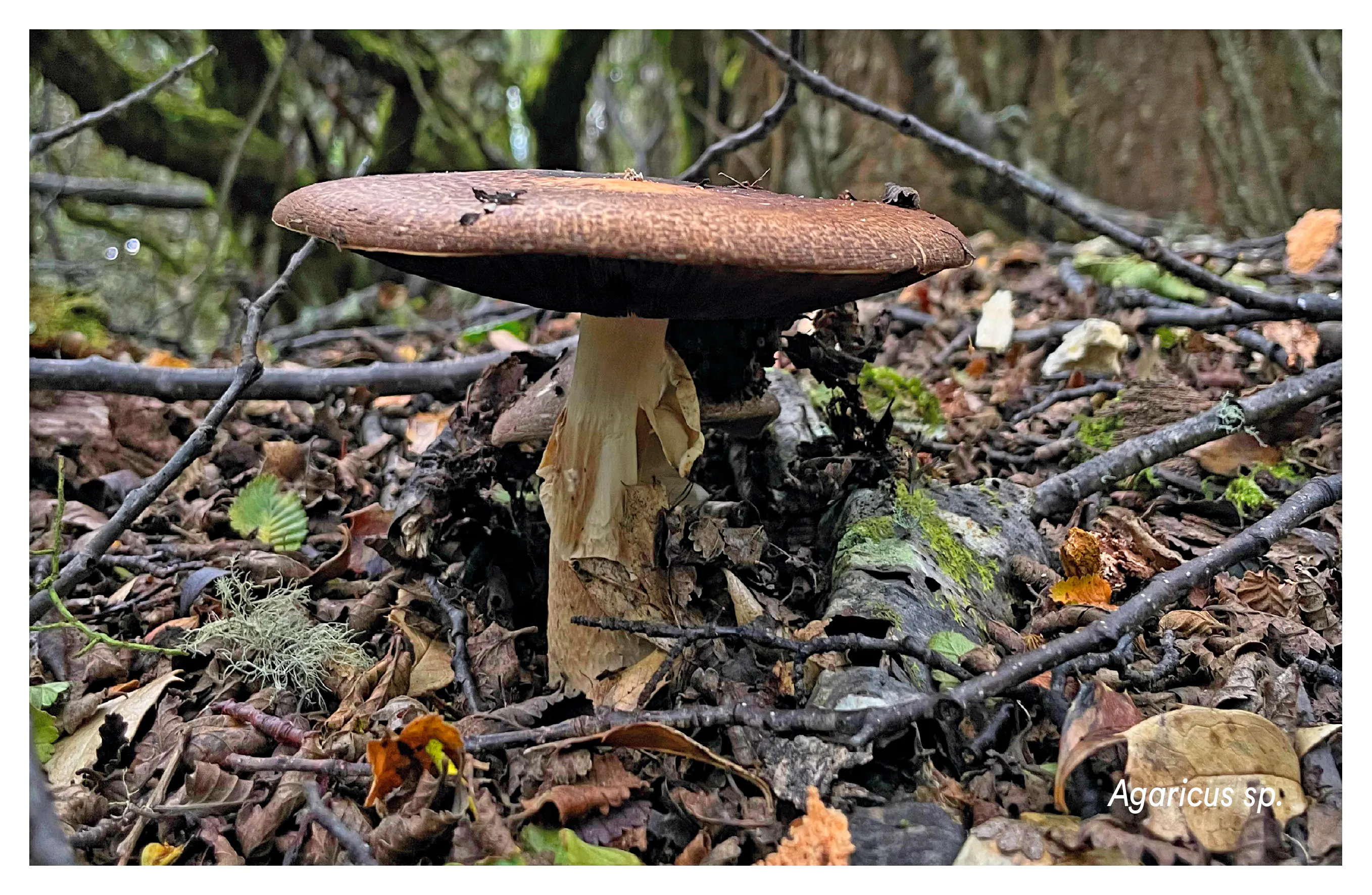
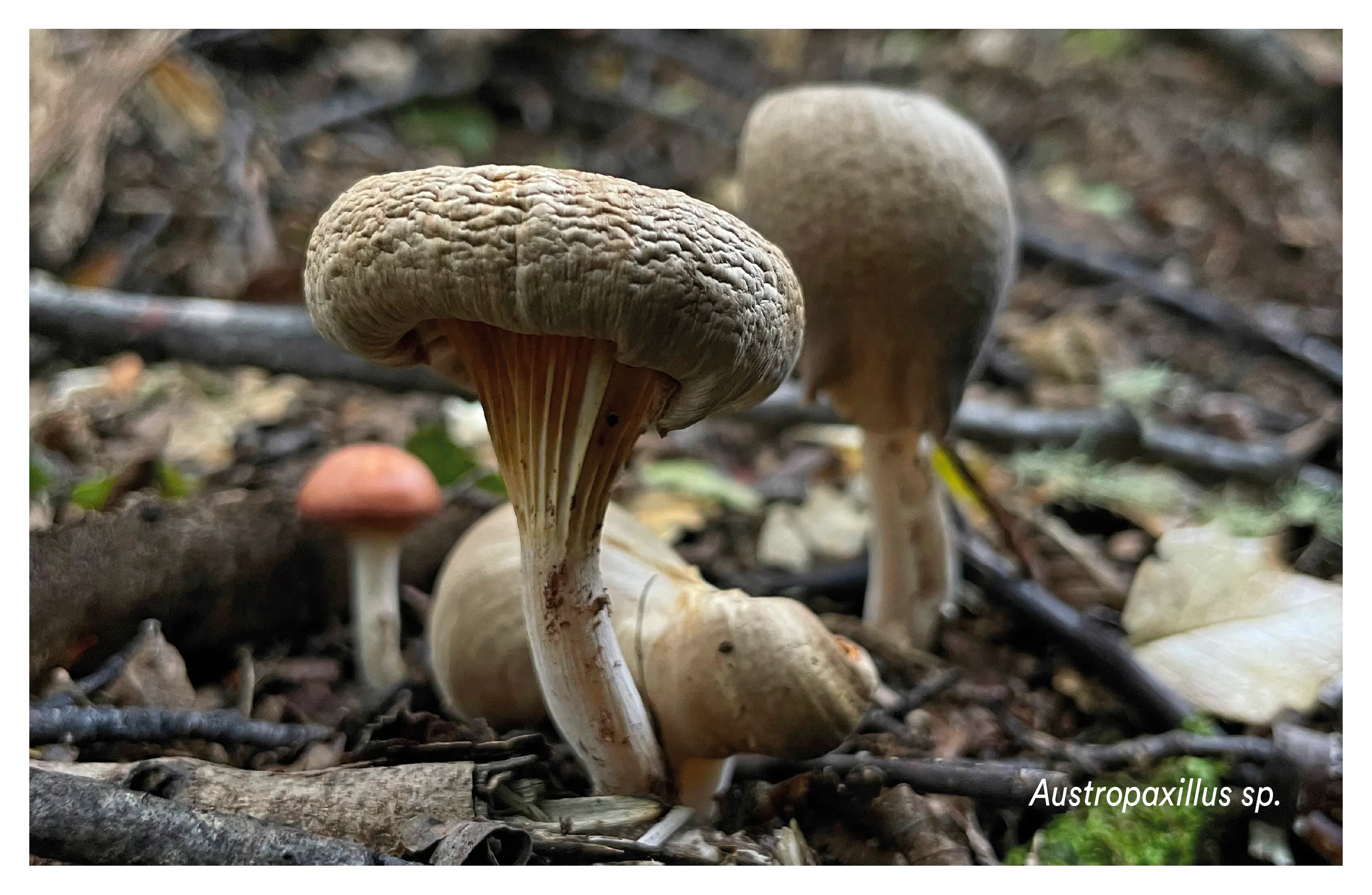
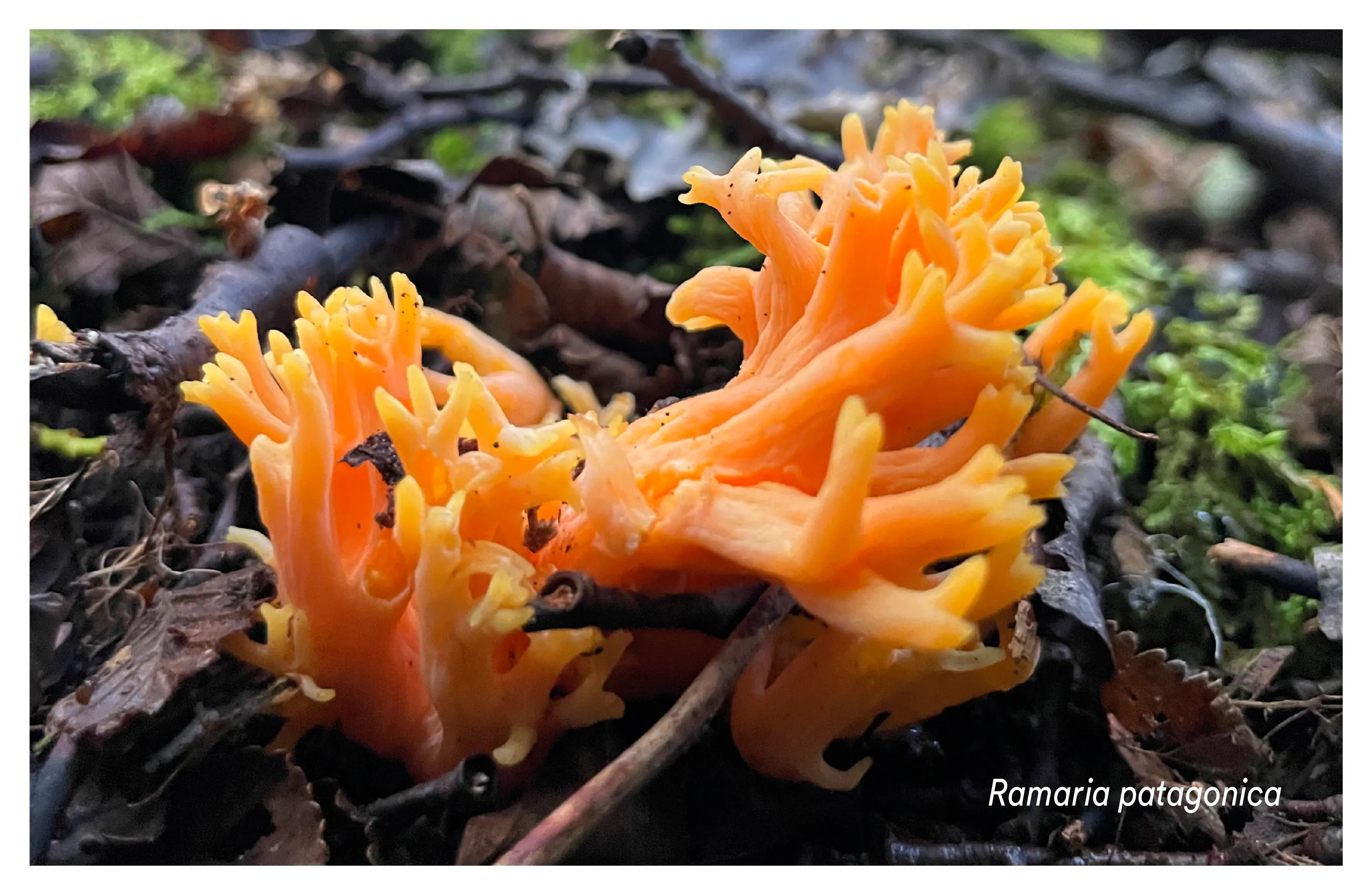
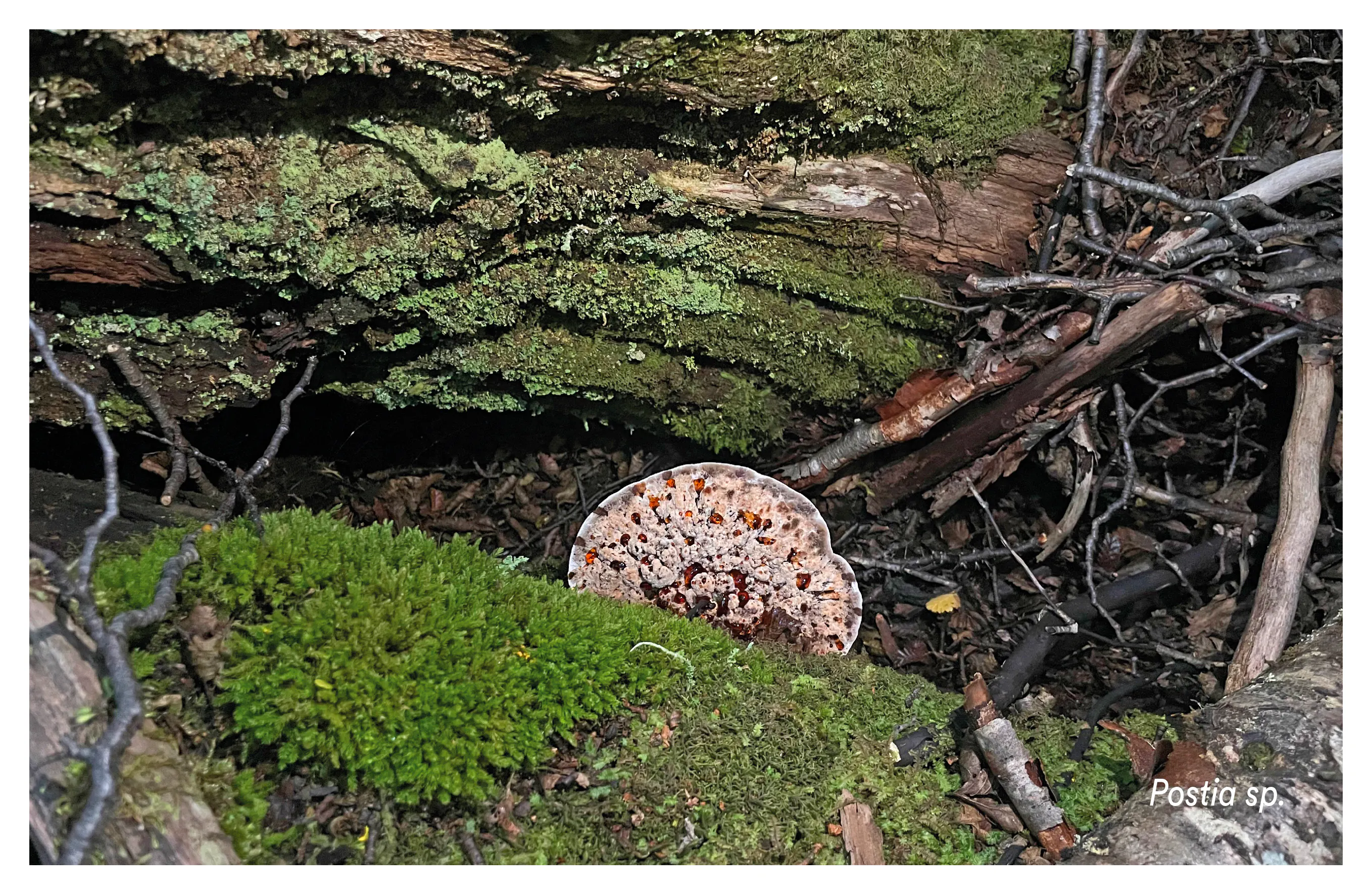
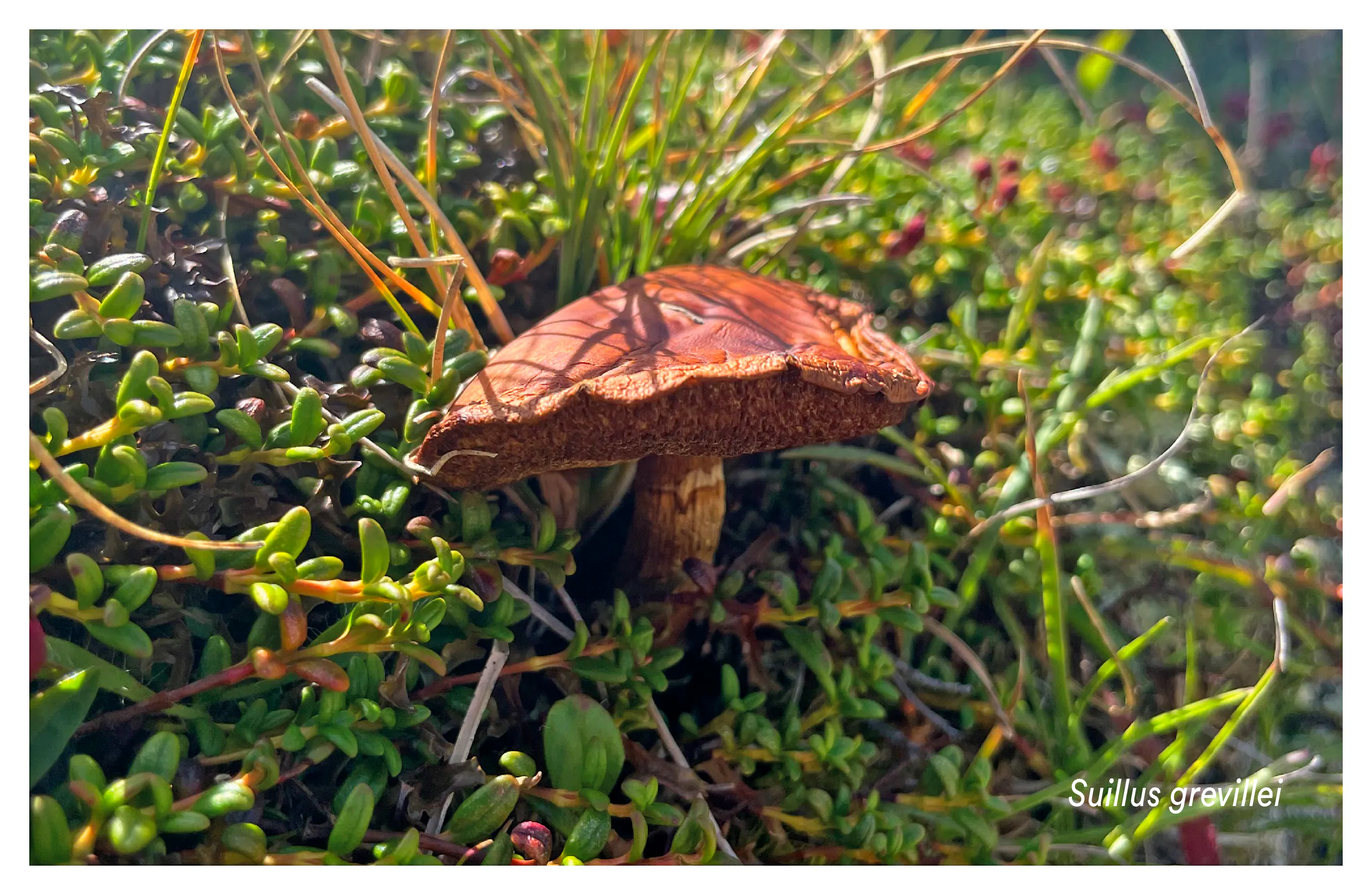
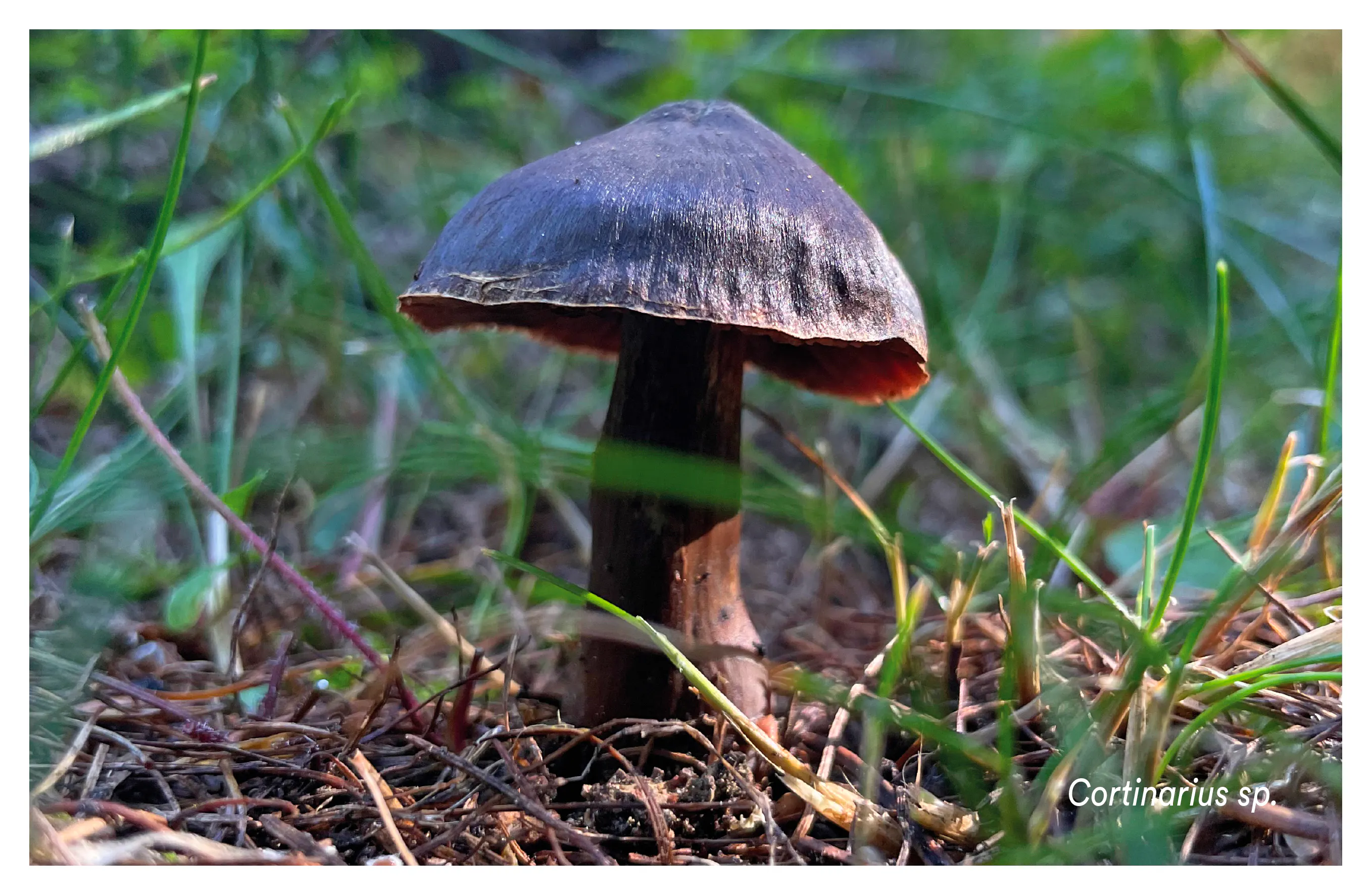
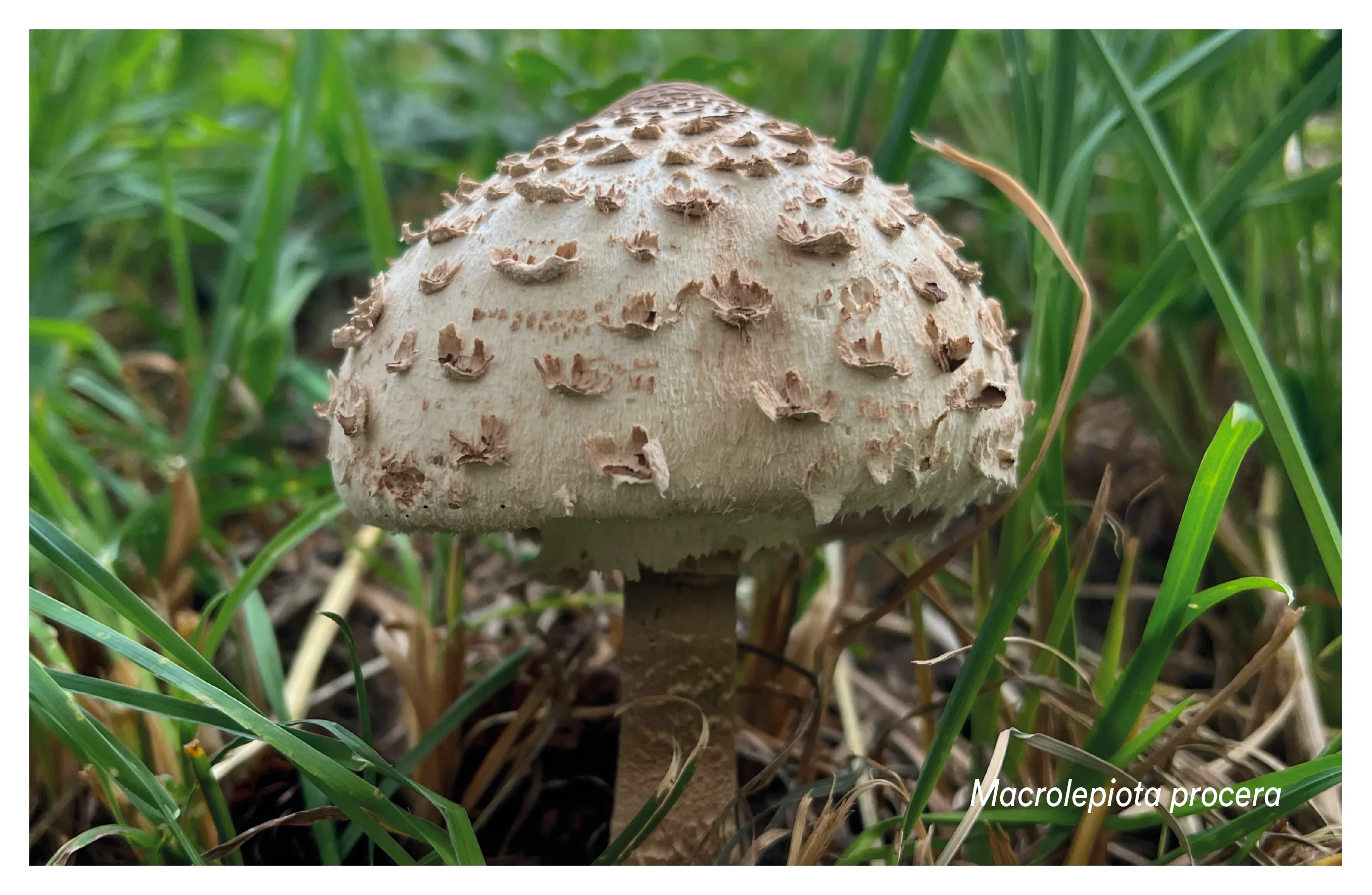
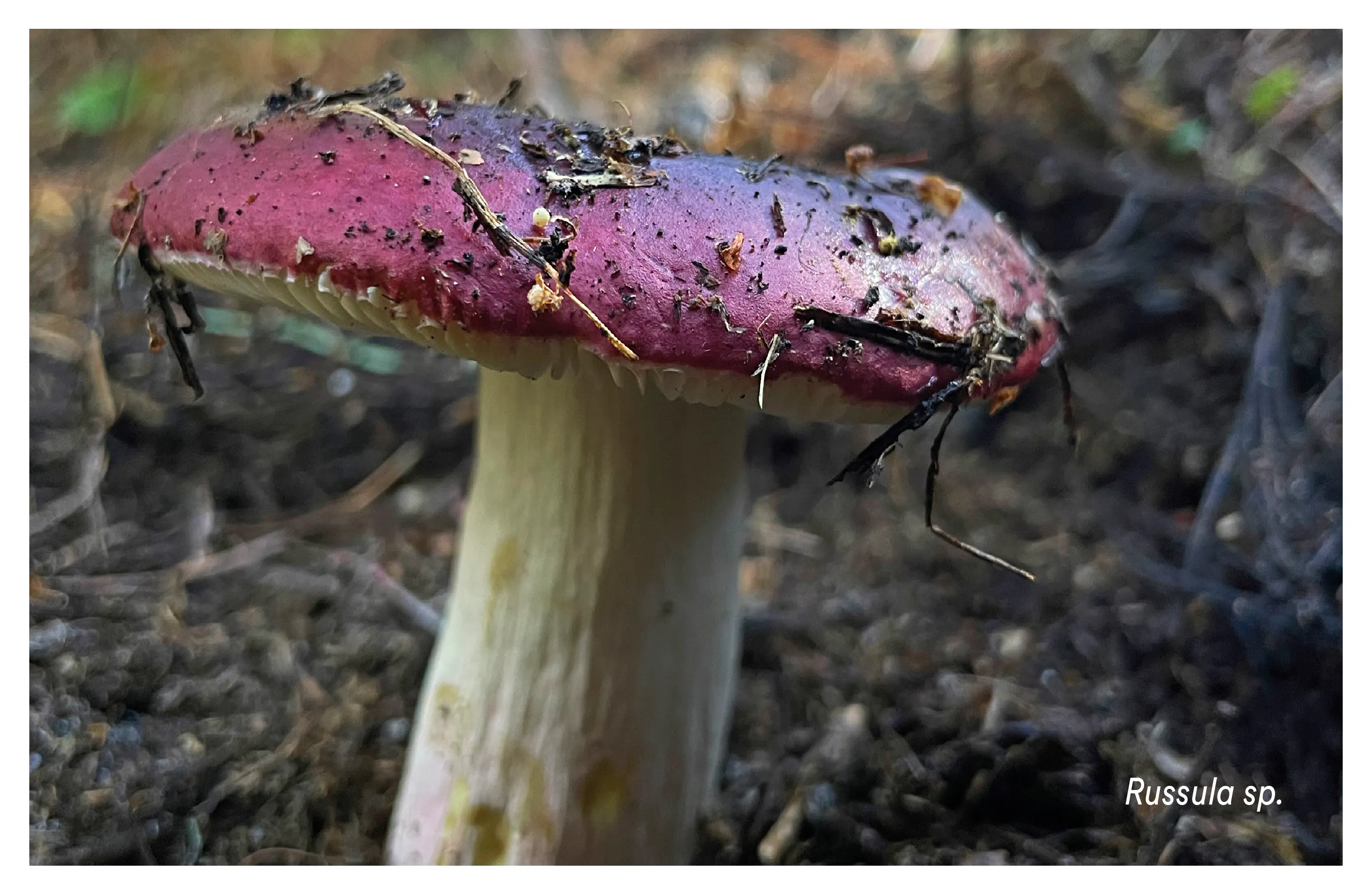
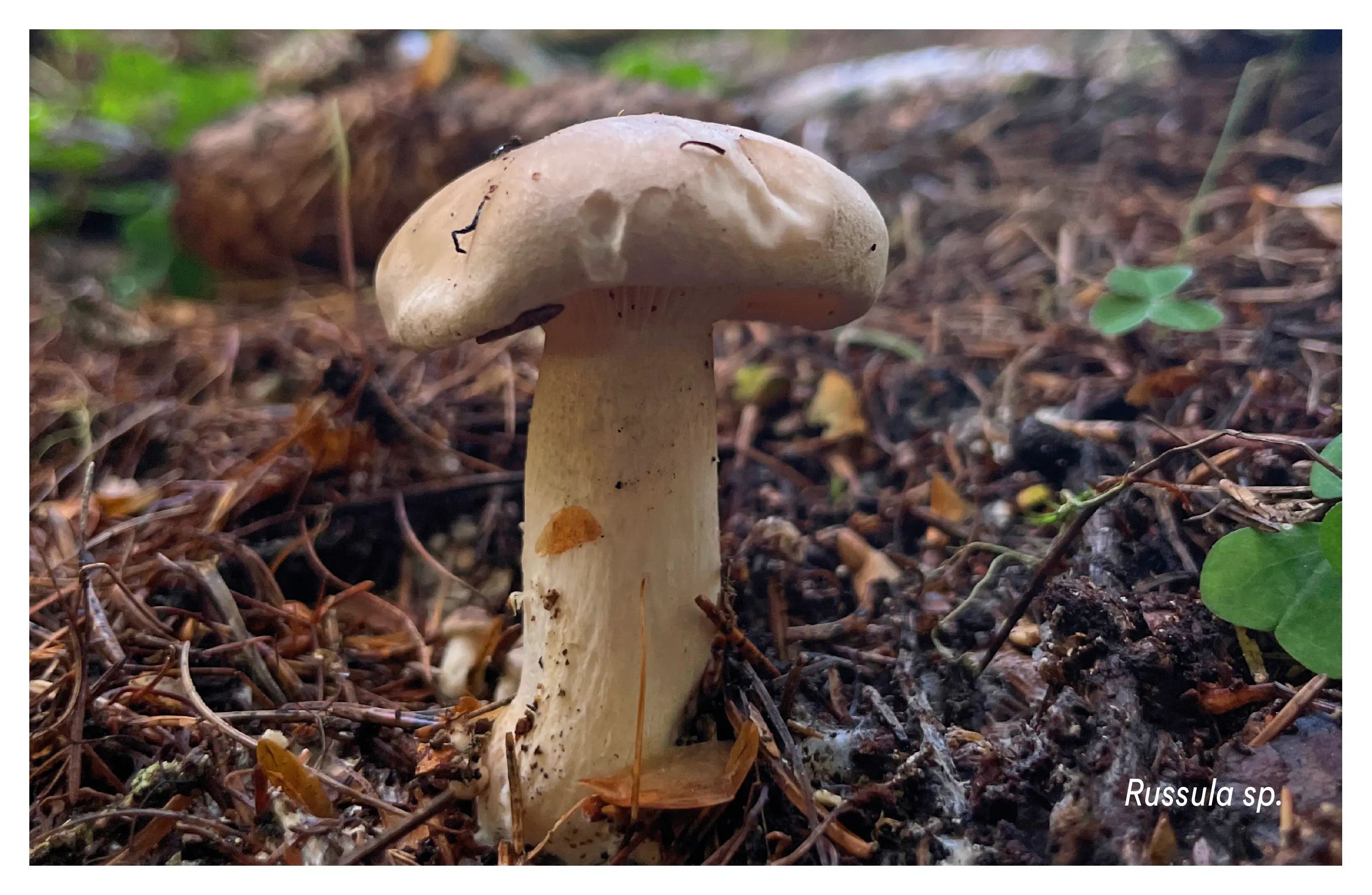
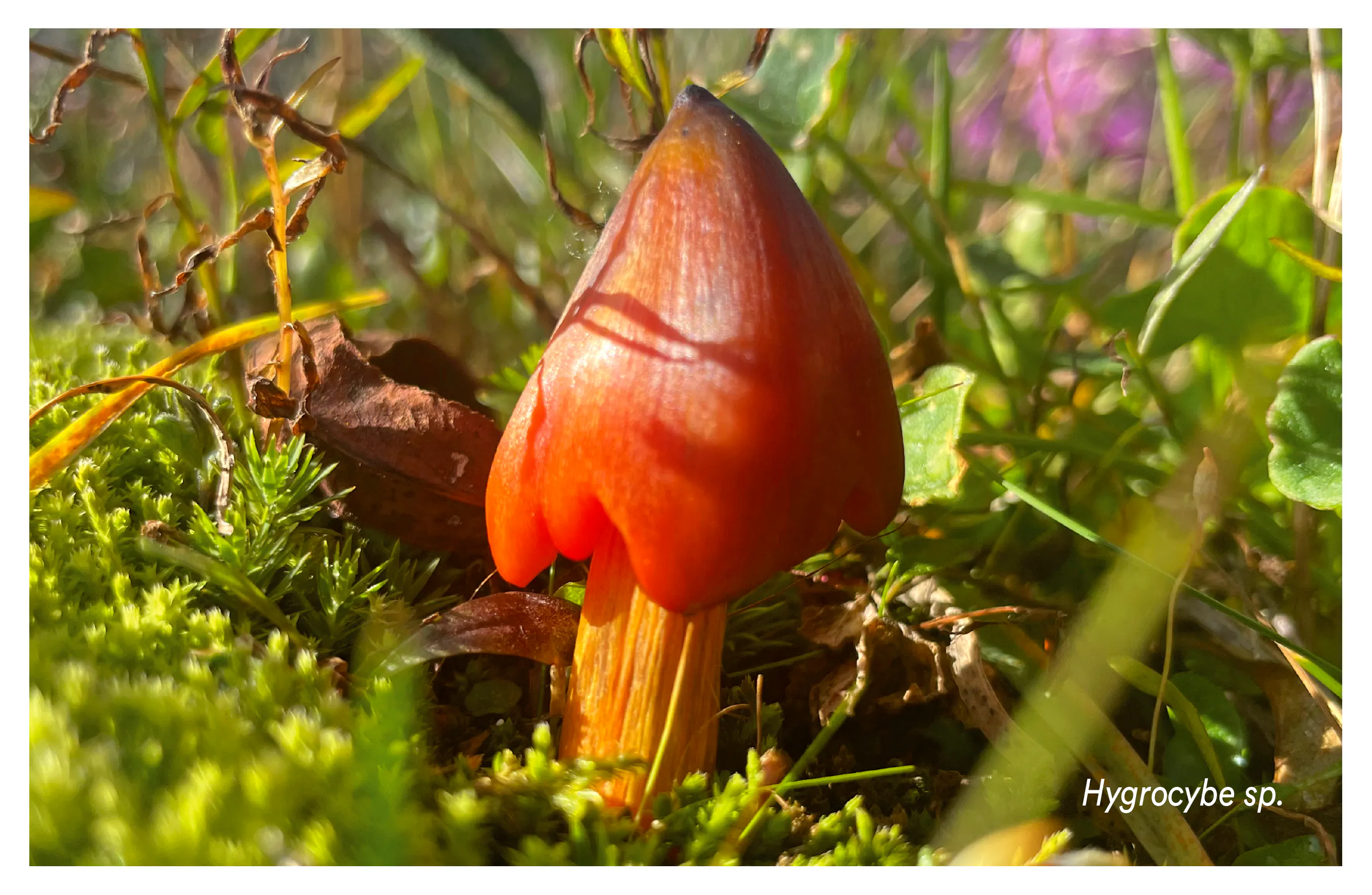
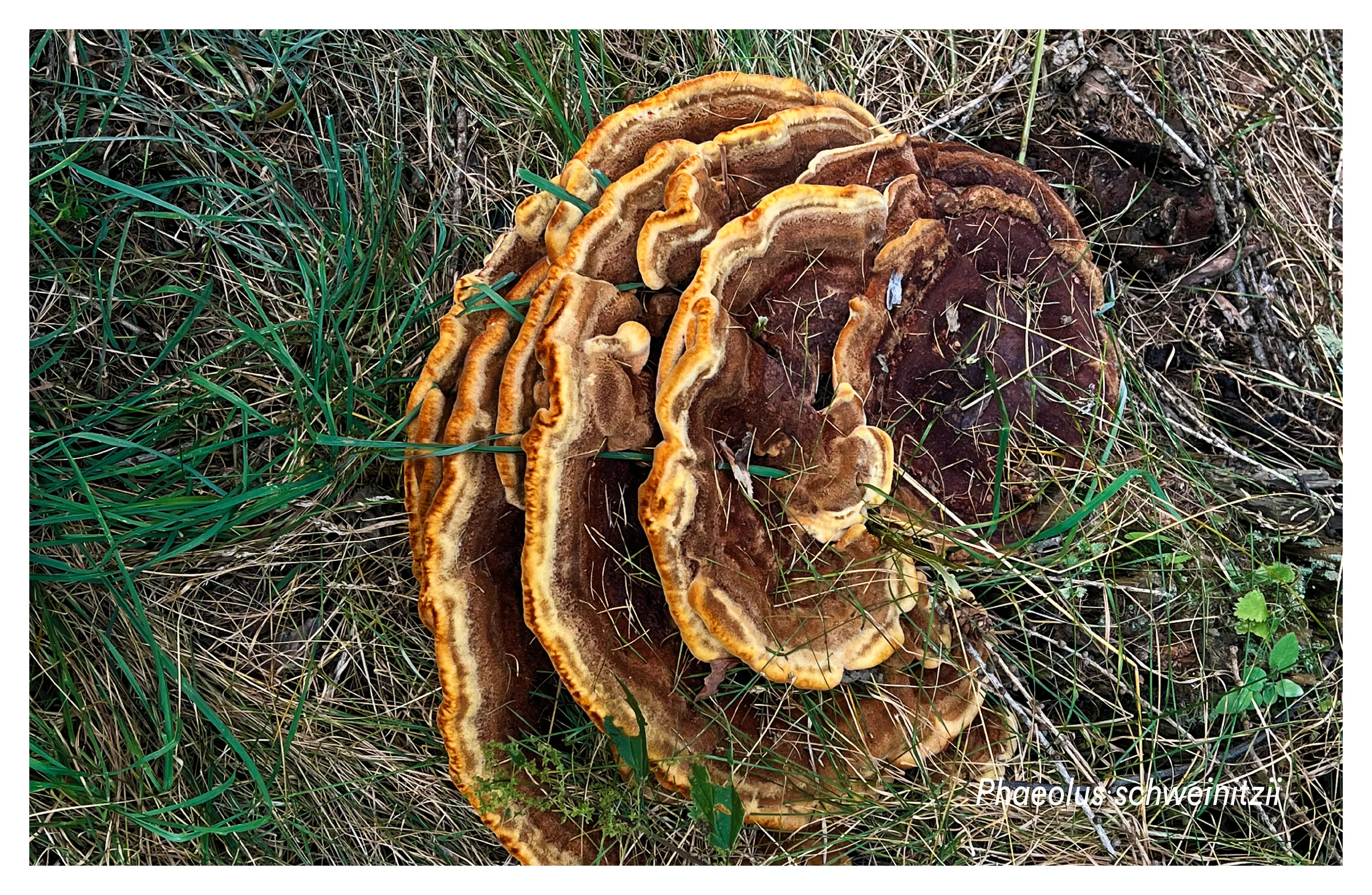
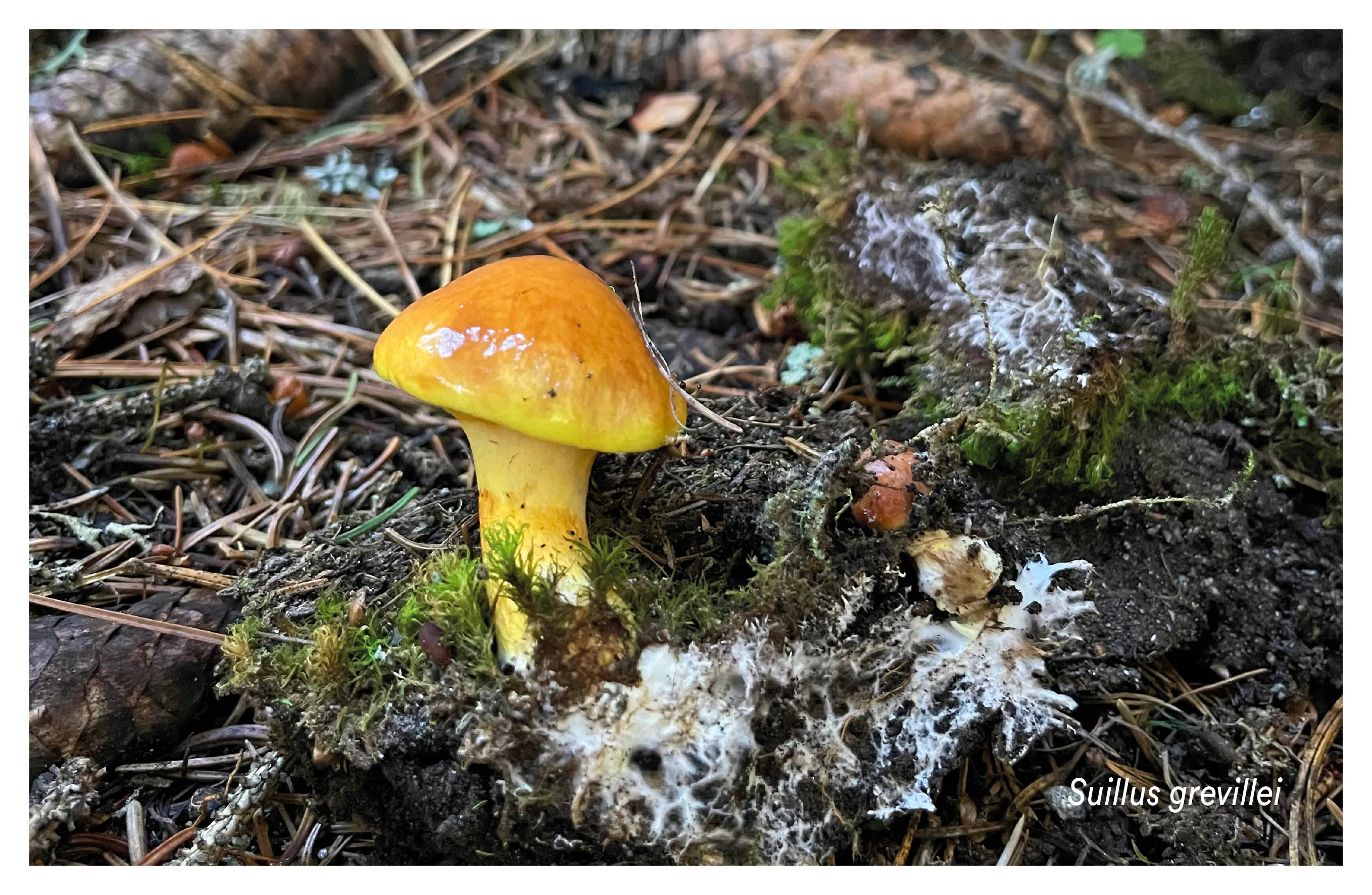
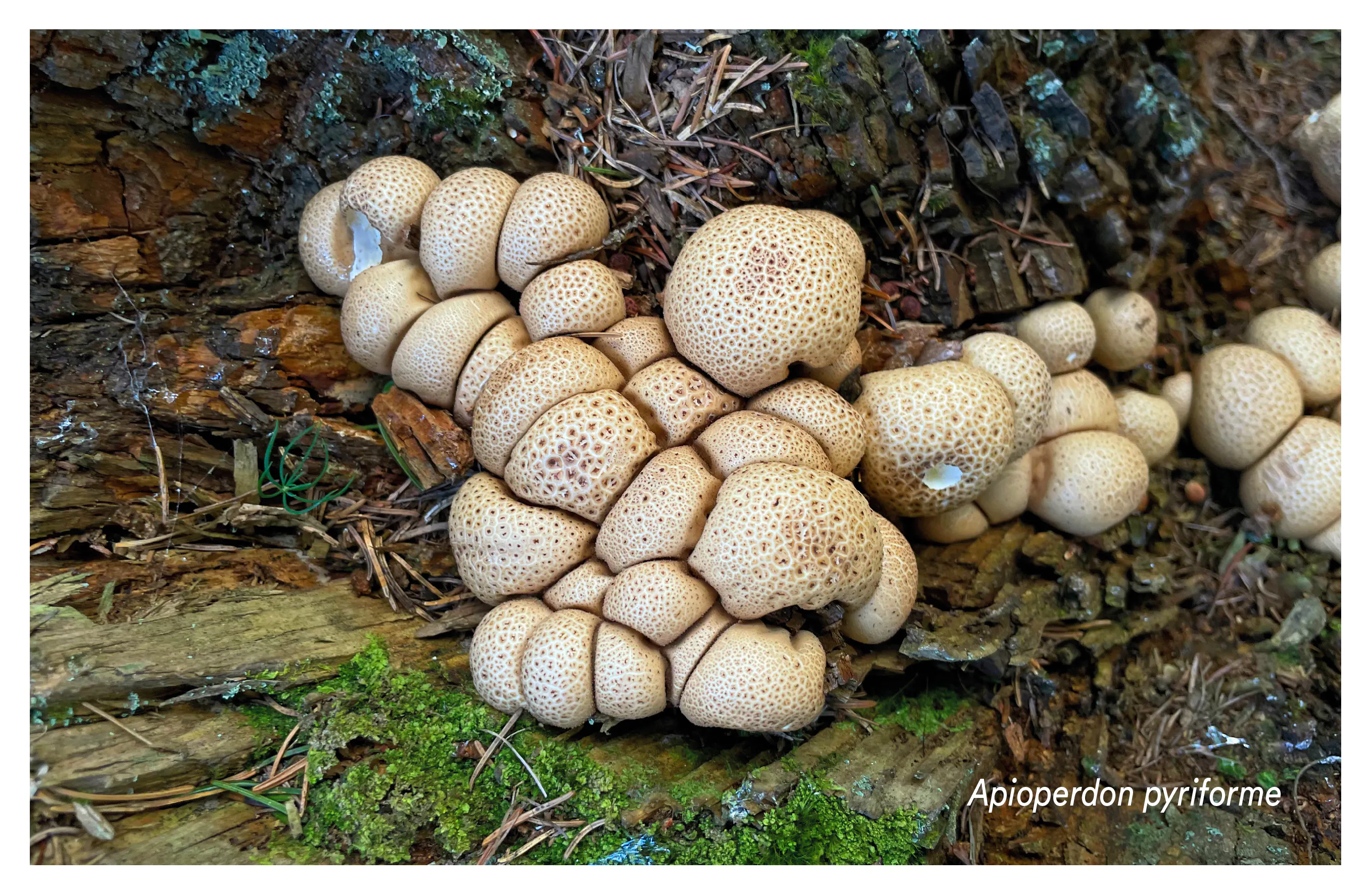
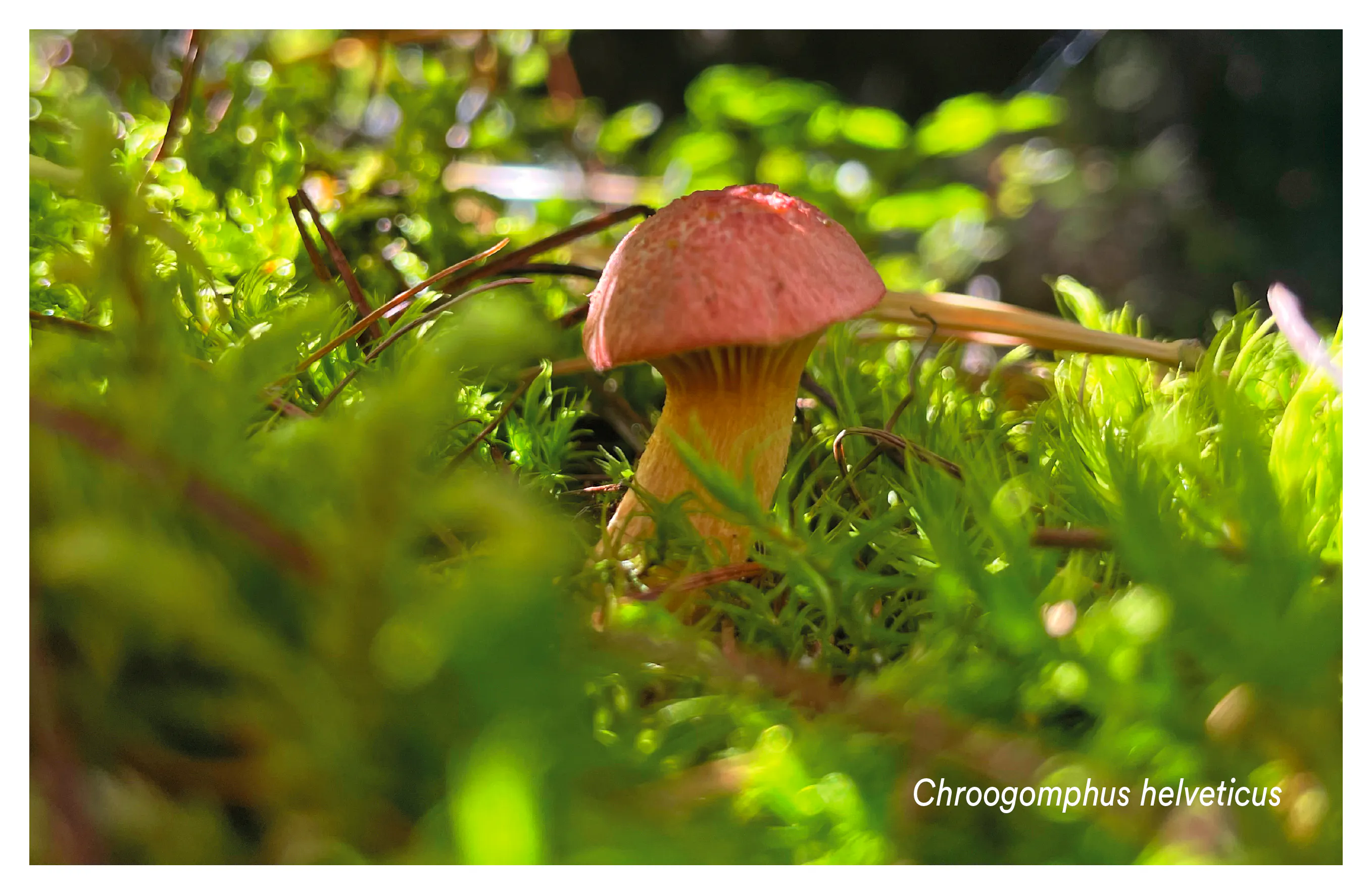
This selection of photographs brings together sporocarps collected during three research expeditions in the Brazilian Amazon (Alto Cuieiras Biological Research Station, Manaus), Chilean Patagonia (Magallanes National Park, Punta Arenas, and Puerto Yartou, CAB Patagonia), and the Swiss Alps (Oberwald and the Aletsch Glacier, Riederalp, Canton of Valais).
Through these material encounters, the project unfolds a process of observation and taxonomic analysis that reveals the richness and diversity of fungal life across geographically distant yet ecologically interconnected territories.
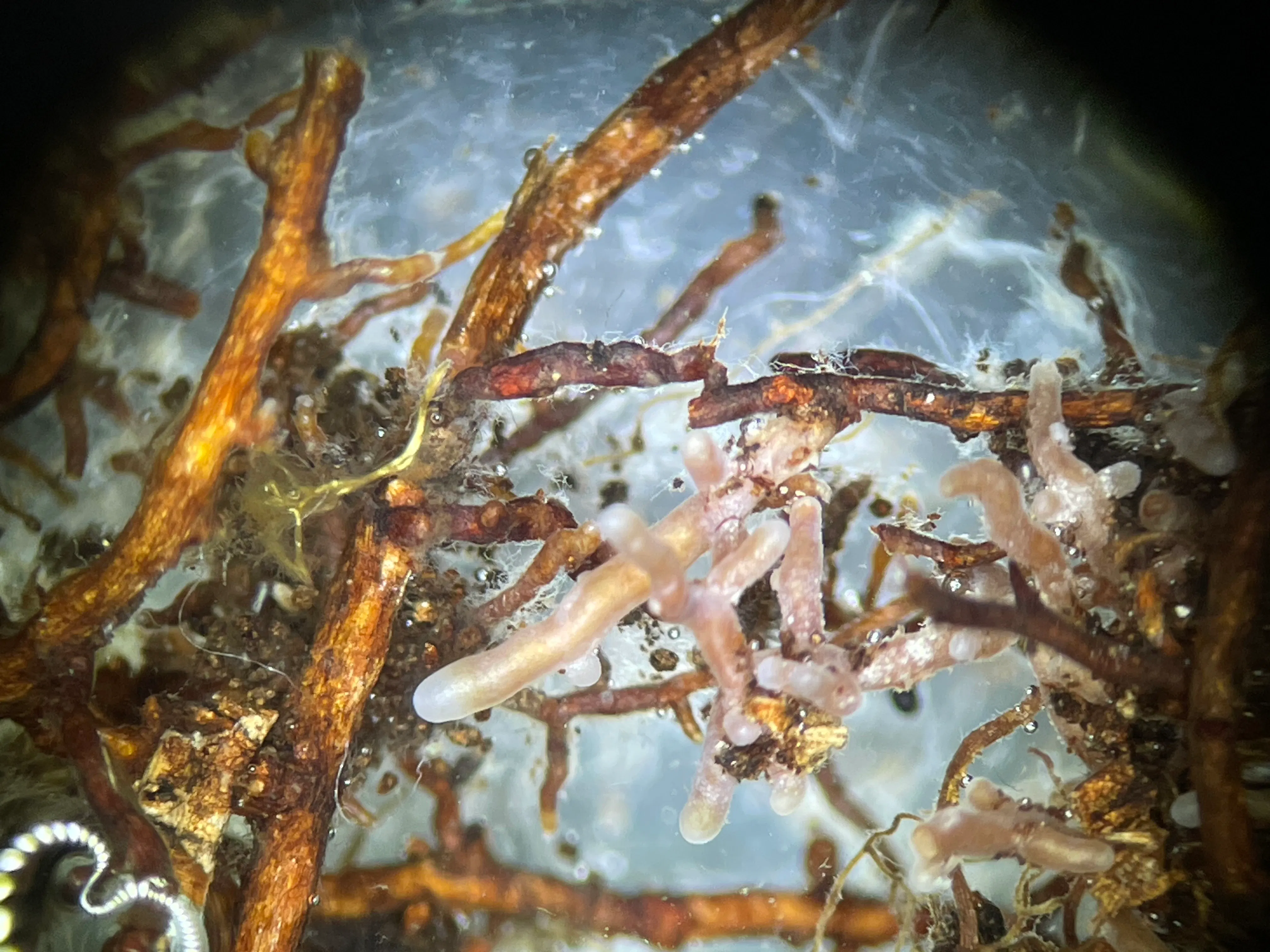
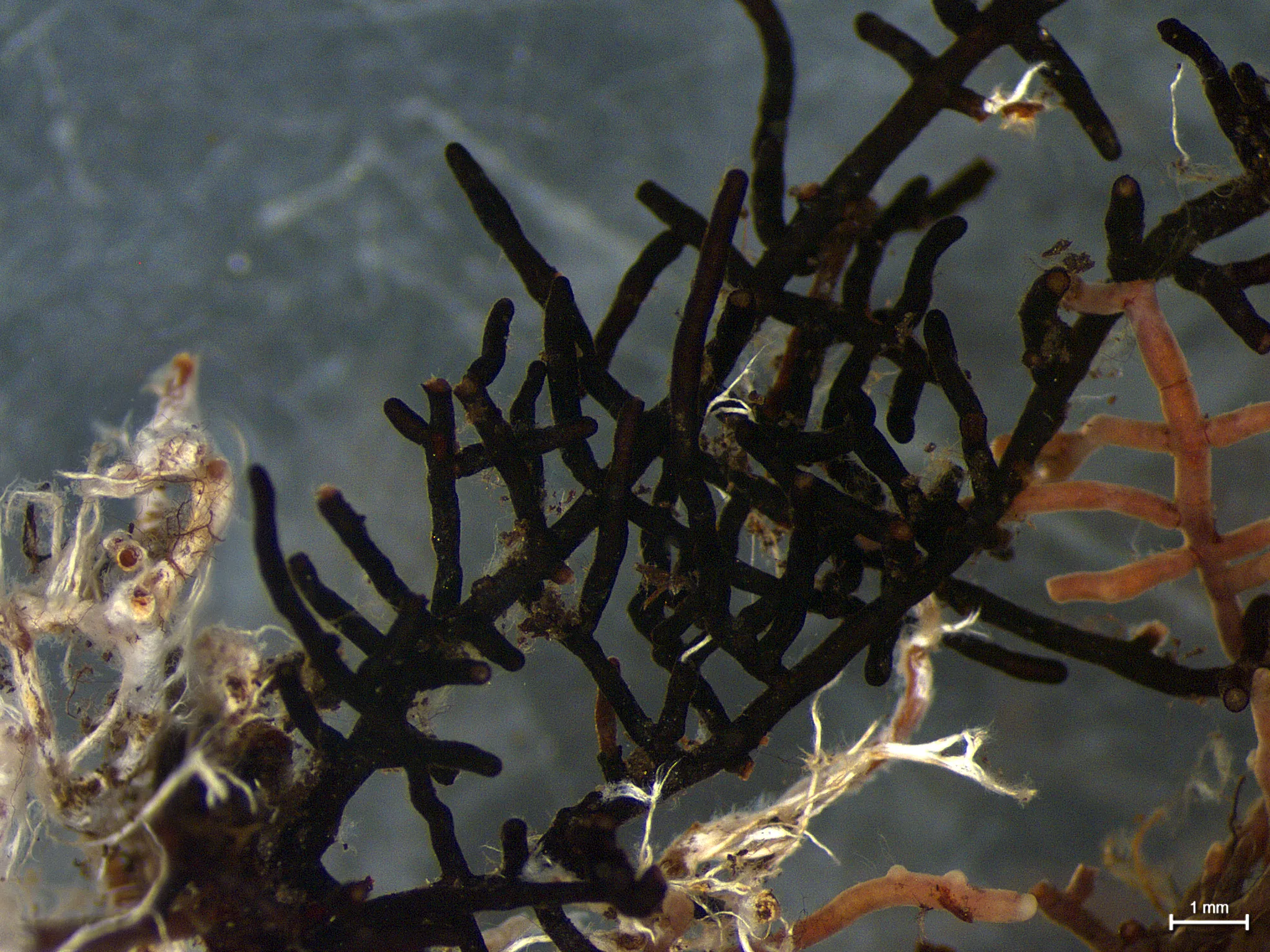
Mycorrhizal fungi in the microscope
Fungi Cosmology, 2024
Through microscopic images, fieldwork documentation, infographics, and approaches to molecular analysis, this work makes visible mycology as a situated and collective practice that moves between the Chilean Patagonian forest, the Brazilian Amazon rainforest, and the Swiss Alpine ecosystems. In doing so, it connects landscape, soil, vegetation, and other forms of biological diversity with the laboratory and the museum.
Across this journey through scales and territories, fungal convergences and differences come into view, alongside patterns of similarity and singularity that reveal how distinct environmental conditions—including human presence as a force shaping the landscape—configure invisible yet essential communities.
The fungal kingdom emerges here as a space of encounter between science, territory, and sensibility, where knowledge is produced collaboratively and shared as a lived experience.
Video 1: Interview with Margaux Schwab, director and founder of foodculture days, Switzerland by Maya Minder
Video 2: Interview with Liliane Fraiji, curator of Labverde in Manaus, Brazil by Maya Minder
Video 3: Interview with Irène Hediger, Head of the AIL Artist-in-Labs Program, Switzerland by Maya Minder
Fungi Cosmology, 2nd edition, at CAB Patagonia, Chile.
_
Texts: María Luisa Murillo and Patricia Silva-Flores.
About Fungi Cosmology
Fungi continuously transform the world around us by creating vast networks of relationships with other living beings. Their lives are deeply intertwined with plants, bacteria, animals, and soils, forming invisible systems that sustain ecosystems across the planet.
Fungi encompasses a vast kingdom that includes mushrooms, molds, and yeasts. Most of a fungus life unfolds beyond our sight in the form of mycelium: a network of microscopic filaments that grows underground or within plants and many other organisms. When environmental conditions are favorable, the mycelium produces the visible fruiting body—the mushroom or sporocarp—which releases spores for reproduction. These spores can remain dormant for years, awaiting the right combination of temperature and humidity to give rise to new life.
Fungi perform a remarkable diversity of ecological functions through their multiple modes of existence. As mycorrhizal symbionts, they weave underground networks that connect plants to soils, enhancing nutrient exchange, resilience, and growth. As lichens, they form intimate partnerships with algae and/or cyanobacteria, contributing gradually to soil formation and opening pathways for life in some of the most extreme environments on Earth. As parasites and pathogens, they shape population dynamics and ecological balance by regulating host organisms and redistributing energy and resources.
By observing and recognizing fungi and their ways of organizing life, we invite you to imagine more interconnected, resilient, and cooperative ways of inhabiting the world.
This selection of photographs brings together sporocarps collected during three research expeditions in the Brazilian Amazon (Alto Cuieiras Biological Research Station, Manaus), Chilean Patagonia (Magallanes National Park, Punta Arenas, and Puerto Yartou, CAB Patagonia), and the Swiss Alps (Oberwald and the Aletsch Glacier, Riederalp, Canton of Valais).
Through these material encounters, the project unfolds a process of observation and taxonomic analysis that reveals the richness and diversity of fungal life across geographically distant yet ecologically interconnected territories.
Mycorrhizal fungi in the microscope
Fungi Cosmology, 2024
Through microscopic images, fieldwork documentation, infographics, and approaches to molecular analysis, this work makes visible mycology as a situated and collective practice that moves between the Chilean Patagonian forest, the Brazilian Amazon rainforest, and the Swiss Alpine ecosystems. In doing so, it connects landscape, soil, vegetation, and other forms of biological diversity with the laboratory and the museum.
Across this journey through scales and territories, fungal convergences and differences come into view, alongside patterns of similarity and singularity that reveal how distinct environmental conditions—including human presence as a force shaping the landscape—configure invisible yet essential communities.
The fungal kingdom emerges here as a space of encounter between science, territory, and sensibility, where knowledge is produced collaboratively and shared as a lived experience.
Video 1: Interview with Margaux Schwab, director and founder of foodculture days, Switzerland by Maya Minder
Video 2: Interview with Liliane Fraiji, curator of Labverde in Manaus, Brazil by Maya Minder
Video 3: Interview with Irène Hediger, Head of the AIL Artist-in-Labs Program, Switzerland by Maya Minder
Fungi Cosmology, 2nd edition, at CAB Patagonia, Chile.
_
Texts: María Luisa Murillo and Patricia Silva-Flores.
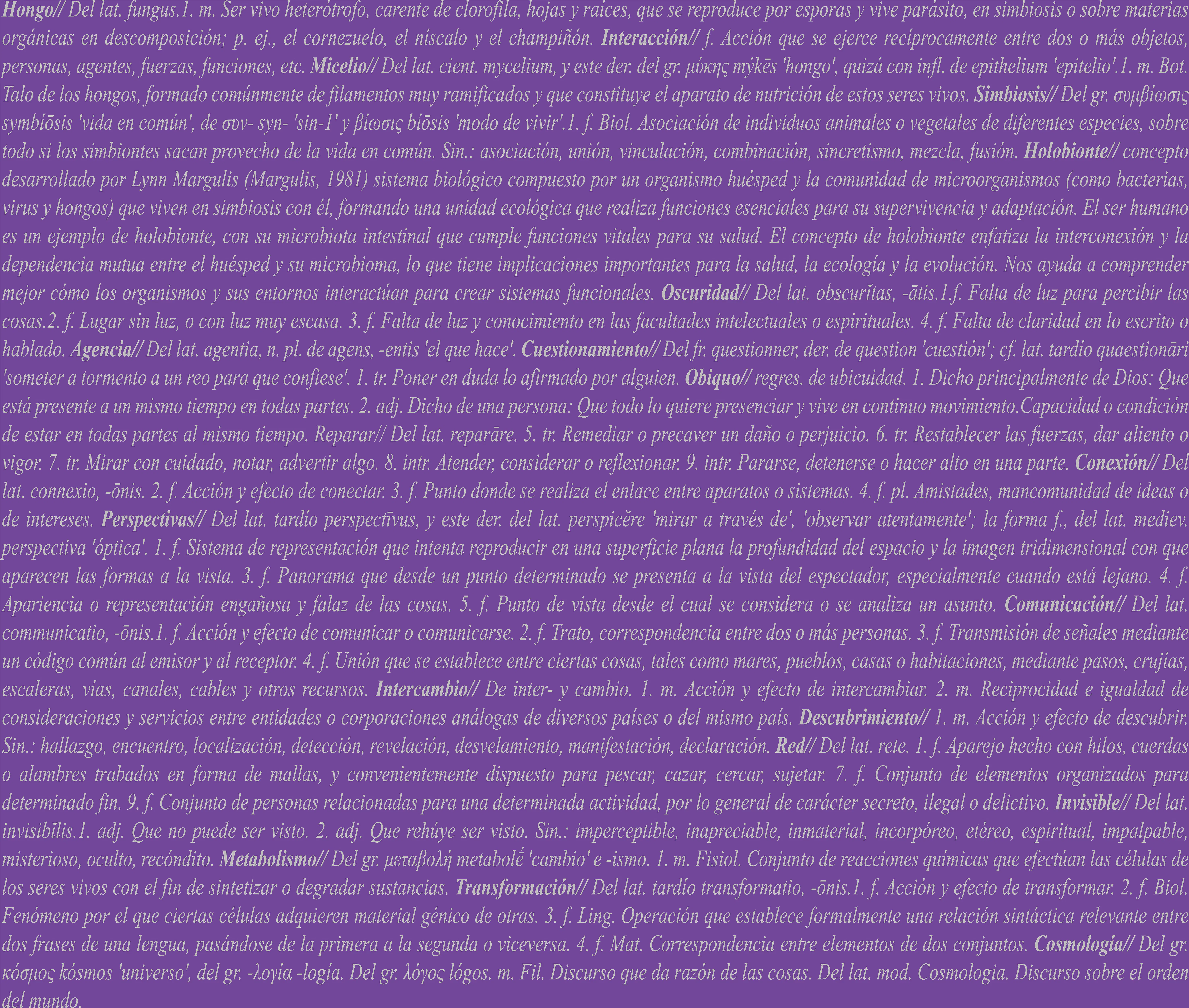
Reflections on Fieldwork
In an effort to better understand the world we inhabit, and to identify the questions and concerns that guide our inquiry, during the process of fieldwork some keywords started to resonate and for the exhibition in Chile were design a glossary that functions as an operational tool rather than a fixed theoretical framework.
These keywords are not intended to explain the works. Instead, they offer possible points of entry—ways of approaching and engaging with them.
This first version of the FC Glossary is conceived as an ontological and perceptual map. The glossary offers orientation toward a particular way of thinking about the work, the territory, and lived experience.
These terms seek to activate relationships, presenting themselves as a web of co-dependencies and co-productions. The presence of notions such as agency, interaction, and the invisible, signals a clear displacement of the human subject as the sole center of meaning. Agency is understood as distributed across organisms, materials, systems, and environments. In this sense, the glossary resonates with perspectives in which the artwork is not merely an expression of human intention, but an assemblage of heterogeneous forces. Chaos, too, is part of the order of things.
Terms such as repair, discovery, and darkness introduce a crucial ethical and perceptual dimension. Repair is not simply a matter of correction; it involves pausing, attending, and looking with care. Darkness is not presented as a lack or absence, but as a condition of possibility for other forms of knowledge to emerge. In this sense, the glossary proposes an aesthetics of slow attention, one that coexists with—and challenges—the extractive logic of rapid and totalizing forms of perception.
_
Text by María Luisa Murillo
Reflections on Fieldwork
In an effort to better understand the world we inhabit, and to identify the questions and concerns that guide our inquiry, during the process of fieldwork some keywords started to resonate and for the exhibition in Chile were design a glossary that functions as an operational tool rather than a fixed theoretical framework.
These keywords are not intended to explain the works. Instead, they offer possible points of entry—ways of approaching and engaging with them.
This first version of the FC Glossary is conceived as an ontological and perceptual map. The glossary offers orientation toward a particular way of thinking about the work, the territory, and lived experience.
These terms seek to activate relationships, presenting themselves as a web of co-dependencies and co-productions. The presence of notions such as agency, interaction, and the invisible, signals a clear displacement of the human subject as the sole center of meaning. Agency is understood as distributed across organisms, materials, systems, and environments. In this sense, the glossary resonates with perspectives in which the artwork is not merely an expression of human intention, but an assemblage of heterogeneous forces. Chaos, too, is part of the order of things.
Terms such as repair, discovery, and darkness introduce a crucial ethical and perceptual dimension. Repair is not simply a matter of correction; it involves pausing, attending, and looking with care. Darkness is not presented as a lack or absence, but as a condition of possibility for other forms of knowledge to emerge. In this sense, the glossary proposes an aesthetics of slow attention, one that coexists with—and challenges—the extractive logic of rapid and totalizing forms of perception.
_
Text by María Luisa Murillo
Eating the Strange: Tiradito de Lengua de Vaca
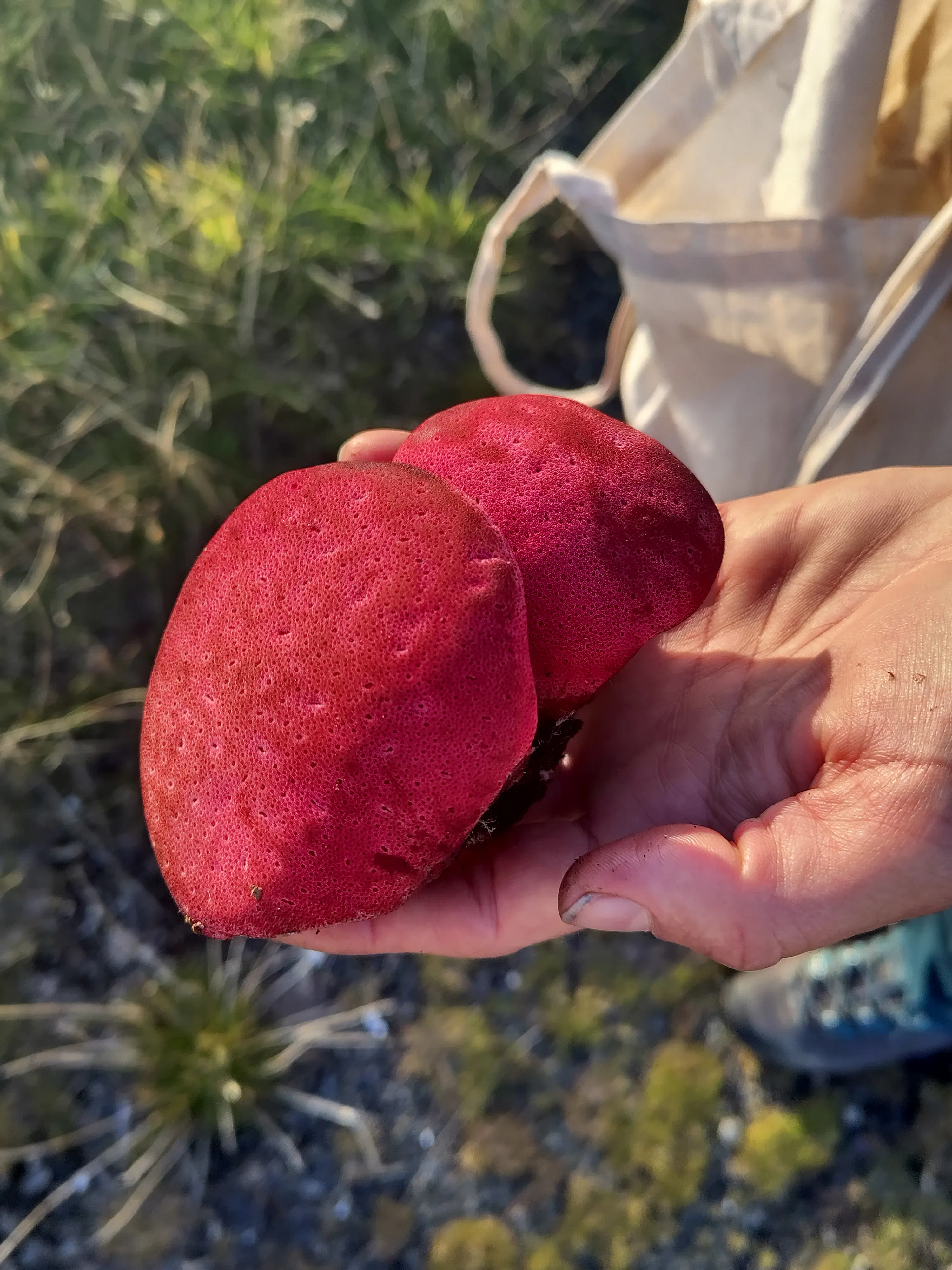
Foraging for Fistulina Antarctica or Lengua de Vaca (cow´s tongue) is an exceptional experience of encountering nature's strangest edible shapes and forms. With its bright red, sometimes pink, color and alienated appearance, it visually resembles a tongue or a slack of meat, which is why it is called beefsteak mushroom. Fistulina also has been known as the "poor man's steak”, a name that refers both to their meat-like appearance and to their historical use as a nourishing meal in contexts where meat was scarce or expensive.
Fistulina antarctica is a fungus that grows on the trunks of trees in the subantarctic forests of Patagonia, on various species of Nothofagus including lenga (Nothofagus pumilio), ñirre (Nothofagus antarctica), and coigüe de Magallanes (Nothofagus betuloides).
Fistulina Antartica (Lengua de vaca) – Maya Minder, March 2024. Patagonia Residency, CAB Patagonia
During a Fungi Cosmology field trip in Patagonia, we witnessed how life on Earth still harbors unexpected wonders and how nature continues to astonish us through its remarkable visual syncretism. Lengua de Vaca literally looks like a tongue: a tree sticking its tongue out toward the forager, in shades ranging from soft pink to deep red colors.
Encountering this species immediately awakened my instincts as a forager. Its flavor proved equally surprising, with delicate floral notes, a subtle hint of citrus, and a soft, spongy texture. The experience challenged my expectations of how food should look and taste, expanding my palate beyond any previous culinary reference.
We experimented with different methods of preparation—boiling, sautéing, and frying—in an attempt to understand the mushroom through our senses, our hands, and our conversations. To know it was not only to analyze it, but to touch it, taste it, and experience it. I can honestly say that it remains one of the strangest, yet most delicious, things my tongue has ever encountered.
A local chef suggested preparing it as a tiradito, an emblematic dish of Peruvian Nikkei food. Emerging from the encounter between Japanese immigrants, who began arriving in Peru in 1899, Nikkei cuisine developed through the fusion of Japanese techniques with Peruvian ingredients, flavors and local traditions. Tiradito, often considered one of its signature dishes, reflects this cultural exchange beautifully.
I am therefore delighted to share this recipe, whose elegance and simplicity honor the singular texture, appearance, and delicate flavor of Lengua de Vaca.
The top surface skin of the Lengua de Vaca has to be removed. One can easily peel it off like a layer of skin. Eating it raw came out as a surprise, since mushrooms most often have to be cooked in order to avoid toxins or digestive problems. For Lengua de Vaca this causes no problems.
Dissecting the mushroom felt like working on a piece of raw meat but its extreme texture slightly reminded me of a fruit or fish. It was beautiful to marvel upon its unique appearance and its colors, surface, softness and dry sponginess.
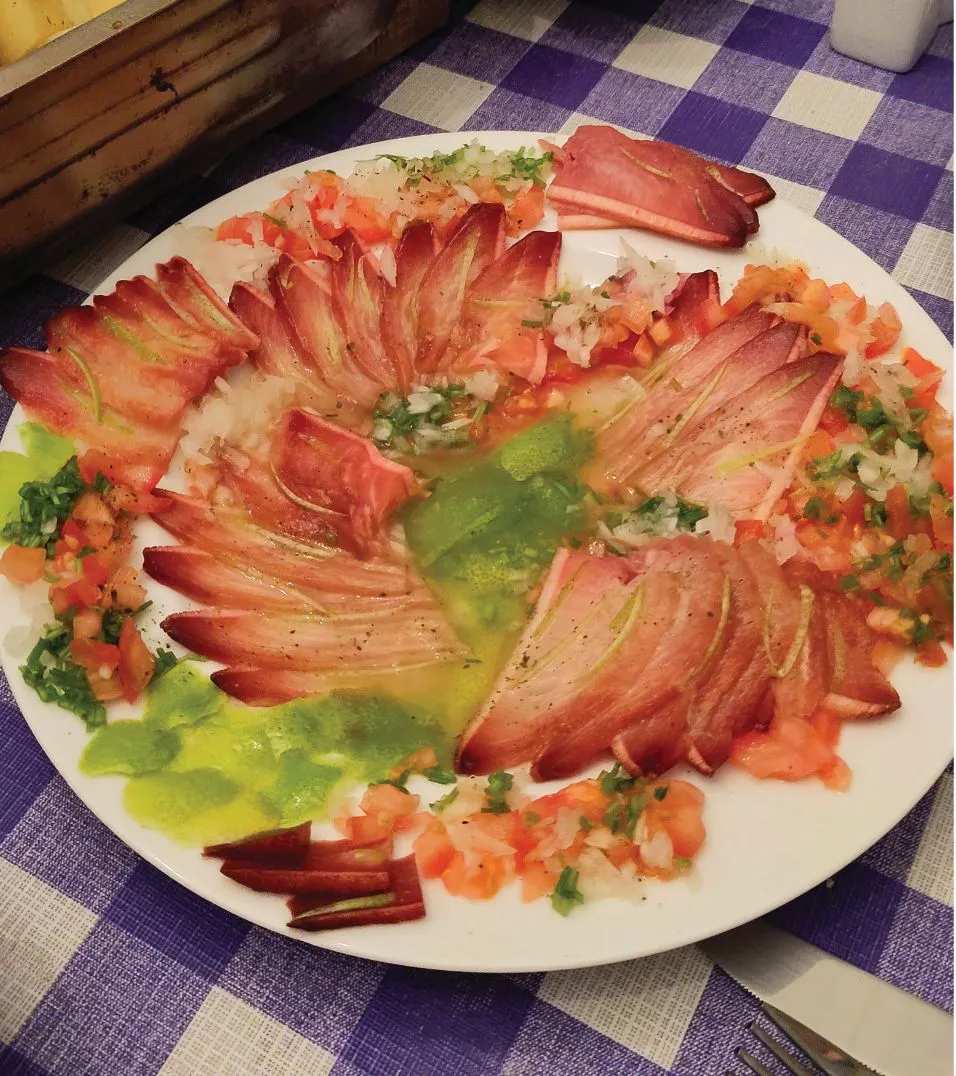
Maya´s Tiradito, Lengua de vaca from Puerto Yartou. Patagonia Field Trip, March 2024
Ingredients:
- 1-2 Lengua de Vaca, Fistulina Antarctica or Fistulina Hepatica (a more common relative)
Sauce :
- the juice of 2 or 3 limes1 thumb of freshly grounded Ginger
- 1 spoon of soy sauce
- 1 spoon of yuzu sauce (optional)
- salt and pepper
Toppings:
(to be mixed into the sauce before topping the Lengua)
- 1 shallot onion cut in brunoise
- 1 small fresh bunch of cilantro cut thinly
- 1/2 a sweet yellow bell pepper cut in brunoise
- 1 small tomato cut in brunoise
- 1 avocado cut in slices (set apart)
Preparation:
Mushrooms: peel off the skin of the top layer. The porous bottom side layer does not have to be removed. Cut the mushroom in thin slices, just like you would prepare tuna sashimi. Align neatly on a plate and top it with the sauce and garnish the fresh avocado slices.
Mix all the ingredients of the sauce, add all the vegetables cut in brunoise into it, except the avocado. Align the avocado with the Lengua de Vaca and pour the sauce with a spoon on top of it. Serve this cold dish directly as an appetizer or a main dish.
_
Text and photos by Maya Minder
Eating the Strange: Tiradito de Lengua de Vaca
Foraging for Fistulina Antarctica or Lengua de Vaca (cow´s tongue) is an exceptional experience of encountering nature's strangest edible shapes and forms. With its bright red, sometimes pink, color and alienated appearance, it visually resembles a tongue or a slack of meat, which is why it is called beefsteak mushroom. Fistulina also has been known as the "poor man's steak”, a name that refers both to their meat-like appearance and to their historical use as a nourishing meal in contexts where meat was scarce or expensive.
Fistulina antarctica is a fungus that grows on the trunks of trees in the subantarctic forests of Patagonia, on various species of Nothofagus including lenga (Nothofagus pumilio), ñirre (Nothofagus antarctica), and coigüe de Magallanes (Nothofagus betuloides).
Fistulina Antartica (Lengua de vaca) – Maya Minder, March 2024. Patagonia Residency, CAB Patagonia
During a Fungi Cosmology field trip in Patagonia, we witnessed how life on Earth still harbors unexpected wonders and how nature continues to astonish us through its remarkable visual syncretism. Lengua de Vaca literally looks like a tongue: a tree sticking its tongue out toward the forager, in shades ranging from soft pink to deep red colors.
Encountering this species immediately awakened my instincts as a forager. Its flavor proved equally surprising, with delicate floral notes, a subtle hint of citrus, and a soft, spongy texture. The experience challenged my expectations of how food should look and taste, expanding my palate beyond any previous culinary reference.
We experimented with different methods of preparation—boiling, sautéing, and frying—in an attempt to understand the mushroom through our senses, our hands, and our conversations. To know it was not only to analyze it, but to touch it, taste it, and experience it. I can honestly say that it remains one of the strangest, yet most delicious, things my tongue has ever encountered.
A local chef suggested preparing it as a tiradito, an emblematic dish of Peruvian Nikkei food. Emerging from the encounter between Japanese immigrants, who began arriving in Peru in 1899, Nikkei cuisine developed through the fusion of Japanese techniques with Peruvian ingredients, flavors and local traditions. Tiradito, often considered one of its signature dishes, reflects this cultural exchange beautifully.
I am therefore delighted to share this recipe, whose elegance and simplicity honor the singular texture, appearance, and delicate flavor of Lengua de Vaca.
The top surface skin of the Lengua de Vaca has to be removed. One can easily peel it off like a layer of skin. Eating it raw came out as a surprise, since mushrooms most often have to be cooked in order to avoid toxins or digestive problems. For Lengua de Vaca this causes no problems.
Dissecting the mushroom felt like working on a piece of raw meat but its extreme texture slightly reminded me of a fruit or fish. It was beautiful to marvel upon its unique appearance and its colors, surface, softness and dry sponginess.
Maya´s Tiradito, Lengua de vaca from Puerto Yartou. Patagonia Field Trip, March 2024
Ingredients:
- 1-2 Lengua de Vaca, Fistulina Antarctica or Fistulina Hepatica (a more common relative)
Sauce :
- the juice of 2 or 3 limes1 thumb of freshly grounded Ginger
- 1 spoon of soy sauce
- 1 spoon of yuzu sauce (optional)
- salt and pepper
Toppings:
(to be mixed into the sauce before topping the Lengua)
- 1 shallot onion cut in brunoise
- 1 small fresh bunch of cilantro cut thinly
- 1/2 a sweet yellow bell pepper cut in brunoise
- 1 small tomato cut in brunoise
- 1 avocado cut in slices (set apart)
Preparation:
Mushrooms: peel off the skin of the top layer. The porous bottom side layer does not have to be removed. Cut the mushroom in thin slices, just like you would prepare tuna sashimi. Align neatly on a plate and top it with the sauce and garnish the fresh avocado slices.
Mix all the ingredients of the sauce, add all the vegetables cut in brunoise into it, except the avocado. Align the avocado with the Lengua de Vaca and pour the sauce with a spoon on top of it. Serve this cold dish directly as an appetizer or a main dish.
_
Text and photos by Maya Minder
Experiencing the World Through Art

The video « Mapu Kufüll Mapu Kufüll » (« Terrestrial Shellfish ») by mapuch artist Seba Calfuqueo is the Mapudungun term used to refer to fungi. The animation reflects on the cosmological perspective of the Mapuche people in relation to mushroom gathering, and on how fungi have become a symbol of resistance for Indigenous communities.
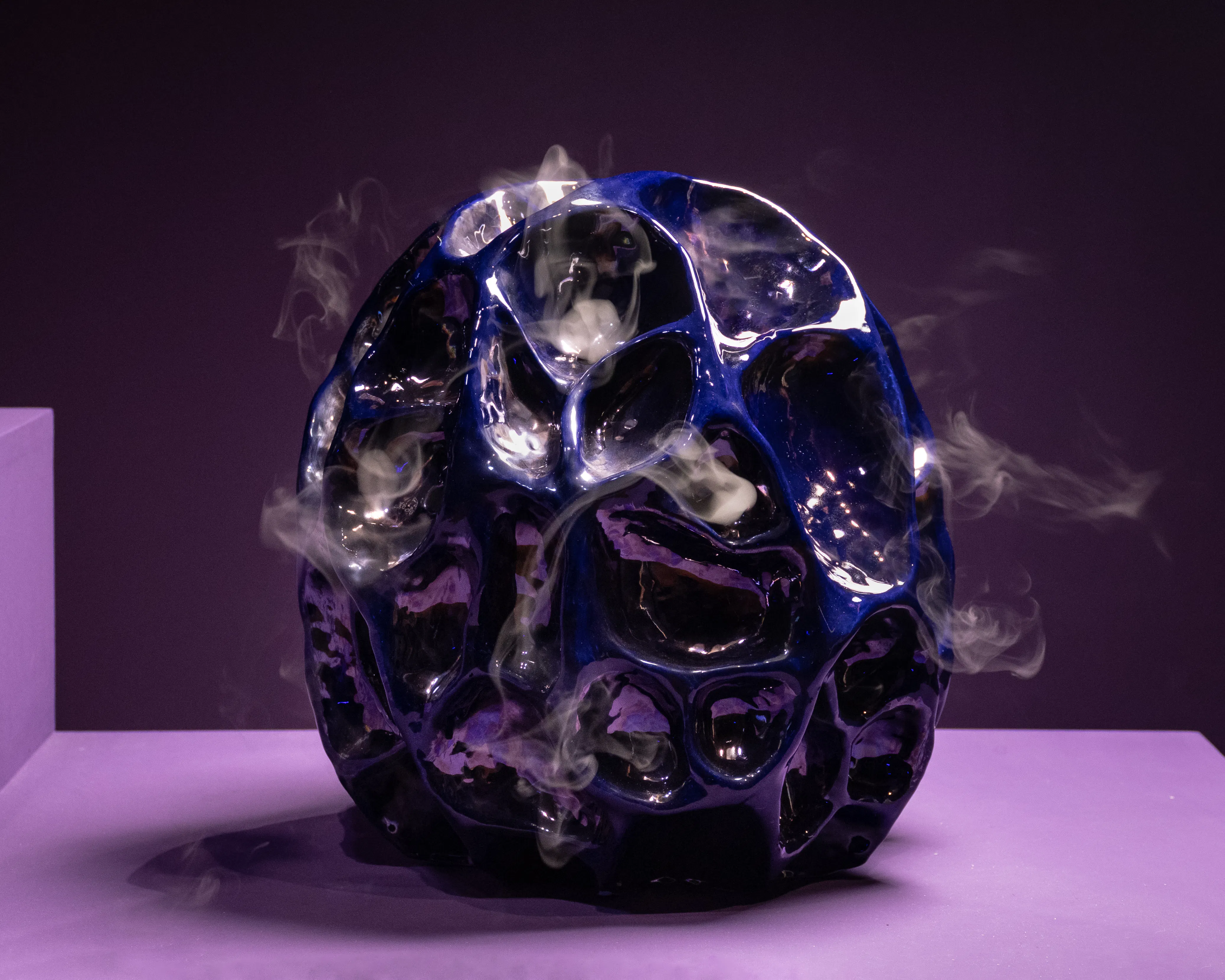
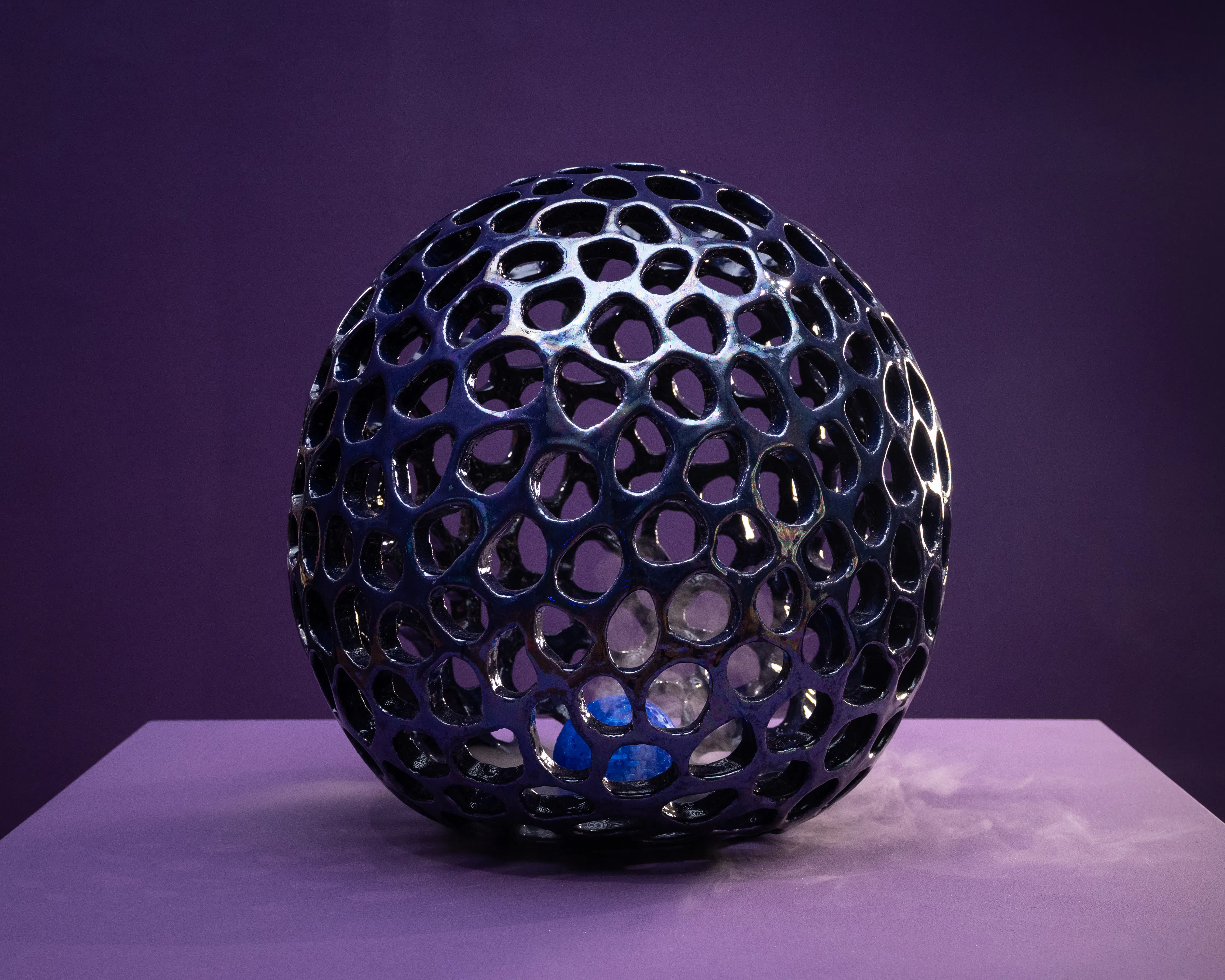
The second work « Odor » (2026) presented is a series of glazed ceramic sculptures fired at 1060°C, drawing inspiration from the fungal world of Wallmapu. Taking spores as its point of departure, the work invites us to engage senses beyond vision, foregrounding smell as a means of evoking the presence of the natural world such as the native forest.
Digüeñe
Morchella
Nothojafnea thaxteri
Experiencing the World Through Art
The video « Mapu Kufüll Mapu Kufüll » (« Terrestrial Shellfish ») by mapuch artist Seba Calfuqueo is the Mapudungun term used to refer to fungi. The animation reflects on the cosmological perspective of the Mapuche people in relation to mushroom gathering, and on how fungi have become a symbol of resistance for Indigenous communities.
The second work « Odor » (2026) presented is a series of glazed ceramic sculptures fired at 1060°C, drawing inspiration from the fungal world of Wallmapu. Taking spores as its point of departure, the work invites us to engage senses beyond vision, foregrounding smell as a means of evoking the presence of the natural world such as the native forest.
Digüeñe
Morchella
Nothojafnea thaxteri
Connection
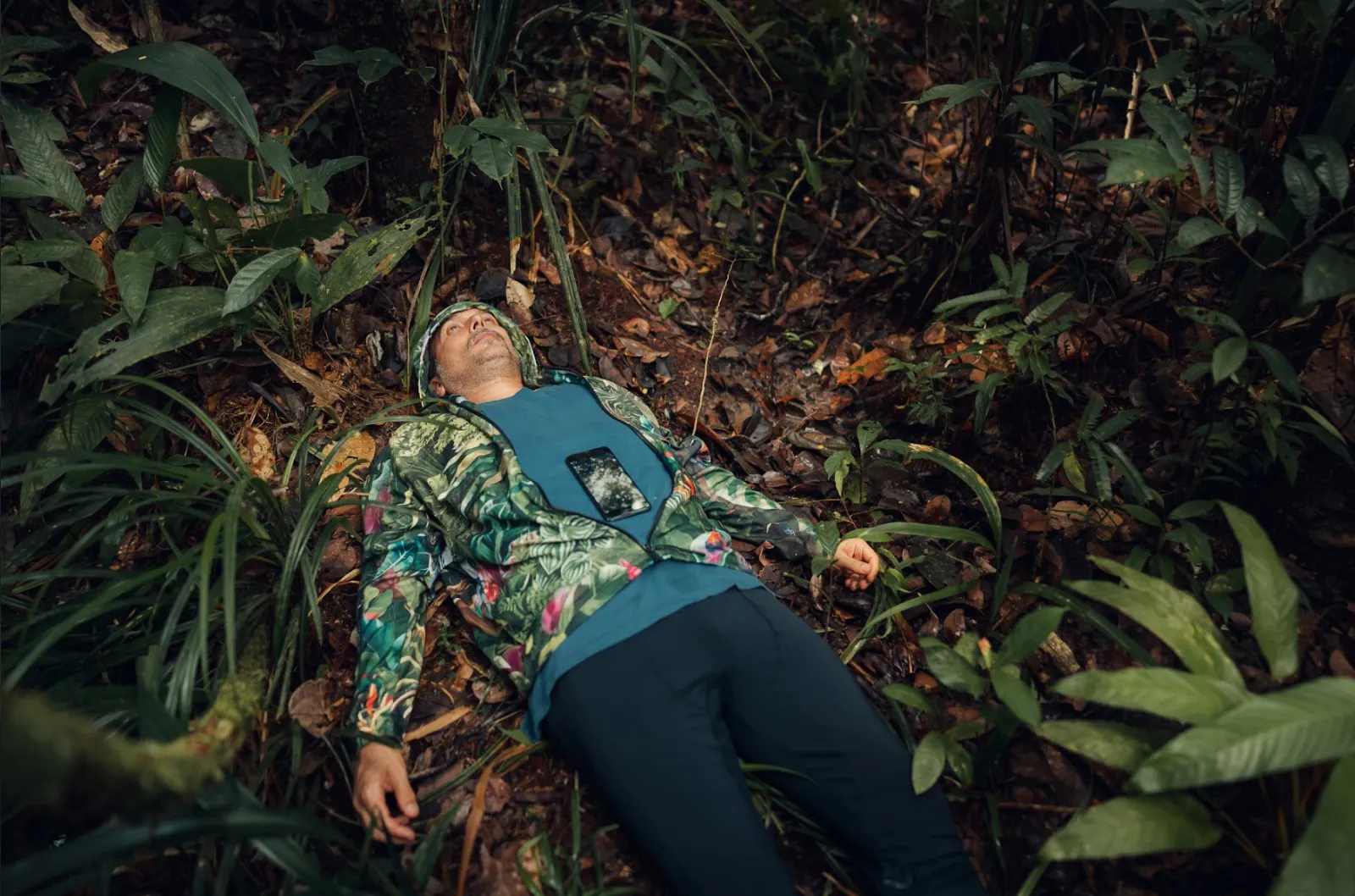
Jorgge Menna Barreto, Rio Cuieras, Brazil. Photo by: Rodrigo Valle, 2023
Much of fungal life operates beyond the limits of perception: underground, in darkness, and across temporal and spatial scales that exceed immediate human experience. Let us direct our attention toward what does not reveal itself readily, through forms of perception that are slowed down, speculative, situated, and mycelial.
The desire for connection plays a fundamental role in the phenomenon of life. Through the connection of bodies, hearts can become “synchronized” within a dynamic and partial correlation.
These complex, diverse, and multidirectional relationships—formed both within and across species—generate symbiotic networks that are essential to the preservation of life and the ecosystems that sustain it. In this way, they invite to shift away from classical, hierarchical, and vertical cosmologies toward a horizontal, distributed, and subterranean logic, where meaning emerges through connection rather than identity.
“Pulse” – Jorgge Menna Barreto, 2024. Single Channel Projection, stereo sound. 4’58”.
_
Text by María Luisa Murillo, Artwork by Jorgge Menna Barreto
Connection
Jorgge Menna Barreto, Rio Cuieras, Brazil. Photo by: Rodrigo Valle, 2023
Much of fungal life operates beyond the limits of perception: underground, in darkness, and across temporal and spatial scales that exceed immediate human experience. Let us direct our attention toward what does not reveal itself readily, through forms of perception that are slowed down, speculative, situated, and mycelial.
The desire for connection plays a fundamental role in the phenomenon of life. Through the connection of bodies, hearts can become “synchronized” within a dynamic and partial correlation.
These complex, diverse, and multidirectional relationships—formed both within and across species—generate symbiotic networks that are essential to the preservation of life and the ecosystems that sustain it. In this way, they invite to shift away from classical, hierarchical, and vertical cosmologies toward a horizontal, distributed, and subterranean logic, where meaning emerges through connection rather than identity.
“Pulse” – Jorgge Menna Barreto, 2024. Single Channel Projection, stereo sound. 4’58”.
_
Text by María Luisa Murillo, Artwork by Jorgge Menna Barreto
Interspecies
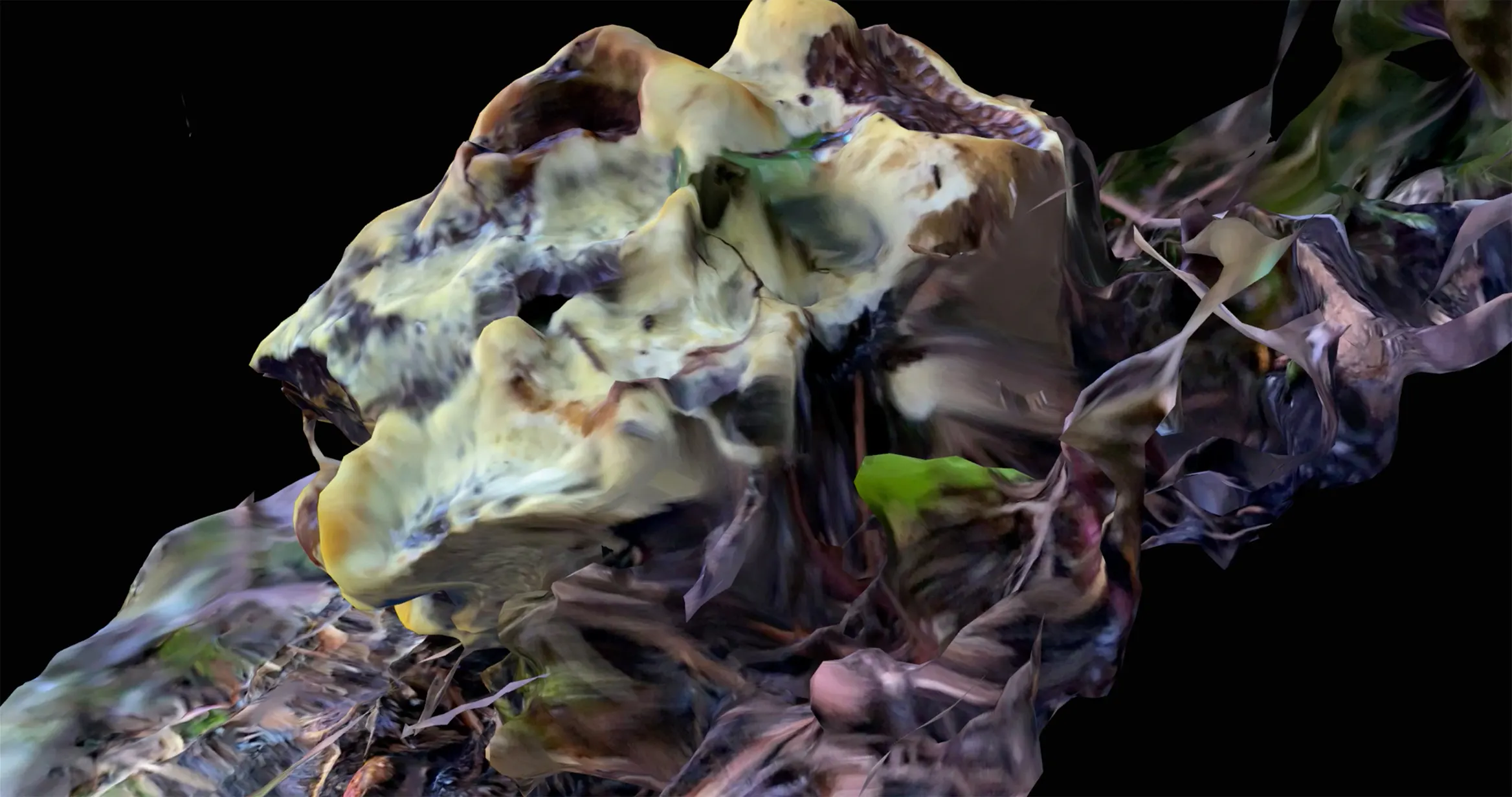
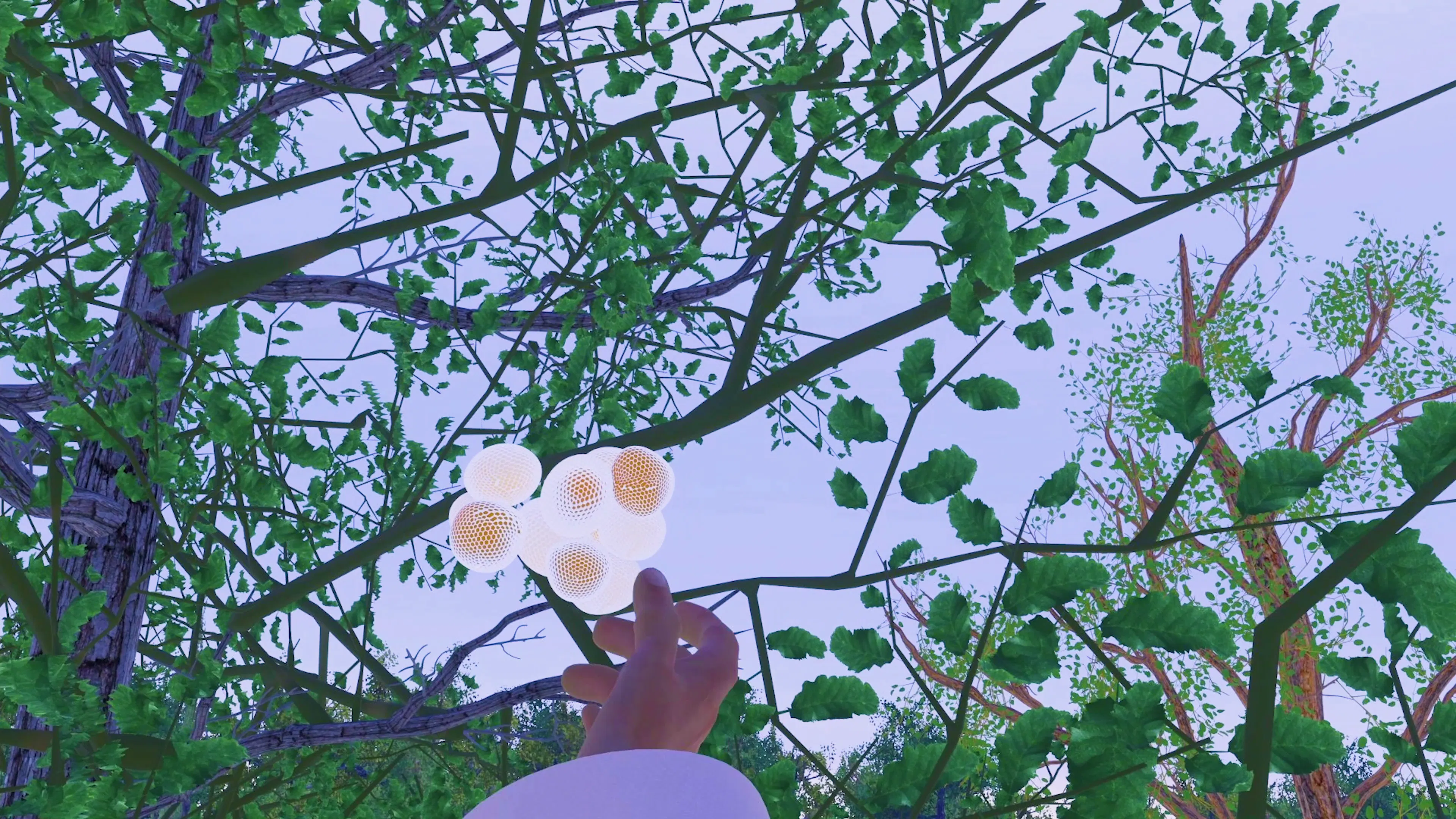
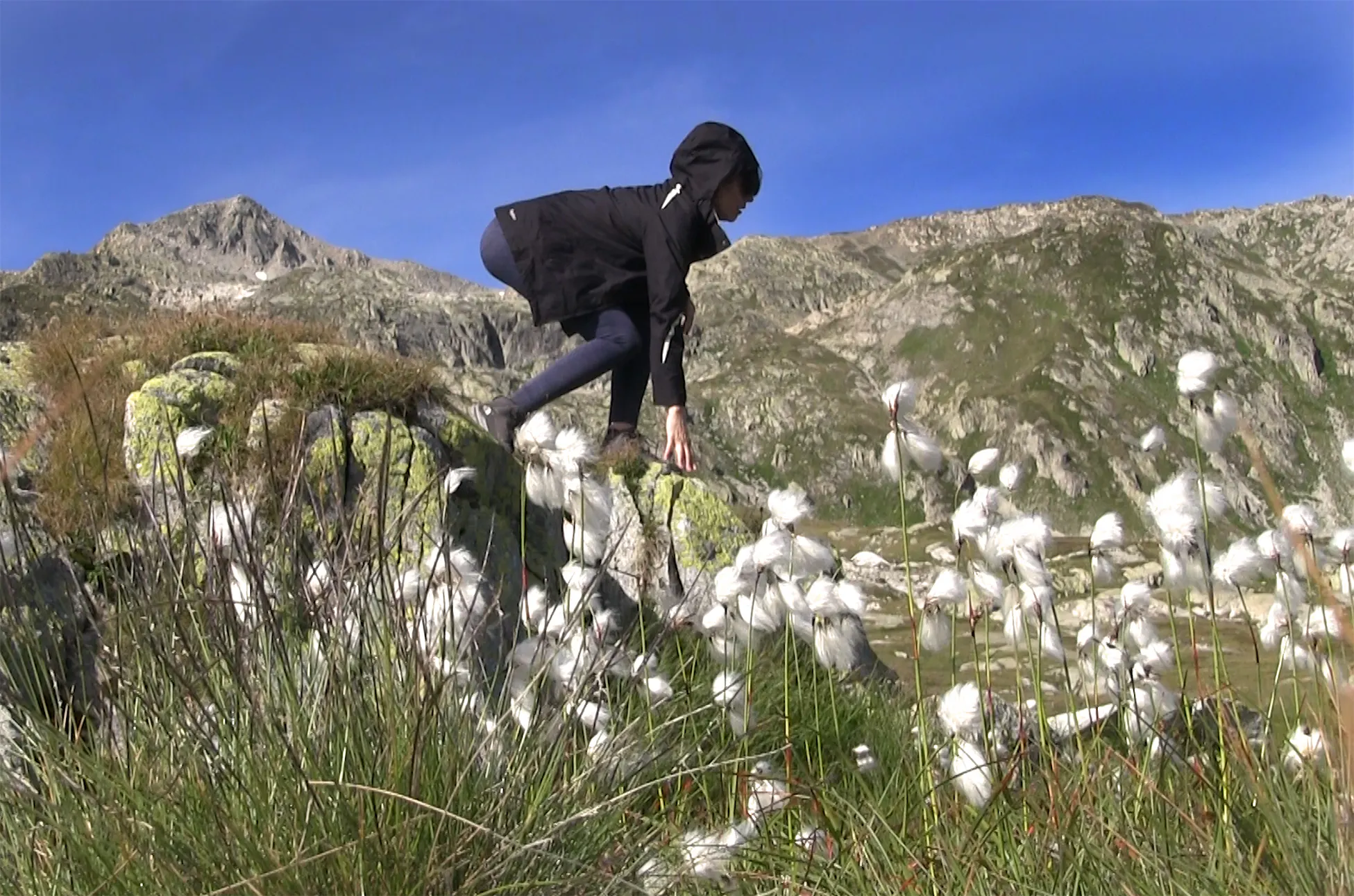
“Fungsectum (Fungi + insect + human continuum)” (still) – Valentina Serrati Sisa, 2026
Among fungi, insects, and human bodies, this work proposes a hybrid territory where boundaries begin to blur. Within the framework of Fungi Cosmology, an international project at the intersection of art, science, and ecology, Valentina invites us to think of knowledge as embodied, relational, and constantly in transformation.
“Fungsectum” does not seek to teach us “how to do” things; rather, it challenges the very conditions under which knowledge is produced. Who produces knowledge? From where? And with what legitimacy?
Through immersive imagery and a speculative narrative, the work questions anthropocentric assumptions and opens space for a posthuman perspective in which mycelial forms of connection link territories, bodies, and ways of knowing. From the Alps to Tierra del Fuego, the piece activates a network of ecological and cultural relationships that compels us to reconsider our place within the world.
Fungsectum (Fungi + insect + human continuum)” short version – Valentina Serrati Sisa, 2026. Sound design Alisu. Images + postproduction + AI: Valentina Serrati Sisa. 3D : Luna Laff. Touchdesigner: Matías Carvajal
No. 1
The interdisciplinary artist-in-residence mistakes ecological awareness for a heroic journey, reenacting colonial modes of conquest and insisting that geographic displacement is equivalent to critical depth, and that remoteness guarantees epistemic legitimacy. In this way, ecology becomes a performance of mobility, science a poetic alibi, and art the sophisticated repetition of an old fantasy: to arrive, to name, to translate, and to leave—while leaving intact the assumption that the world must be traversed in order to exist, and explained in order to be saved.
No. 2
The unique characteristics of remote landscapes blur distinctions between territories in the Global North and Global South, reflecting dynamic processes that exceed geographical boundaries while remaining shaped by the weight of shared histories. The transient nature of residency programs can foster the creation of site-responsive performances that emerge in real time and are deeply embedded within their environments.
The speculative narrative surrounding a fungal cosmology deconstructs this form of performative amateur scientific anthropocentrism, compelling the body toward modes of reconfiguration associated with posthumanist thought. Here, transformation operates as a metaphor for resilience, interdependence, and ecological becoming.
No. 3
Mycelium, mycorrhizae, and fungi function as epistemological bridges toward interconnected, sentient, and rhizomatic ways of thinking. To observe them is to undergo a transformation—to become a body practicing a becoming-insect, perceiving from a fragile, multiple, and situated corporeality.
The construction of this imaginary world—through performance, fungal photogrammetry, generative post-production, and artificial intelligence—seeks to consolidate a speculative fiction that does not represent a future world, but rather rehearses a cosmology in transition, where thinking, creating, and inhabiting become forms of chaotic and interconnected mutuality.
_
Text by María Luisa Murillo, notes and artwork by Valentina Serrati Sisa.
Interspecies
“Fungsectum (Fungi + insect + human continuum)” (still) – Valentina Serrati Sisa, 2026
Among fungi, insects, and human bodies, this work proposes a hybrid territory where boundaries begin to blur. Within the framework of Fungi Cosmology, an international project at the intersection of art, science, and ecology, Valentina invites us to think of knowledge as embodied, relational, and constantly in transformation.
“Fungsectum” does not seek to teach us “how to do” things; rather, it challenges the very conditions under which knowledge is produced. Who produces knowledge? From where? And with what legitimacy?
Through immersive imagery and a speculative narrative, the work questions anthropocentric assumptions and opens space for a posthuman perspective in which mycelial forms of connection link territories, bodies, and ways of knowing. From the Alps to Tierra del Fuego, the piece activates a network of ecological and cultural relationships that compels us to reconsider our place within the world.
Fungsectum (Fungi + insect + human continuum)” short version – Valentina Serrati Sisa, 2026. Sound design Alisu. Images + postproduction + AI: Valentina Serrati Sisa. 3D : Luna Laff. Touchdesigner: Matías Carvajal
No. 1
The interdisciplinary artist-in-residence mistakes ecological awareness for a heroic journey, reenacting colonial modes of conquest and insisting that geographic displacement is equivalent to critical depth, and that remoteness guarantees epistemic legitimacy. In this way, ecology becomes a performance of mobility, science a poetic alibi, and art the sophisticated repetition of an old fantasy: to arrive, to name, to translate, and to leave—while leaving intact the assumption that the world must be traversed in order to exist, and explained in order to be saved.
No. 2
The unique characteristics of remote landscapes blur distinctions between territories in the Global North and Global South, reflecting dynamic processes that exceed geographical boundaries while remaining shaped by the weight of shared histories. The transient nature of residency programs can foster the creation of site-responsive performances that emerge in real time and are deeply embedded within their environments.
The speculative narrative surrounding a fungal cosmology deconstructs this form of performative amateur scientific anthropocentrism, compelling the body toward modes of reconfiguration associated with posthumanist thought. Here, transformation operates as a metaphor for resilience, interdependence, and ecological becoming.
No. 3
Mycelium, mycorrhizae, and fungi function as epistemological bridges toward interconnected, sentient, and rhizomatic ways of thinking. To observe them is to undergo a transformation—to become a body practicing a becoming-insect, perceiving from a fragile, multiple, and situated corporeality.
The construction of this imaginary world—through performance, fungal photogrammetry, generative post-production, and artificial intelligence—seeks to consolidate a speculative fiction that does not represent a future world, but rather rehearses a cosmology in transition, where thinking, creating, and inhabiting become forms of chaotic and interconnected mutuality.
_
Text by María Luisa Murillo, notes and artwork by Valentina Serrati Sisa.
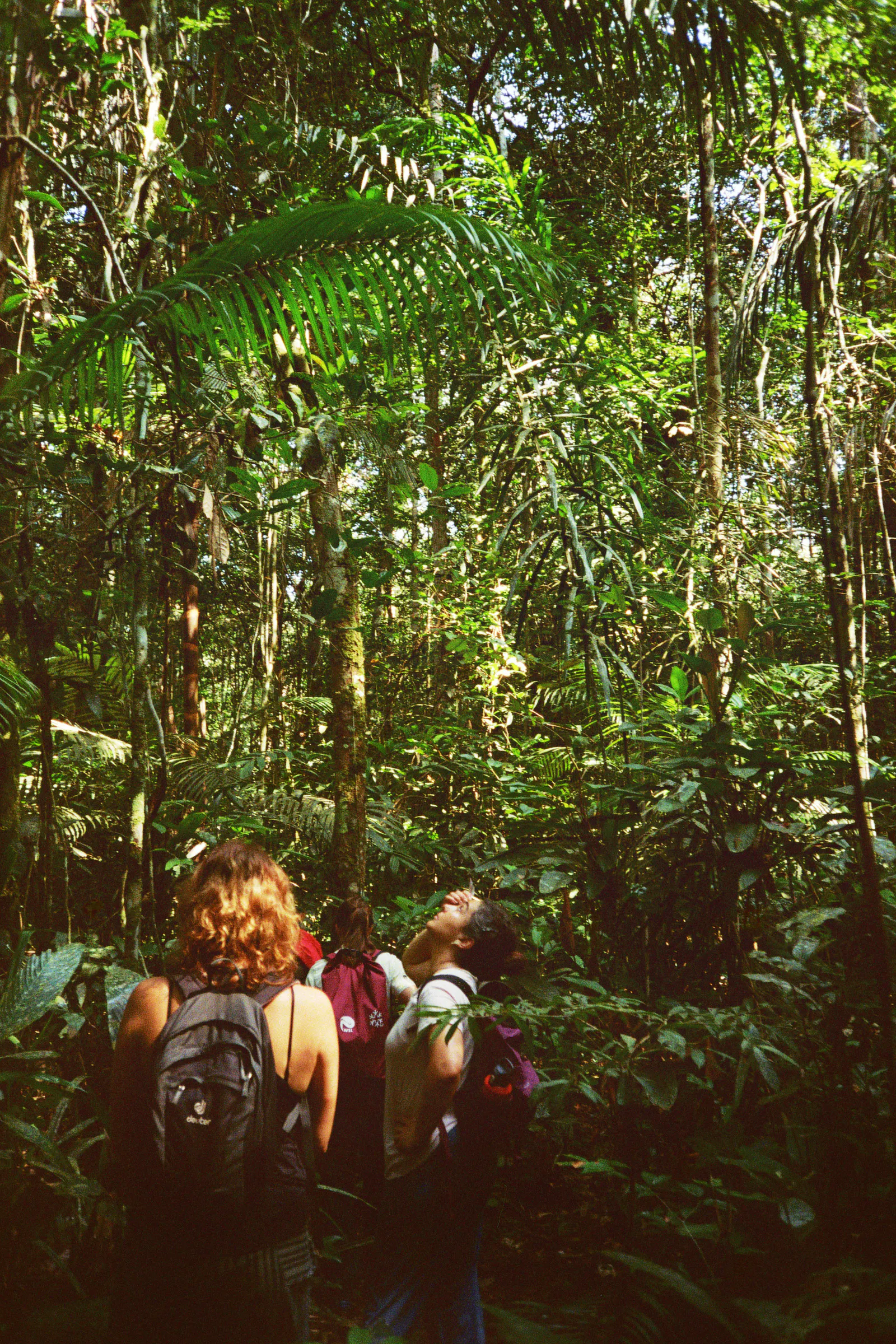
Transformation
About Cantarelo - Cantharellus guyanensis
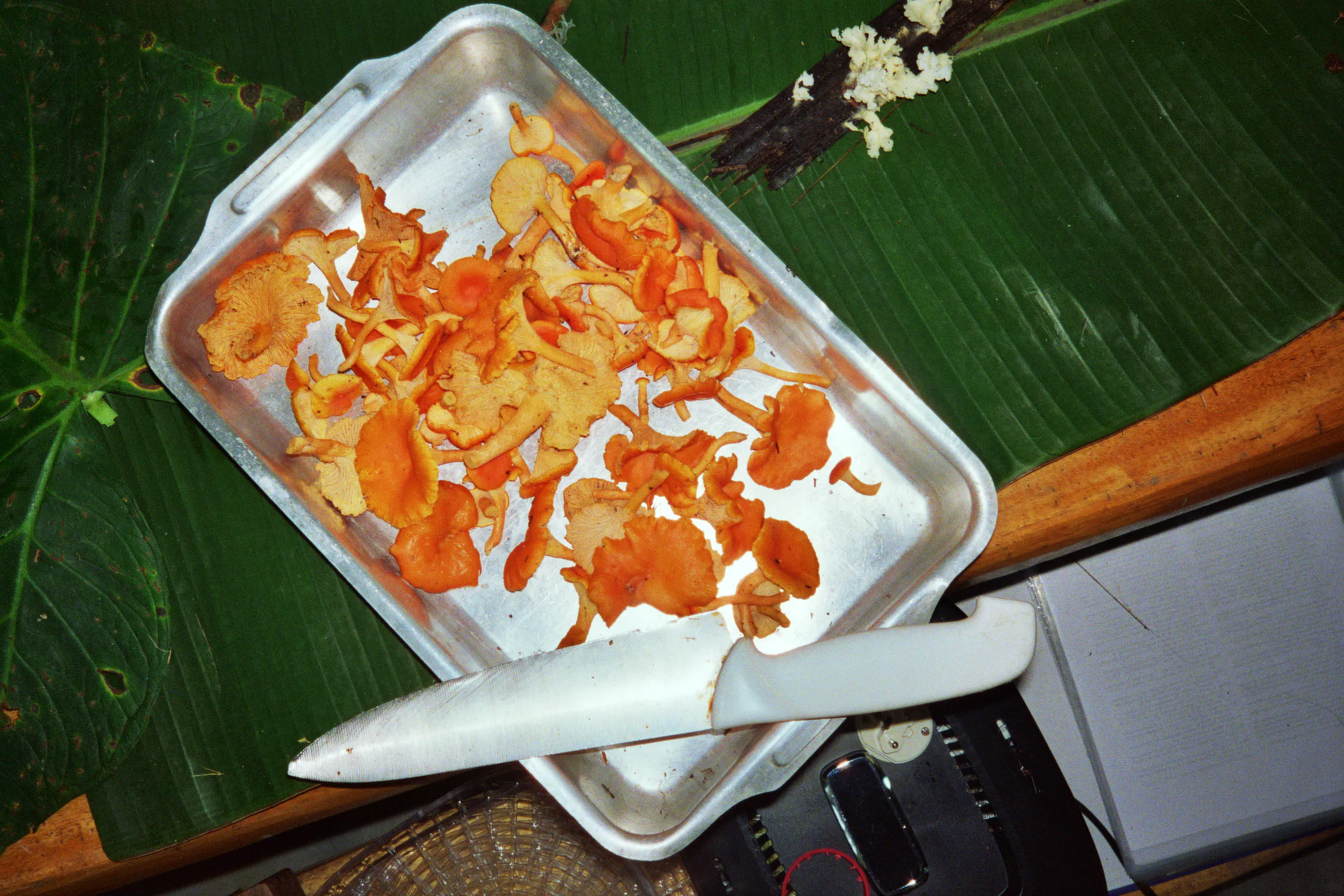
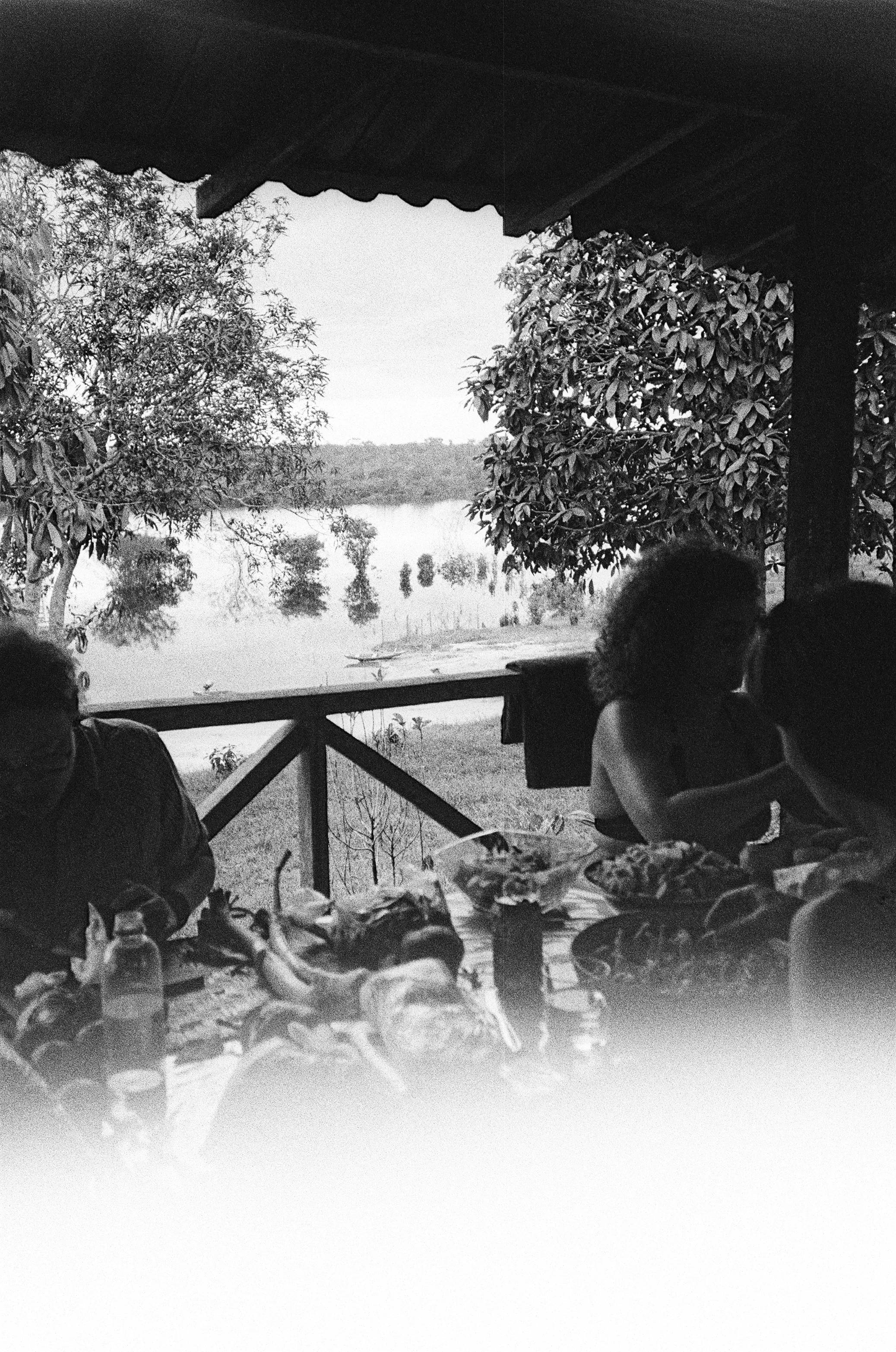
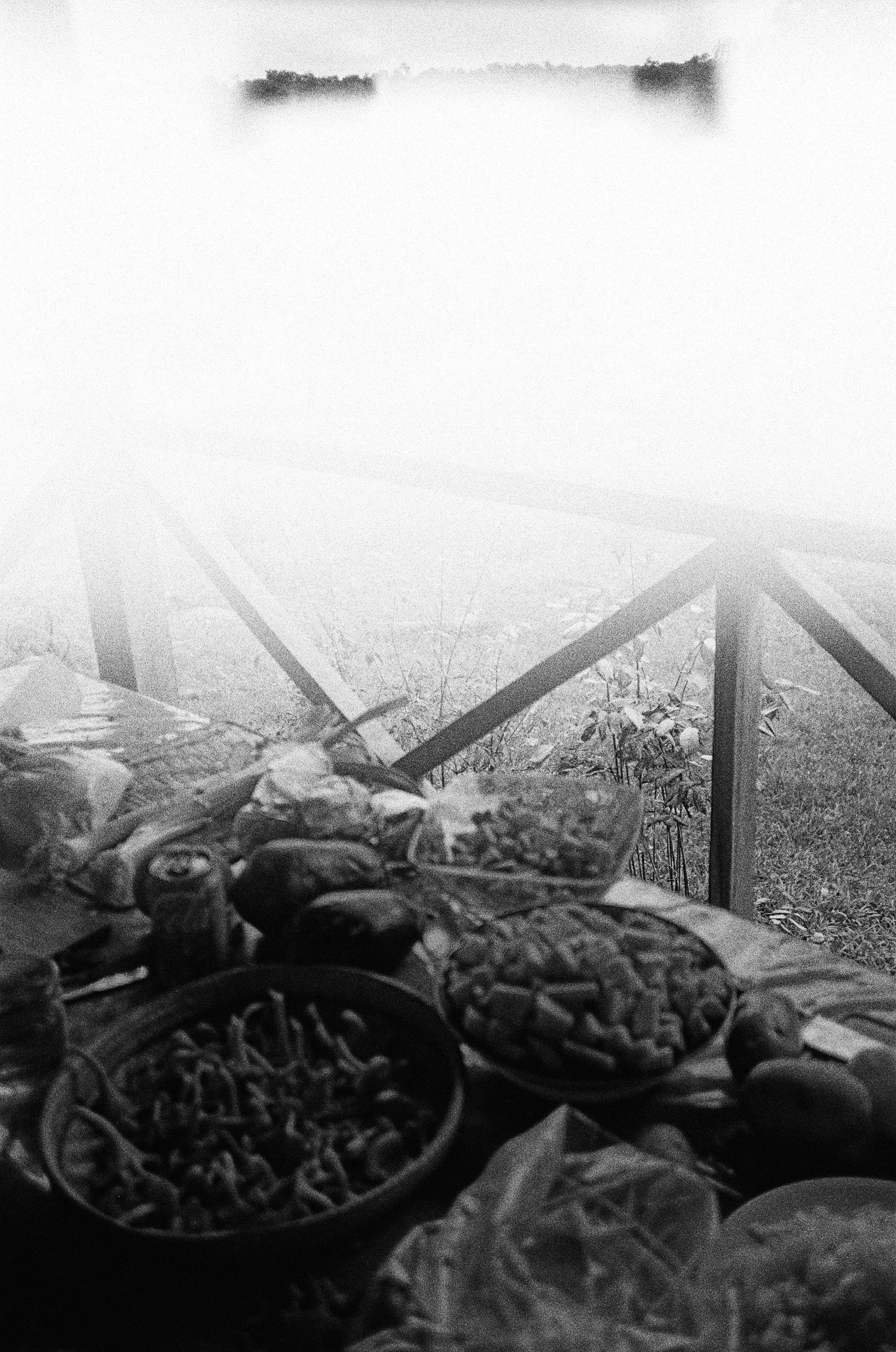
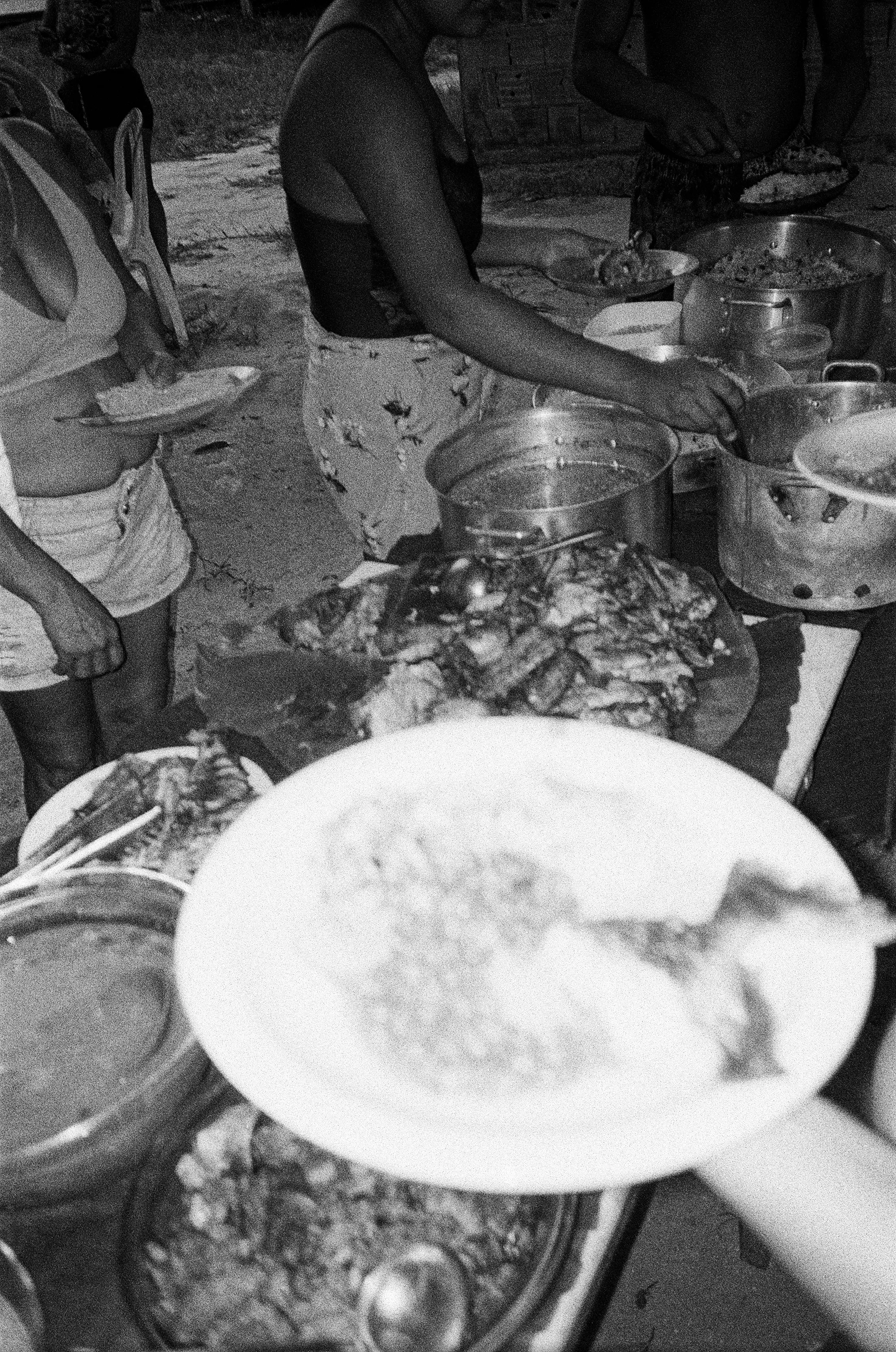
« This species of Cantharellus is very unique because this genus is not common in the tropics. In the Amazon, the special campinarana's white sand forests host an incredible diversity of ectomycorrhizal mushrooms. Due to the extreme conditions of this ecosystem, the fungi are the key to help plants gather nutrients for their living. During the Fungi Cosmology residency in the Amazon, we picked them up and brought them to cook and serve in the indigenous community of the Cuieiras River. » – Ju Simon
How does the artist-scientist navigate the transition from exploration to involvement?
How do we relate to what we investigate?
This question emerges from artistic practice understood as a mode of making that seeks to be respectful of, and attuned to, the environment in which it takes place. It is an approach that aims to activate connections between the researcher, the subject of inquiry, and the living systems within which these interactions unfold.
Through these “exercises in connection,” both artistic and scientific practices can explore and develop methodologies that foster relationships with human and more-than-human ecosystems. Such approaches attempt to place themselves in service of the other, cultivating forms of situated knowledge that remain attentive and responsive to their surroundings.
Rather than striving for mastery or certainty, they invite processes of mutual transformation and genuine connection, opening space for not-knowing and for forms of imperfect making.
In Defense of Imperfect Making
Growing from South to North, propelled by impure and imperfect human bodies, it presents itself as a practice shaped by contradiction. It acknowledges that researching, traveling, undertaking residencies, and producing artworks or knowledge are activities marked by asymmetries, colonial legacy, and ethical frictions that cannot be resolved or closed through a supposedly “correct” position.
Against the temptation of critical immobility—where every action appears already compromised—this curatorial project defends imperfect making as a form of situated responsibility. A mode of practice that derives its legitimacy not from the complexity of the work undertaken, the scale of the logistical achievement, or the accumulation of knowledge, but from its willingness to expose itself to error, discomfort, and mutual transformation.
To think with fungi is to accept opaque processes, non-linear temporalities, and distributed forms of agency. Nothing grows without friction. Nothing transforms without contamination.
In this sense, the project does not seek to represent a fully realized more-than-human ethics. Rather, it rehearses forms of relation that recognize themselves as partial, provisional, and always open to revision.
Art does not appear here as a faithful translation of territory, nor as a form of symbolic salvation. Instead, it becomes a space of experimentation: a place where critical thought does not paralyze action, but accompanies it, unsettles it, and continuously destabilizes its own conditions of possibility.
Fungi Cosmology chooses to remain within the tension. Not in order to resolve it, but to inhabit it.
_
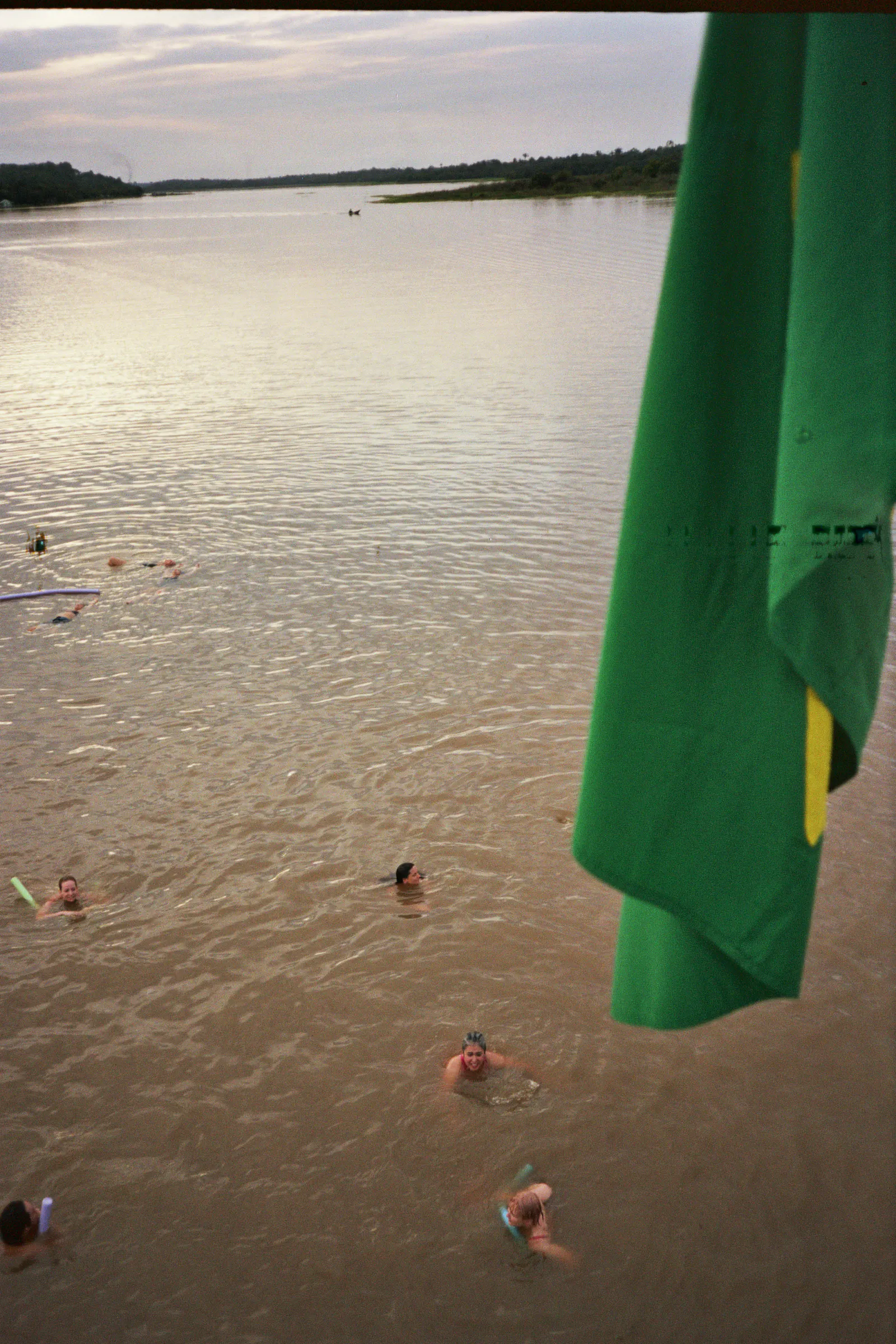
Text by María Luisa Murillo, photos by Margaux Schwab
Transformation
About Cantarelo - Cantharellus guyanensis
« This species of Cantharellus is very unique because this genus is not common in the tropics. In the Amazon, the special campinarana's white sand forests host an incredible diversity of ectomycorrhizal mushrooms. Due to the extreme conditions of this ecosystem, the fungi are the key to help plants gather nutrients for their living. During the Fungi Cosmology residency in the Amazon, we picked them up and brought them to cook and serve in the indigenous community of the Cuieiras River. » – Ju Simon
How does the artist-scientist navigate the transition from exploration to involvement?
How do we relate to what we investigate?
This question emerges from artistic practice understood as a mode of making that seeks to be respectful of, and attuned to, the environment in which it takes place. It is an approach that aims to activate connections between the researcher, the subject of inquiry, and the living systems within which these interactions unfold.
Through these “exercises in connection,” both artistic and scientific practices can explore and develop methodologies that foster relationships with human and more-than-human ecosystems. Such approaches attempt to place themselves in service of the other, cultivating forms of situated knowledge that remain attentive and responsive to their surroundings.
Rather than striving for mastery or certainty, they invite processes of mutual transformation and genuine connection, opening space for not-knowing and for forms of imperfect making.
In Defense of Imperfect Making
Growing from South to North, propelled by impure and imperfect human bodies, it presents itself as a practice shaped by contradiction. It acknowledges that researching, traveling, undertaking residencies, and producing artworks or knowledge are activities marked by asymmetries, colonial legacy, and ethical frictions that cannot be resolved or closed through a supposedly “correct” position.
Against the temptation of critical immobility—where every action appears already compromised—this curatorial project defends imperfect making as a form of situated responsibility. A mode of practice that derives its legitimacy not from the complexity of the work undertaken, the scale of the logistical achievement, or the accumulation of knowledge, but from its willingness to expose itself to error, discomfort, and mutual transformation.
To think with fungi is to accept opaque processes, non-linear temporalities, and distributed forms of agency. Nothing grows without friction. Nothing transforms without contamination.
In this sense, the project does not seek to represent a fully realized more-than-human ethics. Rather, it rehearses forms of relation that recognize themselves as partial, provisional, and always open to revision.
Art does not appear here as a faithful translation of territory, nor as a form of symbolic salvation. Instead, it becomes a space of experimentation: a place where critical thought does not paralyze action, but accompanies it, unsettles it, and continuously destabilizes its own conditions of possibility.
Fungi Cosmology chooses to remain within the tension. Not in order to resolve it, but to inhabit it.
_
Text by María Luisa Murillo, photos by Margaux Schwab
Contributors
Fungi Cosmology is a collaborative project. We would like to express our gratitude to everyone who participated in this journey with us, directly or indirectly.
CREDITS
Marìa Luisa Murillo (CL)
Chilean artist, curator, and cultural manager. She holds a Bachelor's degree in Arts from the Pontifical Catholic University of Chile. Since 2015, she has worked as Director of the Alberto Baeriswyl House Museum in Tierra del Fuego and leads CAB’s Art, Science, and Humanities Residency Program, where she fosters dialogue between art and science through collective experiences of knowledge exchange and creation in the southernmost region of Chile.
As an artist and curator, her research focuses on memory, identity, and modes of inhabiting more-than-human worlds.
Lilian Fraiji (BR)
Curator and producer based in Manaus and São Paulo, Brazil. She is co-founder of Labverde, a platform dedicated to the development of multidisciplinary projects at the intersection of art, science, and ecology.
She has collaborated on numerous curatorial projects in Brazil and internationally, focusing on the Amazonian territory and on poetic and ecological questions. She currently coordinates Labsonora, an artistic research initiative centered on sound and activism, and Speculative Ecologies, an international residency program that promotes artistic and ecological practices in the Amazon.
Margaux Schwab (CH)
Margaux Schwab is a Swiss/Mexican cultural producer and curator working at the intersection of art, ecology, and hospitality, with a particular focus on contexts beyond the traditional gallery space. In 2016, she founded foodculture days, a platform for knowledge exchange centered on food ecologies and politics. Through its biennial format in Vevey, foodculture days acts as a catalyst for dialogue and action, bringing together a wide range of creative and culinary interventions that engage with environmental and social concerns.
As a curator, Schwab’s research focuses on notions of hospitality, conviviality, and access to the arts, approaching food as a nourishing, ideological, conceptual, and discursive material. Her work draws on the specific perspectives and knowledge of artists, researchers, gardeners, historians, architects, designers, activists, farmers, philosophers, botanists, grandmothers, cooks, and other more-than-human forms of intelligence.
By valuing kitchens, markets, fields, and gardens as powerful sites for the transmission of knowledge and cultural practices, Schwab explores how art can reconnect us with these territories through embodied, sensorial, and attentive forms of engagement.
Irene Hediger (CH)
Switzerland cultural manager and Director of the artists-in-labs (AIL) program at the Department of Cultural Analysis, Zurich University of the Arts (ZHdK). Her work focuses on curating and fostering interdisciplinary and transdisciplinary exchanges and practices at the intersection of art, science, and technology, particularly in the fields of environmental science, astrophysics, biology, neuroscience, and medicine.
In 2009, she initiated the international artists-in-labs residency exchange program, creating opportunities for artists to engage directly with scientific research environments. Hediger has curated numerous exhibitions and public programs exploring contemporary art, science, and technology, including Quantum of Disorder, (in)visible transitions, Displacements – Art, Science and the DNA of the Ibex, Propositions for a Poetic Ecosystem, and Interfacing New Heavens.
She holds degrees in Business Administration and Group and Organizational Dynamics (DAGG), as well as a Master's degree in Cultural Management from the University of Basel.
Seba Calfuqueo (CL)
Mapuche trans artist and curator of Espacio 218, Santiago, Chile. She is a member of the Mapuche collective Rangiñtulewfü and of Revista Yene.
Through her work, she draws on her cultural heritage and lived experience as a point of departure for a critical reflection on the social, cultural, and political dynamics that shape the Mapuche subject within contemporary Chilean society and the broader Latin American context.
Her artistic practice spans performance, installation, ceramics, and video, exploring the convergences and divergences between Indigenous cosmologies and Western thought. Her work also engages with themes such as feminism, gender studies, and environmental rights from a situated and embodied perspective.
Maya Minder (CH)
Maya Minder is a Switzerland-Korean artist based in Zurich, working with installation, photography and performance grounded in ecology, female technologies and sustainable materials. Her practice unfolds through research and storytelling — unlearning, unfolding and upheaving forgotten history with taste, gestures and time. Cooking, fermentation, and transformation become ways to foster critical thinking and design within the Anthropocene.
She has exhibited at Kunsthaus Zurich in Switzerland; Kanazawa 21st Century Museum in Japan; Seoul Arts Center in South Korea; Floating University in Berlin, Germany; and By Art Matters, Hangzhou, China. Drawing from the DIY and DIWO movement, her work explores forms of participative research and community driven practices in an era shaped by the ruins of late capitalism. Influenced by ecofeminist and posthuman thought, she creates participatory and situative happenings in which bodies, microbes, technologies, and narratives collide, proposing new ways of living together and sharing culture.
Jorgge Menna Barreto (BR)
Brazilian artist and educator whose practice and research have been dedicated to site-specific art for more than 20 years. In 2014, he undertook a postdoctoral research project at the State University of Santa Catarina, Brazil, where he collaborated with a biologist and an agronomist to investigate the relationship between site-specific art and agroecology, with a focus on agroforestry systems. In 2020, he completed a second postdoctoral research fellowship at Liverpool John Moores University, England, which led to the work he presented at the Liverpool Biennial in 2021.
Menna Barreto was Assistant Professor in the Department of Art at the University of California, Santa Cruz, where he also teached in the MFA program in Environmental Art and Social Practice. He is also affiliated with the Graduate Program in Arts at the State University of Rio de Janeiro, where, together with Eloisa Brantes, he coordinates the research group “Ambientalidades”. Menna Barreto approaches site specificity from a critical South American perspective.
Valentina Serrati (CL)
Valentina Serrati is a Paraguayan-Chilean artist who holds a Bachelor's degree in Arts from the Pontifical Catholic University of Chile and a Master's degree in Digital Media and Technology Cultures from Goldsmiths, University of London, UK.
A media artist working across performance, video art, and video installation, she has extensive experience in both academic institutions and cultural policy development. Over the past twenty-four years, she has developed a distinguished academic career at the School of Arts of the Pontifical Catholic University of Chile, where she played a key role in the creation and development of the university’s Media Arts Area.
In 2019, she founded PRISMA, a platform dedicated to promoting projects at the intersection of art, science, and technology, with a particular interest in nature and ecological thought. In 2025, she launched LAITEC, a space for interdisciplinary creation and research focused on technology within the Faculty of Arts at the Pontifical Catholic University of Chile.
She currently combines artistic practice, teaching, and cultural management, fostering innovation, experimentation, and creative processes involving emerging technologies.
Patricia Silva-Flores (CL)
Ecologist specializing in fungi and mycorrhizae from Punta Arenas, Chile. She is currently an Assistant Professor at the Catholic University of Maule in Talca, Chile; Communications Director of the International Mycorrhiza Society (IMS); co-founder and active member of the South American Mycorrhizal Research Network; and an Associate Scientist with SPUN (Society for the Protection of Underground Networks).
Patricia’s work focuses on three main areas: (1) research on fundamental questions in mycorrhizal ecology, as well as applications of mycorrhizal fungi and symbioses in restoration ecology and forestry and agricultural contexts; (2) the education and training of undergraduate and graduate students in fungal and mycorrhizal ecology and its applications through teaching, supervision of internships, and thesis advising; and (3) public engagement with science, with a primary focus on fostering broader awareness and understanding of fungal and mycorrhizal science.
Ju Simon (BR)
Brazilian Biologist and PhD candidate at the Federal University of Santa Catarina (UFSC) in Florianópolis, Brazil. She holds a Master's degree in Mycology from the National Institute of Amazonian Research (INPA) in Manaus, Brazil.
Since 2012, Juli has been studying, learning, and teaching topics related to mycology. As a fungi enthusiast, she is always interested in discussing the many dimensions of the fungal world. She is also passionate about music and has studied and performed both transverse flute and percussion.
Juli believes that fungi offer a key to understanding life and death, interconnection, and the practice of being present while embracing the ephemeral.
Martina Peter (CH)
Swiss scientist whose primary research interest lies in the various aspects of the symbiotic interactions between forest trees and fungi, known as ectomycorrhizal symbiosis. She investigates the taxonomic and functional diversity of mycorrhizal fungi in forest ecosystems and their ecological roles in a rapidly changing environment.
Her research focuses particularly on the effects of drought and nitrogen deposition on the structure and functioning of mycorrhizal fungal communities. She is also interested in understanding how forest fungi adapt to their environment and ecological lifestyles. Martina primarily employs molecular markers to study mycorrhizal fungal communities and populations, as well as gene expression and enzymatic assays to investigate their functional ecology.
Benjamin Dauphin (CH)
A Swiss scientist, passionate about evolutionary biology and the ways organisms interact with their environment, Benjamin Dauphin is particularly interested in studying local adaptation processes in forest and alpine ecosystems. He is also fascinated by how and why complex mating systems have been maintained throughout the evolutionary history of life.
Using genomic tools and high-resolution environmental data, his research seeks to advance our understanding of adaptation and co-adaptation processes within symbiotic plant–fungus partnerships.
Contributors
Fungi Cosmology is a collaborative project. We would like to express our gratitude to everyone who participated in this journey with us, directly or indirectly.
CREDITS
Marìa Luisa Murillo (CL)
Chilean artist, curator, and cultural manager. She holds a Bachelor's degree in Arts from the Pontifical Catholic University of Chile. Since 2015, she has worked as Director of the Alberto Baeriswyl House Museum in Tierra del Fuego and leads CAB’s Art, Science, and Humanities Residency Program, where she fosters dialogue between art and science through collective experiences of knowledge exchange and creation in the southernmost region of Chile.
As an artist and curator, her research focuses on memory, identity, and modes of inhabiting more-than-human worlds.
Lilian Fraiji (BR)
Curator and producer based in Manaus and São Paulo, Brazil. She is co-founder of Labverde, a platform dedicated to the development of multidisciplinary projects at the intersection of art, science, and ecology.
She has collaborated on numerous curatorial projects in Brazil and internationally, focusing on the Amazonian territory and on poetic and ecological questions. She currently coordinates Labsonora, an artistic research initiative centered on sound and activism, and Speculative Ecologies, an international residency program that promotes artistic and ecological practices in the Amazon.
Margaux Schwab (CH)
Margaux Schwab is a Swiss/Mexican cultural producer and curator working at the intersection of art, ecology, and hospitality, with a particular focus on contexts beyond the traditional gallery space. In 2016, she founded foodculture days, a platform for knowledge exchange centered on food ecologies and politics. Through its biennial format in Vevey, foodculture days acts as a catalyst for dialogue and action, bringing together a wide range of creative and culinary interventions that engage with environmental and social concerns.
As a curator, Schwab’s research focuses on notions of hospitality, conviviality, and access to the arts, approaching food as a nourishing, ideological, conceptual, and discursive material. Her work draws on the specific perspectives and knowledge of artists, researchers, gardeners, historians, architects, designers, activists, farmers, philosophers, botanists, grandmothers, cooks, and other more-than-human forms of intelligence.
By valuing kitchens, markets, fields, and gardens as powerful sites for the transmission of knowledge and cultural practices, Schwab explores how art can reconnect us with these territories through embodied, sensorial, and attentive forms of engagement.
Irene Hediger (CH)
Switzerland cultural manager and Director of the artists-in-labs (AIL) program at the Department of Cultural Analysis, Zurich University of the Arts (ZHdK). Her work focuses on curating and fostering interdisciplinary and transdisciplinary exchanges and practices at the intersection of art, science, and technology, particularly in the fields of environmental science, astrophysics, biology, neuroscience, and medicine.
In 2009, she initiated the international artists-in-labs residency exchange program, creating opportunities for artists to engage directly with scientific research environments. Hediger has curated numerous exhibitions and public programs exploring contemporary art, science, and technology, including Quantum of Disorder, (in)visible transitions, Displacements – Art, Science and the DNA of the Ibex, Propositions for a Poetic Ecosystem, and Interfacing New Heavens.
She holds degrees in Business Administration and Group and Organizational Dynamics (DAGG), as well as a Master's degree in Cultural Management from the University of Basel.
Seba Calfuqueo (CL)
Mapuche trans artist and curator of Espacio 218, Santiago, Chile. She is a member of the Mapuche collective Rangiñtulewfü and of Revista Yene.
Through her work, she draws on her cultural heritage and lived experience as a point of departure for a critical reflection on the social, cultural, and political dynamics that shape the Mapuche subject within contemporary Chilean society and the broader Latin American context.
Her artistic practice spans performance, installation, ceramics, and video, exploring the convergences and divergences between Indigenous cosmologies and Western thought. Her work also engages with themes such as feminism, gender studies, and environmental rights from a situated and embodied perspective.
Maya Minder (CH)
Maya Minder is a Switzerland-Korean artist based in Zurich, working with installation, photography and performance grounded in ecology, female technologies and sustainable materials. Her practice unfolds through research and storytelling — unlearning, unfolding and upheaving forgotten history with taste, gestures and time. Cooking, fermentation, and transformation become ways to foster critical thinking and design within the Anthropocene.
She has exhibited at Kunsthaus Zurich in Switzerland; Kanazawa 21st Century Museum in Japan; Seoul Arts Center in South Korea; Floating University in Berlin, Germany; and By Art Matters, Hangzhou, China. Drawing from the DIY and DIWO movement, her work explores forms of participative research and community driven practices in an era shaped by the ruins of late capitalism. Influenced by ecofeminist and posthuman thought, she creates participatory and situative happenings in which bodies, microbes, technologies, and narratives collide, proposing new ways of living together and sharing culture.
Jorgge Menna Barreto (BR)
Brazilian artist and educator whose practice and research have been dedicated to site-specific art for more than 20 years. In 2014, he undertook a postdoctoral research project at the State University of Santa Catarina, Brazil, where he collaborated with a biologist and an agronomist to investigate the relationship between site-specific art and agroecology, with a focus on agroforestry systems. In 2020, he completed a second postdoctoral research fellowship at Liverpool John Moores University, England, which led to the work he presented at the Liverpool Biennial in 2021.
Menna Barreto was Assistant Professor in the Department of Art at the University of California, Santa Cruz, where he also teached in the MFA program in Environmental Art and Social Practice. He is also affiliated with the Graduate Program in Arts at the State University of Rio de Janeiro, where, together with Eloisa Brantes, he coordinates the research group “Ambientalidades”. Menna Barreto approaches site specificity from a critical South American perspective.
Valentina Serrati (CL)
Valentina Serrati is a Paraguayan-Chilean artist who holds a Bachelor's degree in Arts from the Pontifical Catholic University of Chile and a Master's degree in Digital Media and Technology Cultures from Goldsmiths, University of London, UK.
A media artist working across performance, video art, and video installation, she has extensive experience in both academic institutions and cultural policy development. Over the past twenty-four years, she has developed a distinguished academic career at the School of Arts of the Pontifical Catholic University of Chile, where she played a key role in the creation and development of the university’s Media Arts Area.
In 2019, she founded PRISMA, a platform dedicated to promoting projects at the intersection of art, science, and technology, with a particular interest in nature and ecological thought. In 2025, she launched LAITEC, a space for interdisciplinary creation and research focused on technology within the Faculty of Arts at the Pontifical Catholic University of Chile.
She currently combines artistic practice, teaching, and cultural management, fostering innovation, experimentation, and creative processes involving emerging technologies.
Patricia Silva-Flores (CL)
Ecologist specializing in fungi and mycorrhizae from Punta Arenas, Chile. She is currently an Assistant Professor at the Catholic University of Maule in Talca, Chile; Communications Director of the International Mycorrhiza Society (IMS); co-founder and active member of the South American Mycorrhizal Research Network; and an Associate Scientist with SPUN (Society for the Protection of Underground Networks).
Patricia’s work focuses on three main areas: (1) research on fundamental questions in mycorrhizal ecology, as well as applications of mycorrhizal fungi and symbioses in restoration ecology and forestry and agricultural contexts; (2) the education and training of undergraduate and graduate students in fungal and mycorrhizal ecology and its applications through teaching, supervision of internships, and thesis advising; and (3) public engagement with science, with a primary focus on fostering broader awareness and understanding of fungal and mycorrhizal science.
Ju Simon (BR)
Brazilian Biologist and PhD candidate at the Federal University of Santa Catarina (UFSC) in Florianópolis, Brazil. She holds a Master's degree in Mycology from the National Institute of Amazonian Research (INPA) in Manaus, Brazil.
Since 2012, Juli has been studying, learning, and teaching topics related to mycology. As a fungi enthusiast, she is always interested in discussing the many dimensions of the fungal world. She is also passionate about music and has studied and performed both transverse flute and percussion.
Juli believes that fungi offer a key to understanding life and death, interconnection, and the practice of being present while embracing the ephemeral.
Martina Peter (CH)
Swiss scientist whose primary research interest lies in the various aspects of the symbiotic interactions between forest trees and fungi, known as ectomycorrhizal symbiosis. She investigates the taxonomic and functional diversity of mycorrhizal fungi in forest ecosystems and their ecological roles in a rapidly changing environment.
Her research focuses particularly on the effects of drought and nitrogen deposition on the structure and functioning of mycorrhizal fungal communities. She is also interested in understanding how forest fungi adapt to their environment and ecological lifestyles. Martina primarily employs molecular markers to study mycorrhizal fungal communities and populations, as well as gene expression and enzymatic assays to investigate their functional ecology.
Benjamin Dauphin (CH)
A Swiss scientist, passionate about evolutionary biology and the ways organisms interact with their environment, Benjamin Dauphin is particularly interested in studying local adaptation processes in forest and alpine ecosystems. He is also fascinated by how and why complex mating systems have been maintained throughout the evolutionary history of life.
Using genomic tools and high-resolution environmental data, his research seeks to advance our understanding of adaptation and co-adaptation processes within symbiotic plant–fungus partnerships.