



The Art of Living on the Rift
– Edito by Mateo Chacón Pino, Teesa Bahana, Margaux Schwab
– Edito by Mateo Chacón Pino, Teesa Bahana, Margaux Schwab
Margaux Schwab (foodculture days): Precisely three years ago, foodculture days embarked on a new online editorial chapter by launching Boca A Boca. The intention was to deepen our understanding around certain themes that we question and that question us in return. Each invited guest editor brings their situated perspective, network and sensibilities, allowing the transdisciplinary perspective so dear to us to emerge organically. The intention is to question the role of art and artists in supporting social and political movements of change on multiple scales and, simultaneously, providing them with a platform to expose our western gaze and its implications.
For this new editorial season, beyond enriching the public’s perspective on what African art is, what is primarily at stake is the meaning of its values and the potential of their expression in everyday life.
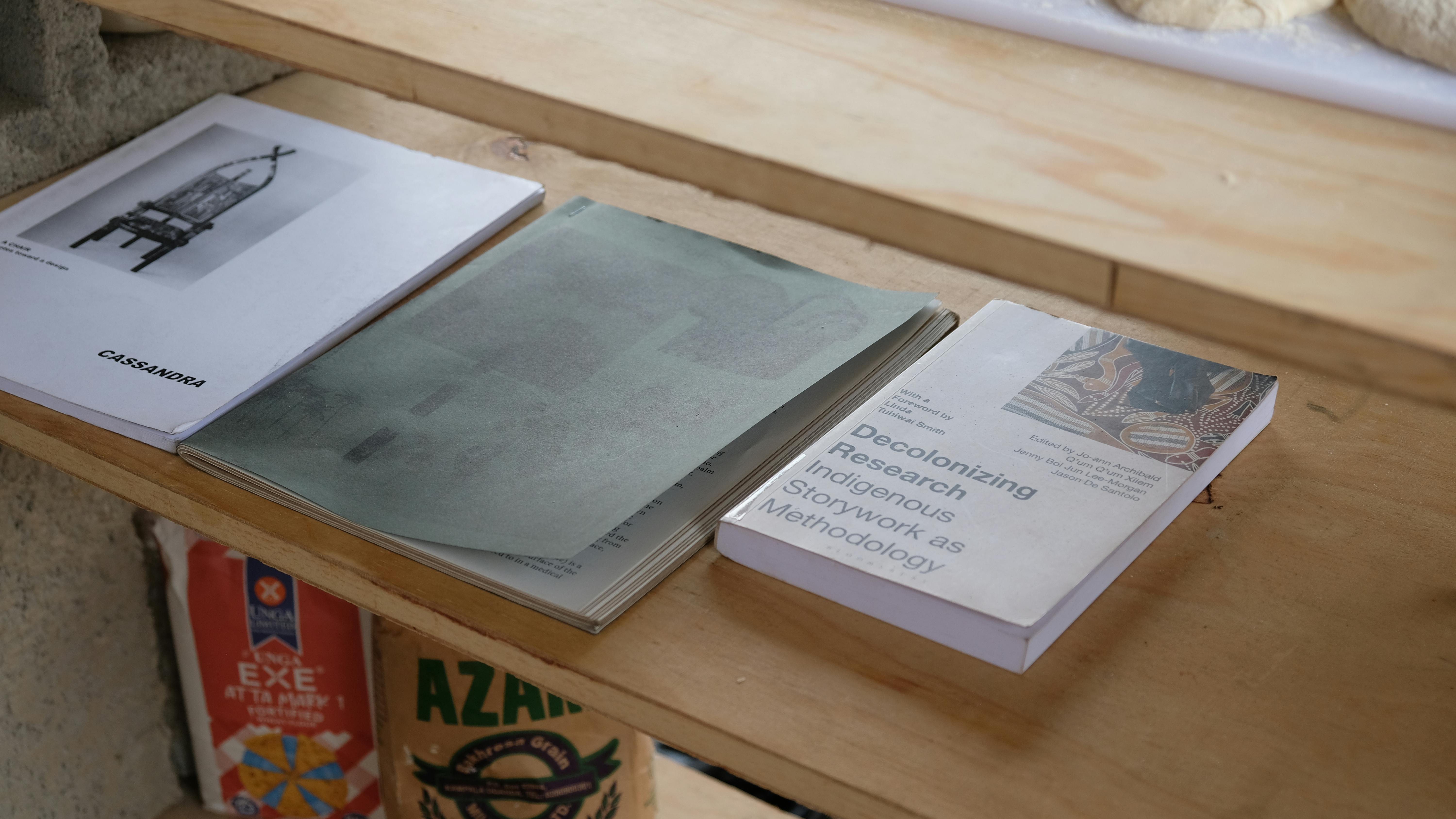
Catherine Lie, Sourdough Architecture (detail), 2024, KLA ART Festival, Ganzu Lumumba Ave. Photo: Mateo Chacón Pino
KLA ART festival (by 32° East, an art and residency center founded in 2011 in Kampala) and foodculture days Biennale share many approaches to field-research, slower cultural work and festival-making, as well as audience/community reach. Together with its director, Teesa Bahana, we realized that we shared a common aspiration: to better understand the most important conditions for enabling sustainable artistic processes rooted in the territory as well as a common longing for growing otherwise.
For its 5th edition, KLA ART festival focused on cultural heritage through the lens of care instructions for the living world. A reflection echoing with foodculture days’ vision on the multiple ways a festival can be(come) a platform to encourage different communities to explore multiple relationships with its surroundings. Together, we celebrate cooking and food as one of the few media that express complex ecologies and territories so well. By letting what is outside enter your body, each bite becomes a manifestation of the interdependence of matter and affects. Eating makes us vulnerable.
By envisioning a nonlocal approach, this cycle inquires how we might try to mitigate the colonial violence inherent in fixed identities and so called cultural differences by letting the mouth be “a portal, an entrance, a door”, as Lucy Cordes Engelman wrote it already in her contribution to an early cycle of Boca A Boca back in 2023. Once again, I am delighted to see how Boca A Boca has turned into a potent tool to get to know new people, e.g., 32° EAST and KLA ART festival teams, or deepen existing relations, like with Mateo Chacón Pino, and connect with our publics through an infinite composition of contributions where every entity is an expression of all others.
32° East/KLA ART: Taking inspiration from the traditional ritual of inter-generational fireside conversations present in many Ugandan cultures, 32° East’s Ekyooto sessions are aimed at facilitating open and non-hierarchical discussions that bring diverse generations together to participate in this longheld alternative knowledge system.
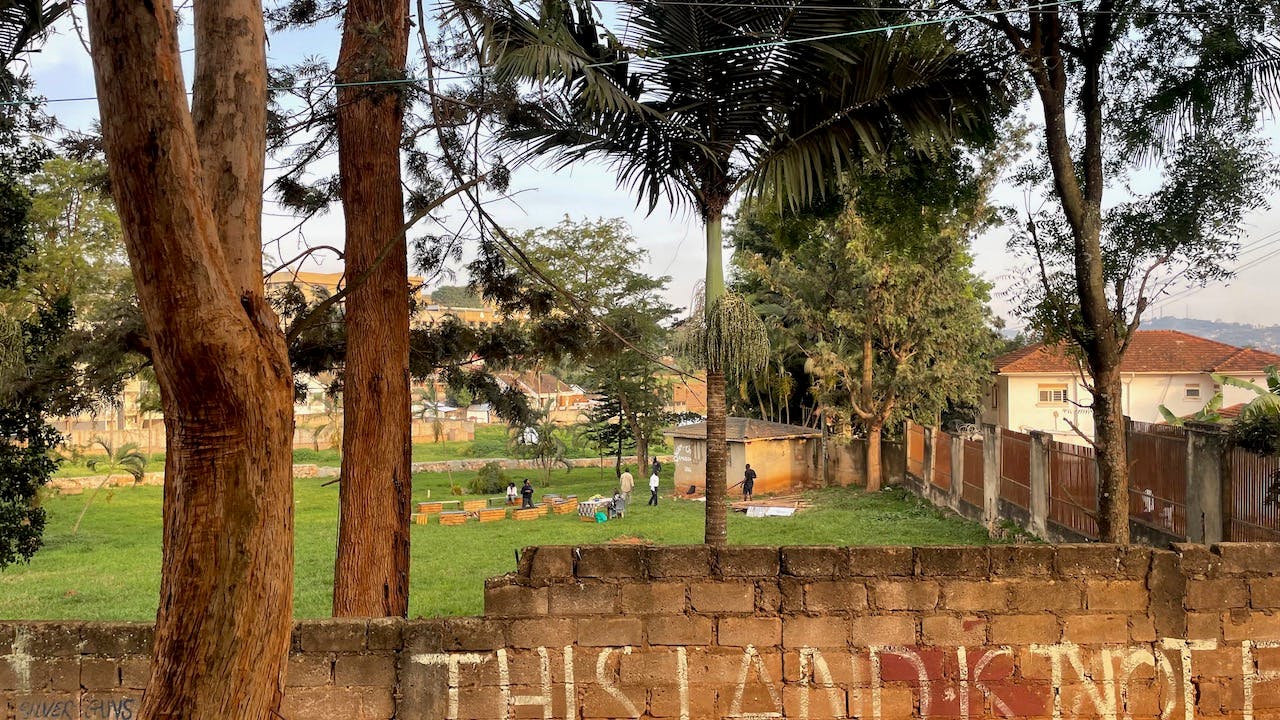
Preparations for Ekyooto, 2024, KLA ART Festival, field behind 32° East. Photo: Mateo Chacón Pino
Our inaugural Ekyooto took place during KLA ART ‘24, led by Kassel-based art historian and curator Mateo Chacón Pino. These conversations explored the intersection of art, ecology, care, and curatorship within both local and global contexts. The sessions which highlighted the need for alternative knowledge-sharing platforms attracted large audiences, and overwhelmingly positive feedback from attendees and 32° East members. Responding to this need, we made Ekyooto a regular part of our 2025 programming, hosting four sessions featuring diverse themes aimed at fostering knowledge exchange, skill sharing, and open discussions on contemporary art and its role in society.
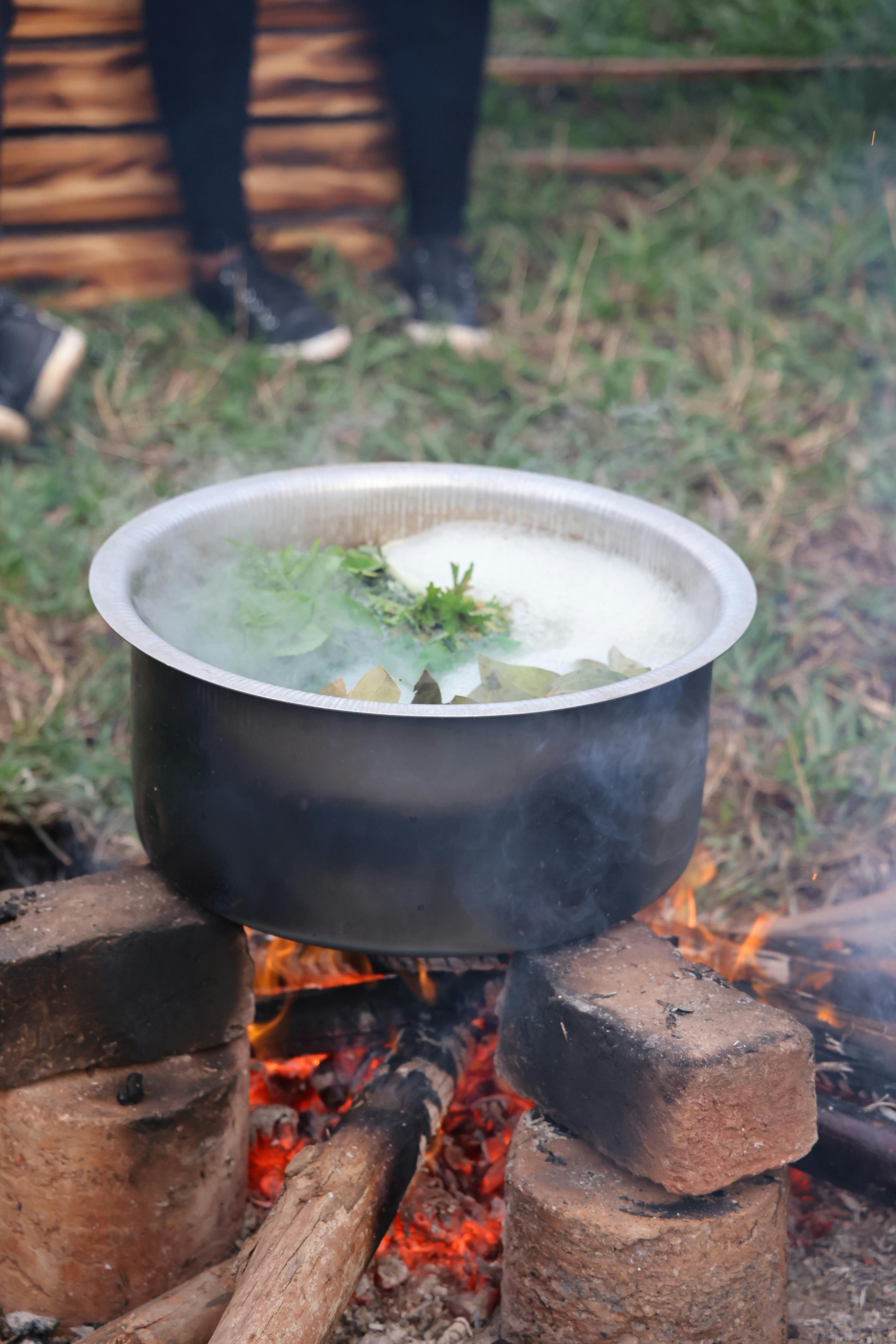
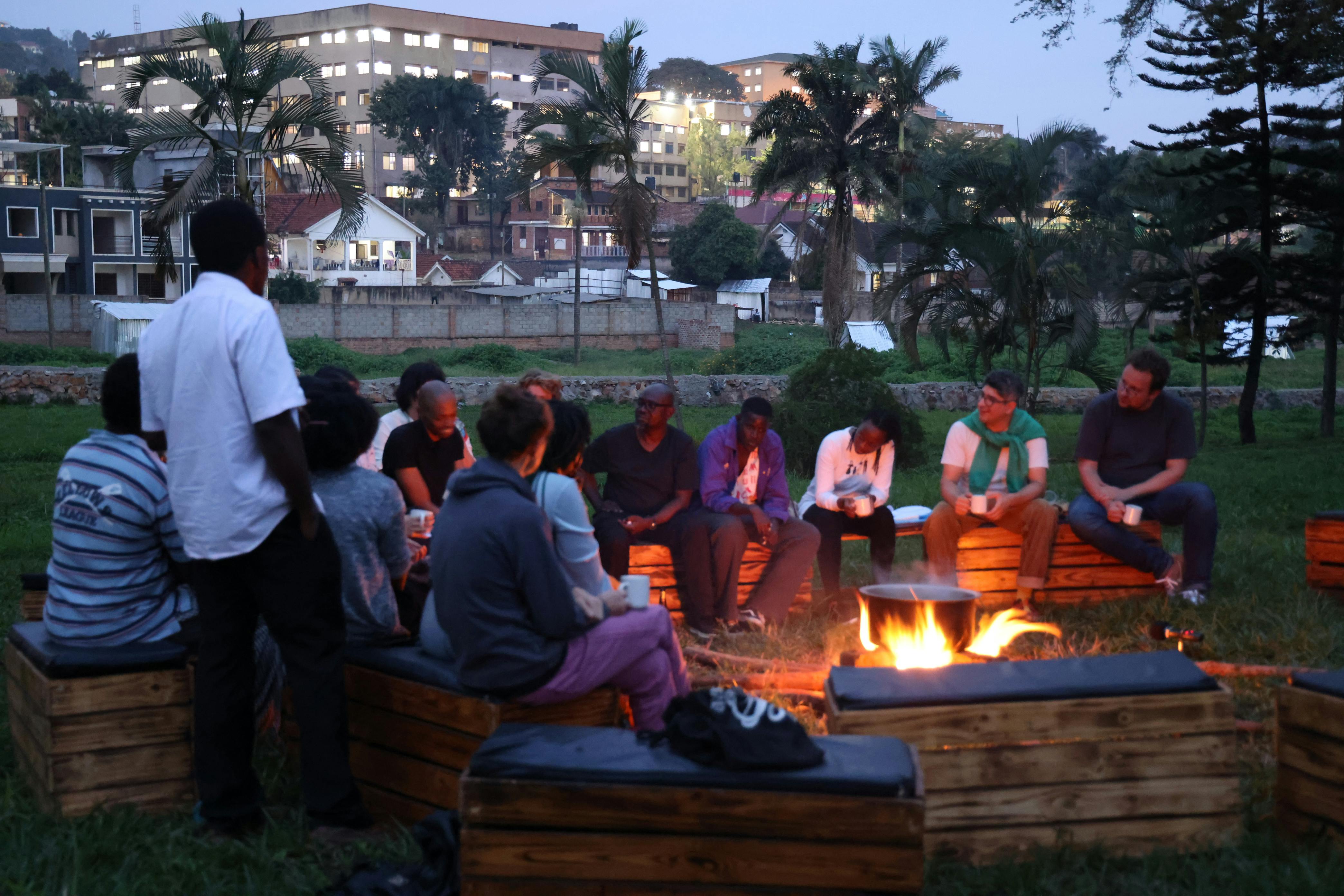
Ekyooto, 2024, KLA ART Festival, field behind 32° East. Photo: 32° East
Mateo Chacón Pino: When preparing for my research trip to Kampala, Uganda, I intended to look for similarities between the artists at KLA ART Festival and the contributors at foodculture days’ Biennale. I was playing the old European train of thought of placing similar things or thoughts together, separating what is different–a base for Linnean thought on species or Cartesian space. Little did I expect to encounter a reality that did not meet my imagination; an embodiment of difference without separability, a thought developed by Brazilian thinker Denise Ferreira da Silva, through food. Personally, I am used to visiting German and Swiss markets and seeing a large variety of apples, each with their distinct taste, e.g., sweet, aromatic, fresh, sour, size or color. Some apples offer themselves for distinct uses depending on their qualities; baking, juice, as snacks, or even as jams. We know the seasons and the regions–variety and diversity are not an expression of politics but rather of culture/agriculture. Yet its kitchentable cousin, the banana, experiences barely a fragment of the same recognition: the European palate only ever tastes the humble Cavendish banana, the dominant global variety as an outcome between ecological resistance through infections and capital-driven monoculture. Whereas East African culture is intimately familiar with a large variety of bananas. As Rebecca Khamala writes you might not find a banana in Uganda, but matooke, embidde, bogoya, and more, all with their own qualities and uses. And often I would hear from those I met which variety they prefer, with little difference to a conversation with Swiss friends about which apple variety they enjoy the most. Rather, the differences highlight the human inability to escape ecological dependencies, despite modernity, capitalism and, most importantly, the attempt to replace ecology through technological means.
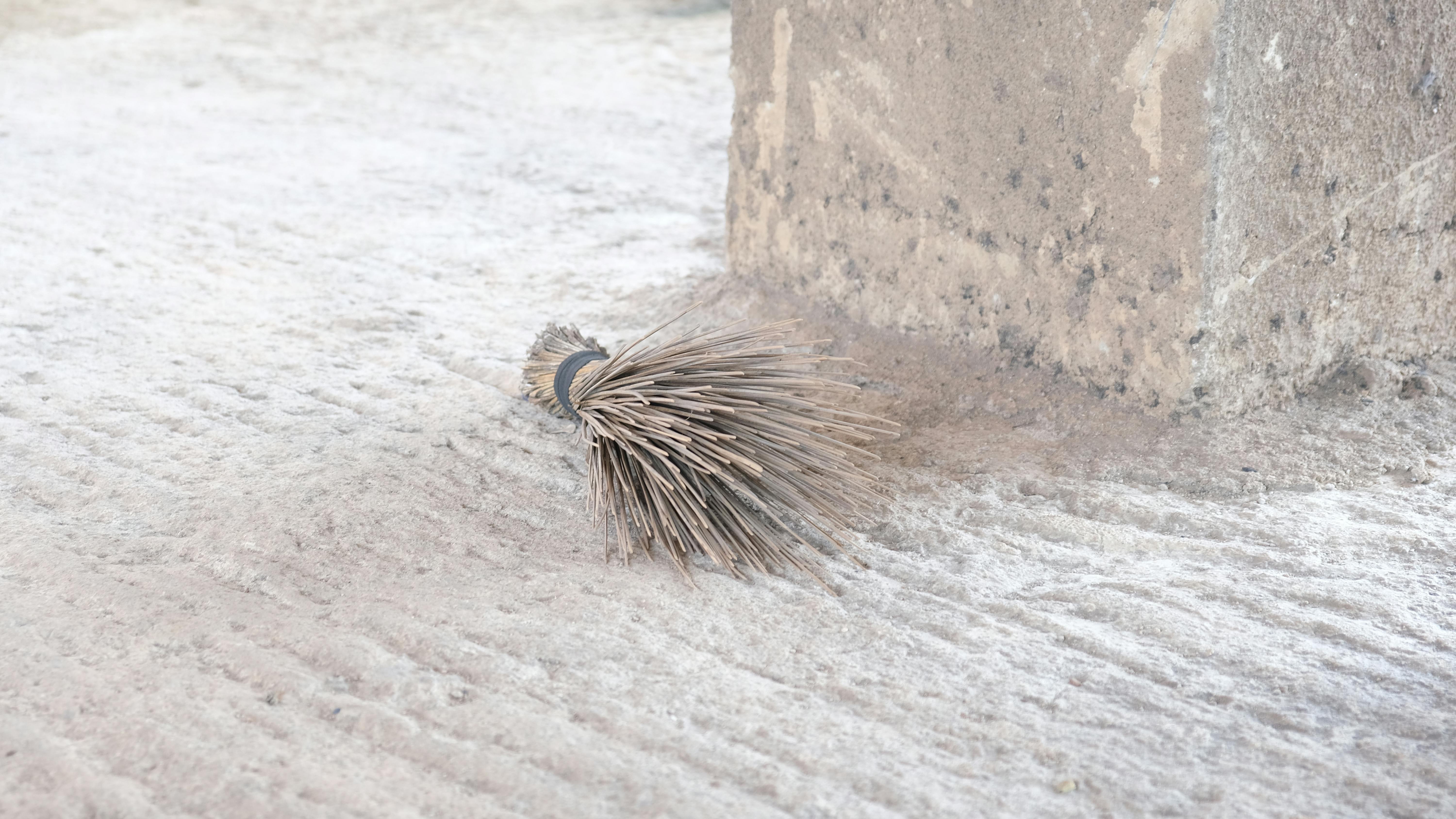
Brogan Mwesigwa, Kumanyagana (detail), 2024, KLA ART Festival, Ganzu Lumumba Ave. Photo: Mateo Chacón Pino
What these attempts do, in erasing differences that make us human and alienating us from each others humanity, is discussed through Jim Chuchu’s film contribution; an essay in giving an appropriate image to the human-made famine in Eastern Africa without falling into the pitfalls of reproducing poverty porn and exoticism. Similarly, Cassiane Pfund opens a poetic debate whether it is new images, new words that are needed or, in my reading, whether we should rather organize quickly. The conversation between Brogan Mwesigwa and Sandra Knecht bridges across multiple differences simultaneously: between Switzerland and Uganda–the Global North and the Global South–, between different generations of artists, and between gendered experiences of living and working within an ecology.
As much as we may share the fact that our lives are being shaped by climate catastrophe, the differences between us and others really only reflect on our own social, economic, political and ecological position. Whether someone suffers more or less does not change our own experience, yet it may help teach us which strategies may or may not be suitable for our individual situation.
This cycle’s title is a reference to Marxian metabolic rift, the disconnect between capitalist logic and natural resources which leads to ecological crises, as is the current climate catastrophe. No matter where we live and under which circumstances; no one will evade the consequences of extractive and monocultural agroeconomy, with the implication that human survival hinges on collaboration and action rather than on techno-solutions or human-centric politics. And this is perhaps what the arts of living on the rift may be: an attempt to acknowledge the distinct experience of being a political agent and subject to ecology, no matter where we live, and attempt to thrive in solidarity. These arts are realist in the sense that it deals with material reality instead of articulating speculation. It is not an exercise in awareness, after all, the torturer is most aware of the victim’s pain. Instead, it is a moral stance for the ecological dimension of any cultural practice, a learning through horizontal difference.
Mateo Chacón Pino (CO/CH) is a an art historian, curator and author. He has curated projects in art spaces, museums, galleries and farms in Switzerland, the Netherlands and Germany. He participated in The Curatorial and Artistic Thing at the sixtyeight art institute in Copenhagen and the Curatorial Program at De Appel, Amsterdam.
Mateo Chacón Pino currently lives in Kassel and works as a research assistant at the documenta Institute and at the University of Kassel in the Department of Art and Society, under Prof. Dr. Liliana Gómez.
In his dissertation "The Distinction of Art & Nature" he questions the epistemic time of art history in the light of the Anthropocene and problematizes the concept of contemporary art in the context of the exhibition. He completed his master's thesis in 2021 at the University of Zurich under Prof. Dr. Bärbel Küster on the role of state art funding for the understanding of art using the case study of the SüdKulturFonds in Switzerland. Further research interests include the social and epistemological conditions of art, the history of knowledge and philosophy of art history, as well as the problem area of aesthetics and sustainability. His work is motivated by the question of the role of art in the transformation to a sustainable society.
Together with Friederike Schäfer he is co-initiator of the research group "Exhibition Ecologies" and he is a member of the Creative Climate Leadership Switzerland network, which is led by Julie's Bicycle.
Teesa Bahana (UGA) is director of 32° East, a not-for-profit that promotes the creation and exploration of contemporary art in Uganda. As director she has supported the development and execution of projects such as KLA ART Labs for research and critical thinking through public practice, KLA ART, Kampala's public art festival, and residency exchanges with partners such as Arts Collaboratory, and Triangle Network.
She is also currently overseeing 32° East's capital project, raising funds to build the first purpose-built art centre in Kampala. With an academic background in sociology and anthropology, she is particularly interested in the intersection between art and Ugandan society, and how artistic environments should be protected and nurtured.
Before her directorship at 32° East, she was on the inaugural organisation committee for Nyege Nyege International Music Festival, and worked in communications and external relations for educational non-profits in Rwanda, Burundi and South Africa. She has spent the last year on study leave getting an MA in Anthropology of Global Futures and Sustainability at SOAS University of London.
Margaux Schwab (CH/MX) lives and works in Vevey after spending ten years in Berlin. She is a cultural producer, researcher, and curator working with the ecologies and politics of the living through food and its imaginaries.
In 2015, she founded foodculture days in Vevey, Switzerland, a platform for sharing knowledge and practices that hosts research, pedagogical, and editorial projects online. The outcome of these continuous exchanges is the foodculture days Biennial, which takes place every two years, free of charge, in the public spaces of Vevey. By valuing kitchens, markets, fields, orchards, and gardens as powerful spaces for the transmission of knowledge and know-how, Schwab is interested in the role of art(ists) in transforming food systems and in how they can connect us to our foodscapes in sensitive, sensorial, and engaged ways.
Since 2025, she is a guest lecturer at the University of Art and Design Basel, Switzerland, within the Co-Create program.
The Art of Living on the Rift
– Edito by Mateo Chacón Pino, Teesa Bahana, Margaux Schwab
– Edito by Mateo Chacón Pino, Teesa Bahana, Margaux Schwab
Margaux Schwab (foodculture days): Precisely three years ago, foodculture days embarked on a new online editorial chapter by launching Boca A Boca. The intention was to deepen our understanding around certain themes that we question and that question us in return. Each invited guest editor brings their situated perspective, network and sensibilities, allowing the transdisciplinary perspective so dear to us to emerge organically. The intention is to question the role of art and artists in supporting social and political movements of change on multiple scales and, simultaneously, providing them with a platform to expose our western gaze and its implications.
For this new editorial season, beyond enriching the public’s perspective on what African art is, what is primarily at stake is the meaning of its values and the potential of their expression in everyday life.
Catherine Lie, Sourdough Architecture (detail), 2024, KLA ART Festival, Ganzu Lumumba Ave. Photo: Mateo Chacón Pino
KLA ART festival (by 32° East, an art and residency center founded in 2011 in Kampala) and foodculture days Biennale share many approaches to field-research, slower cultural work and festival-making, as well as audience/community reach. Together with its director, Teesa Bahana, we realized that we shared a common aspiration: to better understand the most important conditions for enabling sustainable artistic processes rooted in the territory as well as a common longing for growing otherwise.
For its 5th edition, KLA ART festival focused on cultural heritage through the lens of care instructions for the living world. A reflection echoing with foodculture days’ vision on the multiple ways a festival can be(come) a platform to encourage different communities to explore multiple relationships with its surroundings. Together, we celebrate cooking and food as one of the few media that express complex ecologies and territories so well. By letting what is outside enter your body, each bite becomes a manifestation of the interdependence of matter and affects. Eating makes us vulnerable.
By envisioning a nonlocal approach, this cycle inquires how we might try to mitigate the colonial violence inherent in fixed identities and so called cultural differences by letting the mouth be “a portal, an entrance, a door”, as Lucy Cordes Engelman wrote it already in her contribution to an early cycle of Boca A Boca back in 2023. Once again, I am delighted to see how Boca A Boca has turned into a potent tool to get to know new people, e.g., 32° EAST and KLA ART festival teams, or deepen existing relations, like with Mateo Chacón Pino, and connect with our publics through an infinite composition of contributions where every entity is an expression of all others.
32° East/KLA ART: Taking inspiration from the traditional ritual of inter-generational fireside conversations present in many Ugandan cultures, 32° East’s Ekyooto sessions are aimed at facilitating open and non-hierarchical discussions that bring diverse generations together to participate in this longheld alternative knowledge system.
Preparations for Ekyooto, 2024, KLA ART Festival, field behind 32° East. Photo: Mateo Chacón Pino
Our inaugural Ekyooto took place during KLA ART ‘24, led by Kassel-based art historian and curator Mateo Chacón Pino. These conversations explored the intersection of art, ecology, care, and curatorship within both local and global contexts. The sessions which highlighted the need for alternative knowledge-sharing platforms attracted large audiences, and overwhelmingly positive feedback from attendees and 32° East members. Responding to this need, we made Ekyooto a regular part of our 2025 programming, hosting four sessions featuring diverse themes aimed at fostering knowledge exchange, skill sharing, and open discussions on contemporary art and its role in society.
Ekyooto, 2024, KLA ART Festival, field behind 32° East. Photo: 32° East
Mateo Chacón Pino: When preparing for my research trip to Kampala, Uganda, I intended to look for similarities between the artists at KLA ART Festival and the contributors at foodculture days’ Biennale. I was playing the old European train of thought of placing similar things or thoughts together, separating what is different–a base for Linnean thought on species or Cartesian space. Little did I expect to encounter a reality that did not meet my imagination; an embodiment of difference without separability, a thought developed by Brazilian thinker Denise Ferreira da Silva, through food. Personally, I am used to visiting German and Swiss markets and seeing a large variety of apples, each with their distinct taste, e.g., sweet, aromatic, fresh, sour, size or color. Some apples offer themselves for distinct uses depending on their qualities; baking, juice, as snacks, or even as jams. We know the seasons and the regions–variety and diversity are not an expression of politics but rather of culture/agriculture. Yet its kitchentable cousin, the banana, experiences barely a fragment of the same recognition: the European palate only ever tastes the humble Cavendish banana, the dominant global variety as an outcome between ecological resistance through infections and capital-driven monoculture. Whereas East African culture is intimately familiar with a large variety of bananas. As Rebecca Khamala writes you might not find a banana in Uganda, but matooke, embidde, bogoya, and more, all with their own qualities and uses. And often I would hear from those I met which variety they prefer, with little difference to a conversation with Swiss friends about which apple variety they enjoy the most. Rather, the differences highlight the human inability to escape ecological dependencies, despite modernity, capitalism and, most importantly, the attempt to replace ecology through technological means.
Brogan Mwesigwa, Kumanyagana (detail), 2024, KLA ART Festival, Ganzu Lumumba Ave. Photo: Mateo Chacón Pino
What these attempts do, in erasing differences that make us human and alienating us from each others humanity, is discussed through Jim Chuchu’s film contribution; an essay in giving an appropriate image to the human-made famine in Eastern Africa without falling into the pitfalls of reproducing poverty porn and exoticism. Similarly, Cassiane Pfund opens a poetic debate whether it is new images, new words that are needed or, in my reading, whether we should rather organize quickly. The conversation between Brogan Mwesigwa and Sandra Knecht bridges across multiple differences simultaneously: between Switzerland and Uganda–the Global North and the Global South–, between different generations of artists, and between gendered experiences of living and working within an ecology.
As much as we may share the fact that our lives are being shaped by climate catastrophe, the differences between us and others really only reflect on our own social, economic, political and ecological position. Whether someone suffers more or less does not change our own experience, yet it may help teach us which strategies may or may not be suitable for our individual situation.
This cycle’s title is a reference to Marxian metabolic rift, the disconnect between capitalist logic and natural resources which leads to ecological crises, as is the current climate catastrophe. No matter where we live and under which circumstances; no one will evade the consequences of extractive and monocultural agroeconomy, with the implication that human survival hinges on collaboration and action rather than on techno-solutions or human-centric politics. And this is perhaps what the arts of living on the rift may be: an attempt to acknowledge the distinct experience of being a political agent and subject to ecology, no matter where we live, and attempt to thrive in solidarity. These arts are realist in the sense that it deals with material reality instead of articulating speculation. It is not an exercise in awareness, after all, the torturer is most aware of the victim’s pain. Instead, it is a moral stance for the ecological dimension of any cultural practice, a learning through horizontal difference.
Mateo Chacón Pino (CO/CH) is a an art historian, curator and author. He has curated projects in art spaces, museums, galleries and farms in Switzerland, the Netherlands and Germany. He participated in The Curatorial and Artistic Thing at the sixtyeight art institute in Copenhagen and the Curatorial Program at De Appel, Amsterdam.
Mateo Chacón Pino currently lives in Kassel and works as a research assistant at the documenta Institute and at the University of Kassel in the Department of Art and Society, under Prof. Dr. Liliana Gómez.
In his dissertation "The Distinction of Art & Nature" he questions the epistemic time of art history in the light of the Anthropocene and problematizes the concept of contemporary art in the context of the exhibition. He completed his master's thesis in 2021 at the University of Zurich under Prof. Dr. Bärbel Küster on the role of state art funding for the understanding of art using the case study of the SüdKulturFonds in Switzerland. Further research interests include the social and epistemological conditions of art, the history of knowledge and philosophy of art history, as well as the problem area of aesthetics and sustainability. His work is motivated by the question of the role of art in the transformation to a sustainable society.
Together with Friederike Schäfer he is co-initiator of the research group "Exhibition Ecologies" and he is a member of the Creative Climate Leadership Switzerland network, which is led by Julie's Bicycle.
Teesa Bahana (UGA) is director of 32° East, a not-for-profit that promotes the creation and exploration of contemporary art in Uganda. As director she has supported the development and execution of projects such as KLA ART Labs for research and critical thinking through public practice, KLA ART, Kampala's public art festival, and residency exchanges with partners such as Arts Collaboratory, and Triangle Network.
She is also currently overseeing 32° East's capital project, raising funds to build the first purpose-built art centre in Kampala. With an academic background in sociology and anthropology, she is particularly interested in the intersection between art and Ugandan society, and how artistic environments should be protected and nurtured.
Before her directorship at 32° East, she was on the inaugural organisation committee for Nyege Nyege International Music Festival, and worked in communications and external relations for educational non-profits in Rwanda, Burundi and South Africa. She has spent the last year on study leave getting an MA in Anthropology of Global Futures and Sustainability at SOAS University of London.
Margaux Schwab (CH/MX) lives and works in Vevey after spending ten years in Berlin. She is a cultural producer, researcher, and curator working with the ecologies and politics of the living through food and its imaginaries.
In 2015, she founded foodculture days in Vevey, Switzerland, a platform for sharing knowledge and practices that hosts research, pedagogical, and editorial projects online. The outcome of these continuous exchanges is the foodculture days Biennial, which takes place every two years, free of charge, in the public spaces of Vevey. By valuing kitchens, markets, fields, orchards, and gardens as powerful spaces for the transmission of knowledge and know-how, Schwab is interested in the role of art(ists) in transforming food systems and in how they can connect us to our foodscapes in sensitive, sensorial, and engaged ways.
Since 2025, she is a guest lecturer at the University of Art and Design Basel, Switzerland, within the Co-Create program.

WHICH RITUALS FOR THE FUTURE, WHICH RITUALS FOR NOW ? on commemoration and uncertainty – by Cassiane Pfund
to begin with
i wished to imagine rituals for the future
to fill a blank
to defy despair
to make celebrations and find communities
to embrace trust and name hope
an unpleasant truth is that i don’t know anymore
i don’t know where to start
nor how to (dis)continue
I don’t know
and not knowing now feels harder than ever...
but have i ever known anyway?
and you, have you ever known anyway?
what i observe from here, in switzerland, is that a certain
amount of recent art works and exhibitions, texts, research
programs and open calls is directed towards detangling,
unfolding, expanding, hacking, recreating, building, undoing,
reshaping, reinventing and designing future(s)...
but what would be
what would it sound or taste like
a future to yearn for?
00. what tongue(s)?
storytelling and underground stories have probably been an act
of resisting oppressions and uncertainties, an act of imagining
alternative solutions and gathering since human beings can
speak.
when mateo chacón pino contacted me to write a text, my
mouth felt dry as if my tongue was gone, and words were barely
present. i asked myself:
do we need more and more and more and more words?
in an attempt to grasp something from a landscape my fingers
don’t recognize most textures of
from futures that feel blurry
–unimaginable and distant, yet so close–
i sit by the river
searching sediments and pebbles for another tongue
a sensory one for
what is
what resists
what evolves
what survives
a tongue that dances
a tongue that doubts and trusts
a tongue that listens
a tongue for now
pause
gravity is what has the capacity to make bodies sink, just as
much as it allows them to be held, for as long as a ground
remains.
–in any case
we will learn to breathe
we will learn to swim
they say
who is we?
who is they?
pause
for now
close your eyes
your own flesh
merged with water
feels like the translucent one of a jellyfish
marine mammals¹
appear
marine heatwaves the moment after
and the same melody
again and again
reminding you of a sacred foundation
creatures that came before
all those who will hopefully come after
01. future(s)
if tomorrow can be understood as much as
the day after today
a period of time close to now
a few decades centuries ahead
or even when the sun explodes
–and yet probably some time before–
what future(s) are we talking about?
what is meant to be understood when the word ‘future’ is used?
is it really and only a matter of time?
and what would make future(s) possible?
I read somewhere that quantum physics and ongoing
research keep showing us how little our understanding of the
future is. fascinating enough, it feels like time perceived as
linear
tends to mimic a common representation of human life; a
chronological timeline starting with birth and ending with
death.
but is it really?
in the piece niagara 3000, the artist pamina de coulon says
le futur vient de l’amont²
future comes from upstream
pause
for now
I close my eyes
the same melody unfolds
creatures who came before
those who will come after
02. where to start?
a place to start could be causality, whilst keeping in mind the
richness and uncertainty of multifactoriality, that is,
when different factors are involved and it becomes complex to
tell which causes what and how. ie, it can be very difficult to
identify what cause(s) migraines because different elements
are, most of the time, commonly identified to
be(come) potential triggers, such as food, stress, sensory
stimulation, pollution, abuse, etc., and in many cases, they tend
to be combined. this is when a holistic vision tends to
highlight the notions of system and ecosystem.
if part of what a future to yearn for may be like partially depends
on how we, as societies, decide to take action, on what we, as
societies, decide to embody and nurture,
how to prepare the bed for such futures now?
how can we find ways through by embracing the discomfort of
uncertainty?
how can we allow ourselves to grieve, not as a sign of despair,
rather as a way of integrating the fragility of life and
reactivating our love for the earth we live on?
and again, who is we?
in her last book vivre libre³, amandine gay expresses with clarity
how the desire to transform society must be thought of as a
collective effort that starts with an intimate movement. she
writes:
we aspired to transform society without being aware
that it started with our own liberation from norms that
are productivism, competition, need for attention or
even precarity.⁴
her vision offers the chance to both come back to one’s own
situated body through decentering oneself from normativity with
a certain lucidity regarding how falling into the trap of white
supremacy–by both internalizing and reproducing its tools–needs to be talked about, not with the intention of blaming
individuals, but as a reminder of where such transformation
starts with.
03. hierarchised knowledge⁵, and bodies
in 2016, i remember an introductory class on
epistemology⁶ and the exam i wonderfully failed at. i found
myself having difficulties at engaging with the subject as the
approach was lacking something i needed, something crucial i
struggled to identify at the time. i then started to look around to
soon realize that, at the time, the department–in which i tried
to fit in not without anxiety–had a tendency to deeming itself
as a temple of knowledge whilst actually failing at
reporting on diversity of knowledge, as well as broadening
perspectives, representations and points of view.
a year later, i meet marie lefebvre–a researcher based in
montreal who i am happy to call friend– she introduced
me to both a philosophical and social practice which aims to decenter a
commonly shared view on (brain perceived)
intelligence and knowledge. such practice underlines
the necessity of both listening to–in a broad sense–and
considering every person as a potential epistemic agent in the
sense that everyone can be learned from. this vision makes
space for both a redistribution of power, and
questioning stereotypes as well as other hindrances to
legitimacy.
here are two definitions of knowledge from the merriam
webster dictionary⁷:
the circumstance or condition of apprehending truth,
fact, or reality immediately with the mind or senses.
the sum of what is known: the body of truth,
information, and principles acquired by humankind.⁷
i wonder how could coexist different modes of knowledge
acquisition without hierarchies, and beyond these very modes,
how to collectively aim towards what marie explained to me.
and what about access to knowledge?
could it be that the absence of situated bodies within such an
analytic field was a central factor of the
disconnection i experienced?
and if yes, how to value body intelligence and operate from a
common ground: we experience and feel–in our own sensitive
ways–, therefore we belong?
cultivating long term visions contributes to giving a more
consistent direction to actions and helps find meaning.
however, whilst imagining futures is crucial, it cannot be
sufficient as the act of imagining itself is intertwined with the
now⁸, and i will even say, with situated nows.
a future to yearn for won’t magically happen
without taking accountability
without dismantling any kind of supremacy
without feeling
and coming back to (our) bodies with radical honesty
04. epistemic injustice
the notion of epistemic injustice invented by miranda fricker⁹,
invites to address the question of knowledge as power. indeed,
who is perceived as contributing to the creation of knowledge
and who is not? which voices are heared, which are ignored
and which are silenced?
each time a voice is ignored and silenced,
what will be remembered from the past shrinks already, and
with it, an understanding of the present. to feel a sense of the
present(s) that is or are being lived, and project any type of
possible future, there is an essential urge to work towards
resisting separation.
like many authors and artists, wendy
delorme¹⁰ reaffirms in an interview with constant spina for censored magazine¹¹,
reaffirms separation:
nous sommes un tout : humains, arbres, montagnes,
cours d’eau et animaux. tout le monde du vivant est
interconnecté, interdépendant. c’est très simple, c’est
une évidence, et pourtant, de par nos modes de vie
d’aujourd’hui, on ne cesse de l’oublier.¹²
we are one: humans, trees, mountains, rivers
and animals. all living things are
interconnected and interdependent. it's very
simple, it's obvious, and yet, because of our
lifestyles today, we keep forgetting it.
an article on epistemic (knowledge) injustice within the field of
psychiatry research provides an understanding of the concept:
epistemic injustice is a form of systemic discrimination
relating to the creation of knowledge. it occurs when
people from marginalized groups are denied capacity
as ‘epistemic agents’ (i.e., as creators of knowledge),
and are diminished or excluded from the process of
creating meaning. such exclusion creates conditions
in which the lived experiences of marginalized people
are primarily interpreted by people who do not share
their social position.[...] as an approach, lived
experience work recognized that marginalized people
are rarely afforded the opportunity to theorize their own
experiences and generate solutions.¹³
the authors of the article mention and warn against the risk of
epistemic exploitation, which appears to be another form of
extractivism when these lived experiences are absorbed within
existing dominant structures where they become tokens¹⁴. in
reality, the question of the lived experiences, when facing
extractivism mecanisms, is deeply intertwined with colonial
thinking:
[the question of the lived experiences] has
encountered an inherent problem though in seeking
to challenge western traditional valuing of positivist
approaches to research, with their emphasis on
‘objectivity’, ‘neutrality’ and ‘distance’. these are still strong
in the psych system and have distorted our
understandings of what counts as knowledge. so, if you
have direct experience of a problem, like poverty,
distress or indeed colonisation, where such research
values apply, you can expect to be granted less credibility
and your knowledge seen as less reliable
because you are ‘too close to the problem’ – it affects you
and you cannot claim to be neutral, objective and distant
from it. thus, you can expect to be seen as an inferior
knower and your knowledge less reliable. this
means effectively that if you have experience of
discrimination and oppression you can expect
routinely to face further discrimination and be further
marginalised and devalued.¹⁵
05. sensitive knowledge
the centre d’archivage des savoirs sensibles, an art work by the
company création dans la chambre¹⁶ which connects popular
archives, knowledge(s) and memory, moved me deeply. here is
the description i found on their website:
cette installation monumentale d’archivage populaire
offerte aux citoyen-n-e-x-s deviendra en quelque sorte
un lieu d’échange poétique d’apprentissage, sans
discrimination quant à l’autorité d’un savoir sur un
autre; nous voulons proposer un espace déhiérarchisé
où tou-x-t-e-s peuvent laisser quelque chose au monde
dans une optique de transmission. que ce soit par un
enseignement artisanal unique, une chanson cachée
dans un vieux souvenir, l’histoire d’un-e-x aïeul-e-x
transmise par l’oralité, une recette familiale ancestrale
ou l’étude toute personnelle d’un comportement
animalier, chacun pourra agir sur la mémoire collective
en perpétuelle construction.
the centre d’archivage du savoir sensible highlights an
important dimension: knowledge cannot be reduced to one
single type or category. vigilance and humility are required to
avoid establishing competition or hierarchy
between one another, and be aware of where they come from
and/or were taken from.
06. lineage & commemoration
whilst i wonder what the tools to help us embody such
a change of perspective could be, commemorating visits me.
what will remain if there is no one to remember?
some weeks ago, at a round table organized by the association
afrikalab¹⁷, co-moderated by ivan larson ndenguewith germaine
acogny and shelly ohene-nyako, the notion of lineage appeared
as an essential way of both honouring and remembering who
we learned and still learn from.
commemoration is an act of togetherness
one of collective resistance
which prevents memory from being erased
a ritual to keep traces
bring them back to life for a moment
before transmitting them further
i like to see it as a cycle of honoring what came before
receiving
listening
learning
questioning
refusing
nurturing
transforming
then confiding
a cycle having its own rythms which requires
slowness and presence
awareness and proximity
being aware of what made life possible
invites us to proceed to an ongoing choreography
a movement which defies linearity
bringing ancient memories
asking to adjust
to learn
to choose what we keep honoring
what we’ll have transformed
–or tried to–
to be aware of the traces we may leave
and repeat
from where i write
and for now
this ground remains.
cassiane c. pfund (BR/CH)’s practice situates itself in the interstices. reassembling writing, art, research and poetry, it considers words as a starting point from which to explore other media such as performance, installation and publishing as sculptures and collective experiences of transmission. its wish is to open up slow spaces where people can meet, exchange stories, feel their emotions and raise questions.
cassiane c. pfund (*1993) lives in Geneva. first trained as a philosopher (ma degree, unige & uqam, 2018), they then desired to feel and deepen concepts from a body and interdisciplinary artistic perspective. (ma cap, hbk, 2020)
website: cassianepfund.ch
[1] the expression ‘marine mammals’ is borrowed from author and
researcher alexis pauline gumps and her text undrowned: black feminist
lessons learned from marine mammals, ak press (2020).
[2] niagara 3000 is a performance by artist and author pamina de
coulon from the fire of emotions saga.
[3] gay amandine, vivre libre, exister au cœur de la suprématie blanche,
cahiers libres, la découverte, october 2025.
[4] ibid., p.114.
[5] in english, the term ‘knowledge’ refers indiscriminately to both
learning and understanding, which is not the case in french.
[6] the introductory course in epistemology is a compulsory module in
philosophy studies at the university of geneva.
[7] this definition is taken from the meriam webster dictionary:
https://www.merriam-webster.com/dictionary/knowledge
[8] during her talk at the w.o.r.d. school, author and activist sarah
durieux introduced the importance of anchoring discourse in the
present when it comes to storytelling and political discourse.
[9] history records that the concept of epidemic injustice was first
formulated by philosopher miranda fricker.
[10] wendy delorme is a french author, performer, teacher, researcher
and feminist activist.
[11] censored magazine is an editorial platform where feminist ideas,
emerging creativity and transmission intersect, beyond the dominant
narratives.
[12] Ibid., constant spina (2025), interview with wendy delorme: le
roman comme un cycle de l’eau, [online].
[13] celestin okoroji, tanya mackay, dan robotham, dation beckford,
Vanessa Pinfold (2023), Epistemic injustice and mental health research:
a pragmatic approach to working with lived experience expertise,
frontiers in psychiatry, vol. 14, [online],
https://www.frontiersin.org/journals/psychiatry/articles/10.3389/fpsyt.
2023.1114725/full
[14] tokenism refers to the practice whereby a group or organisation
includes people from minority backgrounds without making any real
structural changes or providing them with long-term support, as it is in
fact a case of superficial inclusion.
[15] peter beresford, diana rose (2023), decolonising global mental
health: the role of mad studies, cambridge prisms: global mental health,
cambridge university press, [online],
https://www.cambridge.org/core/journals/global-mental-health/article/
decolonising-global-mental-health-the-role-of-mad-studies/
EEF259FE948CAA0E25E57036D547EBFC.
[16] the centre d'archivage des savoirs sensibles is a project created by
the quebec-based company création dans la chambre:
https://www.creationdanslachambre.com/
[17] afrikalab is a venue dedicated to culture, ‘living together’,
transmission and training in the city of geneva.
WHICH RITUALS FOR THE FUTURE, WHICH RITUALS FOR NOW ? on commemoration and uncertainty – by Cassiane Pfund
to begin with
i wished to imagine rituals for the future
to fill a blank
to defy despair
to make celebrations and find communities
to embrace trust and name hope
an unpleasant truth is that i don’t know anymore
i don’t know where to start
nor how to (dis)continue
I don’t know
and not knowing now feels harder than ever...
but have i ever known anyway?
and you, have you ever known anyway?
what i observe from here, in switzerland, is that a certain
amount of recent art works and exhibitions, texts, research
programs and open calls is directed towards detangling,
unfolding, expanding, hacking, recreating, building, undoing,
reshaping, reinventing and designing future(s)...
but what would be
what would it sound or taste like
a future to yearn for?
00. what tongue(s)?
storytelling and underground stories have probably been an act
of resisting oppressions and uncertainties, an act of imagining
alternative solutions and gathering since human beings can
speak.
when mateo chacón pino contacted me to write a text, my
mouth felt dry as if my tongue was gone, and words were barely
present. i asked myself:
do we need more and more and more and more words?
in an attempt to grasp something from a landscape my fingers
don’t recognize most textures of
from futures that feel blurry
–unimaginable and distant, yet so close–
i sit by the river
searching sediments and pebbles for another tongue
a sensory one for
what is
what resists
what evolves
what survives
a tongue that dances
a tongue that doubts and trusts
a tongue that listens
a tongue for now
pause
gravity is what has the capacity to make bodies sink, just as
much as it allows them to be held, for as long as a ground
remains.
–in any case
we will learn to breathe
we will learn to swim
they say
who is we?
who is they?
pause
for now
close your eyes
your own flesh
merged with water
feels like the translucent one of a jellyfish
marine mammals¹
appear
marine heatwaves the moment after
and the same melody
again and again
reminding you of a sacred foundation
creatures that came before
all those who will hopefully come after
01. future(s)
if tomorrow can be understood as much as
the day after today
a period of time close to now
a few decades centuries ahead
or even when the sun explodes
–and yet probably some time before–
what future(s) are we talking about?
what is meant to be understood when the word ‘future’ is used?
is it really and only a matter of time?
and what would make future(s) possible?
I read somewhere that quantum physics and ongoing
research keep showing us how little our understanding of the
future is. fascinating enough, it feels like time perceived as
linear
tends to mimic a common representation of human life; a
chronological timeline starting with birth and ending with
death.
but is it really?
in the piece niagara 3000, the artist pamina de coulon says
le futur vient de l’amont²
future comes from upstream
pause
for now
I close my eyes
the same melody unfolds
creatures who came before
those who will come after
02. where to start?
a place to start could be causality, whilst keeping in mind the
richness and uncertainty of multifactoriality, that is,
when different factors are involved and it becomes complex to
tell which causes what and how. ie, it can be very difficult to
identify what cause(s) migraines because different elements
are, most of the time, commonly identified to
be(come) potential triggers, such as food, stress, sensory
stimulation, pollution, abuse, etc., and in many cases, they tend
to be combined. this is when a holistic vision tends to
highlight the notions of system and ecosystem.
if part of what a future to yearn for may be like partially depends
on how we, as societies, decide to take action, on what we, as
societies, decide to embody and nurture,
how to prepare the bed for such futures now?
how can we find ways through by embracing the discomfort of
uncertainty?
how can we allow ourselves to grieve, not as a sign of despair,
rather as a way of integrating the fragility of life and
reactivating our love for the earth we live on?
and again, who is we?
in her last book vivre libre³, amandine gay expresses with clarity
how the desire to transform society must be thought of as a
collective effort that starts with an intimate movement. she
writes:
we aspired to transform society without being aware
that it started with our own liberation from norms that
are productivism, competition, need for attention or
even precarity.⁴
her vision offers the chance to both come back to one’s own
situated body through decentering oneself from normativity with
a certain lucidity regarding how falling into the trap of white
supremacy–by both internalizing and reproducing its tools–needs to be talked about, not with the intention of blaming
individuals, but as a reminder of where such transformation
starts with.
03. hierarchised knowledge⁵, and bodies
in 2016, i remember an introductory class on
epistemology⁶ and the exam i wonderfully failed at. i found
myself having difficulties at engaging with the subject as the
approach was lacking something i needed, something crucial i
struggled to identify at the time. i then started to look around to
soon realize that, at the time, the department–in which i tried
to fit in not without anxiety–had a tendency to deeming itself
as a temple of knowledge whilst actually failing at
reporting on diversity of knowledge, as well as broadening
perspectives, representations and points of view.
a year later, i meet marie lefebvre–a researcher based in
montreal who i am happy to call friend– she introduced
me to both a philosophical and social practice which aims to decenter a
commonly shared view on (brain perceived)
intelligence and knowledge. such practice underlines
the necessity of both listening to–in a broad sense–and
considering every person as a potential epistemic agent in the
sense that everyone can be learned from. this vision makes
space for both a redistribution of power, and
questioning stereotypes as well as other hindrances to
legitimacy.
here are two definitions of knowledge from the merriam
webster dictionary⁷:
the circumstance or condition of apprehending truth,
fact, or reality immediately with the mind or senses.
the sum of what is known: the body of truth,
information, and principles acquired by humankind.⁷
i wonder how could coexist different modes of knowledge
acquisition without hierarchies, and beyond these very modes,
how to collectively aim towards what marie explained to me.
and what about access to knowledge?
could it be that the absence of situated bodies within such an
analytic field was a central factor of the
disconnection i experienced?
and if yes, how to value body intelligence and operate from a
common ground: we experience and feel–in our own sensitive
ways–, therefore we belong?
cultivating long term visions contributes to giving a more
consistent direction to actions and helps find meaning.
however, whilst imagining futures is crucial, it cannot be
sufficient as the act of imagining itself is intertwined with the
now⁸, and i will even say, with situated nows.
a future to yearn for won’t magically happen
without taking accountability
without dismantling any kind of supremacy
without feeling
and coming back to (our) bodies with radical honesty
04. epistemic injustice
the notion of epistemic injustice invented by miranda fricker⁹,
invites to address the question of knowledge as power. indeed,
who is perceived as contributing to the creation of knowledge
and who is not? which voices are heared, which are ignored
and which are silenced?
each time a voice is ignored and silenced,
what will be remembered from the past shrinks already, and
with it, an understanding of the present. to feel a sense of the
present(s) that is or are being lived, and project any type of
possible future, there is an essential urge to work towards
resisting separation.
like many authors and artists, wendy
delorme¹⁰ reaffirms in an interview with constant spina for censored magazine¹¹,
reaffirms separation:
nous sommes un tout : humains, arbres, montagnes,
cours d’eau et animaux. tout le monde du vivant est
interconnecté, interdépendant. c’est très simple, c’est
une évidence, et pourtant, de par nos modes de vie
d’aujourd’hui, on ne cesse de l’oublier.¹²
we are one: humans, trees, mountains, rivers
and animals. all living things are
interconnected and interdependent. it's very
simple, it's obvious, and yet, because of our
lifestyles today, we keep forgetting it.
an article on epistemic (knowledge) injustice within the field of
psychiatry research provides an understanding of the concept:
epistemic injustice is a form of systemic discrimination
relating to the creation of knowledge. it occurs when
people from marginalized groups are denied capacity
as ‘epistemic agents’ (i.e., as creators of knowledge),
and are diminished or excluded from the process of
creating meaning. such exclusion creates conditions
in which the lived experiences of marginalized people
are primarily interpreted by people who do not share
their social position.[...] as an approach, lived
experience work recognized that marginalized people
are rarely afforded the opportunity to theorize their own
experiences and generate solutions.¹³
the authors of the article mention and warn against the risk of
epistemic exploitation, which appears to be another form of
extractivism when these lived experiences are absorbed within
existing dominant structures where they become tokens¹⁴. in
reality, the question of the lived experiences, when facing
extractivism mecanisms, is deeply intertwined with colonial
thinking:
[the question of the lived experiences] has
encountered an inherent problem though in seeking
to challenge western traditional valuing of positivist
approaches to research, with their emphasis on
‘objectivity’, ‘neutrality’ and ‘distance’. these are still strong
in the psych system and have distorted our
understandings of what counts as knowledge. so, if you
have direct experience of a problem, like poverty,
distress or indeed colonisation, where such research
values apply, you can expect to be granted less credibility
and your knowledge seen as less reliable
because you are ‘too close to the problem’ – it affects you
and you cannot claim to be neutral, objective and distant
from it. thus, you can expect to be seen as an inferior
knower and your knowledge less reliable. this
means effectively that if you have experience of
discrimination and oppression you can expect
routinely to face further discrimination and be further
marginalised and devalued.¹⁵
05. sensitive knowledge
the centre d’archivage des savoirs sensibles, an art work by the
company création dans la chambre¹⁶ which connects popular
archives, knowledge(s) and memory, moved me deeply. here is
the description i found on their website:
cette installation monumentale d’archivage populaire
offerte aux citoyen-n-e-x-s deviendra en quelque sorte
un lieu d’échange poétique d’apprentissage, sans
discrimination quant à l’autorité d’un savoir sur un
autre; nous voulons proposer un espace déhiérarchisé
où tou-x-t-e-s peuvent laisser quelque chose au monde
dans une optique de transmission. que ce soit par un
enseignement artisanal unique, une chanson cachée
dans un vieux souvenir, l’histoire d’un-e-x aïeul-e-x
transmise par l’oralité, une recette familiale ancestrale
ou l’étude toute personnelle d’un comportement
animalier, chacun pourra agir sur la mémoire collective
en perpétuelle construction.
the centre d’archivage du savoir sensible highlights an
important dimension: knowledge cannot be reduced to one
single type or category. vigilance and humility are required to
avoid establishing competition or hierarchy
between one another, and be aware of where they come from
and/or were taken from.
06. lineage & commemoration
whilst i wonder what the tools to help us embody such
a change of perspective could be, commemorating visits me.
what will remain if there is no one to remember?
some weeks ago, at a round table organized by the association
afrikalab¹⁷, co-moderated by ivan larson ndenguewith germaine
acogny and shelly ohene-nyako, the notion of lineage appeared
as an essential way of both honouring and remembering who
we learned and still learn from.
commemoration is an act of togetherness
one of collective resistance
which prevents memory from being erased
a ritual to keep traces
bring them back to life for a moment
before transmitting them further
i like to see it as a cycle of honoring what came before
receiving
listening
learning
questioning
refusing
nurturing
transforming
then confiding
a cycle having its own rythms which requires
slowness and presence
awareness and proximity
being aware of what made life possible
invites us to proceed to an ongoing choreography
a movement which defies linearity
bringing ancient memories
asking to adjust
to learn
to choose what we keep honoring
what we’ll have transformed
–or tried to–
to be aware of the traces we may leave
and repeat
from where i write
and for now
this ground remains.
cassiane c. pfund (BR/CH)’s practice situates itself in the interstices. reassembling writing, art, research and poetry, it considers words as a starting point from which to explore other media such as performance, installation and publishing as sculptures and collective experiences of transmission. its wish is to open up slow spaces where people can meet, exchange stories, feel their emotions and raise questions.
cassiane c. pfund (*1993) lives in Geneva. first trained as a philosopher (ma degree, unige & uqam, 2018), they then desired to feel and deepen concepts from a body and interdisciplinary artistic perspective. (ma cap, hbk, 2020)
website: cassianepfund.ch
[1] the expression ‘marine mammals’ is borrowed from author and
researcher alexis pauline gumps and her text undrowned: black feminist
lessons learned from marine mammals, ak press (2020).
[2] niagara 3000 is a performance by artist and author pamina de
coulon from the fire of emotions saga.
[3] gay amandine, vivre libre, exister au cœur de la suprématie blanche,
cahiers libres, la découverte, october 2025.
[4] ibid., p.114.
[5] in english, the term ‘knowledge’ refers indiscriminately to both
learning and understanding, which is not the case in french.
[6] the introductory course in epistemology is a compulsory module in
philosophy studies at the university of geneva.
[7] this definition is taken from the meriam webster dictionary:
https://www.merriam-webster.com/dictionary/knowledge
[8] during her talk at the w.o.r.d. school, author and activist sarah
durieux introduced the importance of anchoring discourse in the
present when it comes to storytelling and political discourse.
[9] history records that the concept of epidemic injustice was first
formulated by philosopher miranda fricker.
[10] wendy delorme is a french author, performer, teacher, researcher
and feminist activist.
[11] censored magazine is an editorial platform where feminist ideas,
emerging creativity and transmission intersect, beyond the dominant
narratives.
[12] Ibid., constant spina (2025), interview with wendy delorme: le
roman comme un cycle de l’eau, [online].
[13] celestin okoroji, tanya mackay, dan robotham, dation beckford,
Vanessa Pinfold (2023), Epistemic injustice and mental health research:
a pragmatic approach to working with lived experience expertise,
frontiers in psychiatry, vol. 14, [online],
https://www.frontiersin.org/journals/psychiatry/articles/10.3389/fpsyt.
2023.1114725/full
[14] tokenism refers to the practice whereby a group or organisation
includes people from minority backgrounds without making any real
structural changes or providing them with long-term support, as it is in
fact a case of superficial inclusion.
[15] peter beresford, diana rose (2023), decolonising global mental
health: the role of mad studies, cambridge prisms: global mental health,
cambridge university press, [online],
https://www.cambridge.org/core/journals/global-mental-health/article/
decolonising-global-mental-health-the-role-of-mad-studies/
EEF259FE948CAA0E25E57036D547EBFC.
[16] the centre d'archivage des savoirs sensibles is a project created by
the quebec-based company création dans la chambre:
https://www.creationdanslachambre.com/
[17] afrikalab is a venue dedicated to culture, ‘living together’,
transmission and training in the city of geneva.
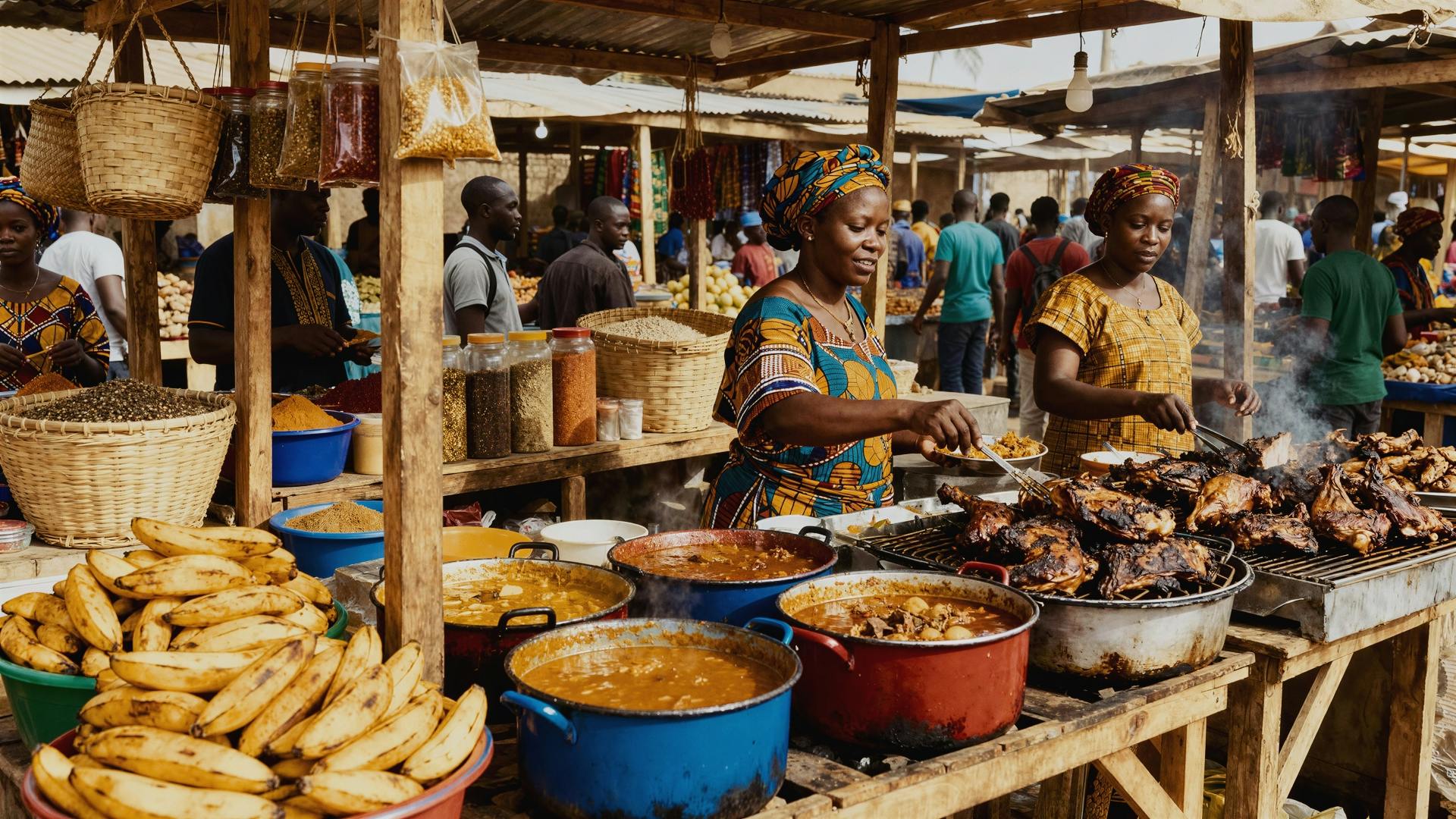
The Camera Cannot Eat – by Jim Chuchu
"The Camera Cannot Eat" is a video essay that wrestles with the quandary of how to make images about African food culture when every visual choice (whether 'traditional' or 'contemporary') feeds extractive gazes built over centuries of colonial image-making.
The work uses the very materials it critiques (stock footage of Africans cooking and eating, AI-generated imagery of 'African food') to reveal how thoroughly the visual language of African food has already been captured, catalogued, and turned into data.
Rather than offering solutions, the essay stews in this tension, suggesting that what cannot be photographed, the senses of taste and smell, and the embodied experience of gathering around food, might be what remains safe, as yet unreachable by the circuits of extraction
Jim Chuchu (KE) began his artistic practice as part of Kenyan alternative music group Just a Band, creating music and visual works until 2012. His visual works have since exhibited at MoMA, the Vitra Design Museum, and as part of the Smithsonian National Museum of African Art collection, while his films have screened at Berlin, Toronto, and Rotterdam international film festivals.
In 2014, Jim co-founded the Nest Collective, a multidisciplinary art collective based in Nairobi, Kenya. Their critically-acclaimed queer anthology film Stories of Our Lives won the Jury Prize at the 2015 Berlinale Teddy Awards and has screened in more than 90 countries, despite being banned in Kenya for 'promoting homosexuality'.
As part of the Nest Collective, Jim participated in the International Inventories Programme, an international research project investigating the presence of Kenyan cultural objects in global institutions. Between 2018-2021, the project catalogued more than 32,000 objects and engaged publics on urgent debates around object movement and colonial history.
Since transitioning to solo practice in 2021, Jim has composed for the Emmy-nominated Netflix documentary Hack Your Health (2024) and is a participating artist in the African Film and Media Arts Collective (AFMAC), developed by artist Julie Mehretu. He is currently directing documentary shorts as part of African in the Anthropocene, exploring African experiences of unprecedented environmental and social change, slated for release in early 2026.
His work consistently examines questions of representation, cultural sovereignty, and the politics of image-making in contemporary Africa.
The Camera Cannot Eat – by Jim Chuchu
"The Camera Cannot Eat" is a video essay that wrestles with the quandary of how to make images about African food culture when every visual choice (whether 'traditional' or 'contemporary') feeds extractive gazes built over centuries of colonial image-making.
The work uses the very materials it critiques (stock footage of Africans cooking and eating, AI-generated imagery of 'African food') to reveal how thoroughly the visual language of African food has already been captured, catalogued, and turned into data.
Rather than offering solutions, the essay stews in this tension, suggesting that what cannot be photographed, the senses of taste and smell, and the embodied experience of gathering around food, might be what remains safe, as yet unreachable by the circuits of extraction
Jim Chuchu (KE) began his artistic practice as part of Kenyan alternative music group Just a Band, creating music and visual works until 2012. His visual works have since exhibited at MoMA, the Vitra Design Museum, and as part of the Smithsonian National Museum of African Art collection, while his films have screened at Berlin, Toronto, and Rotterdam international film festivals.
In 2014, Jim co-founded the Nest Collective, a multidisciplinary art collective based in Nairobi, Kenya. Their critically-acclaimed queer anthology film Stories of Our Lives won the Jury Prize at the 2015 Berlinale Teddy Awards and has screened in more than 90 countries, despite being banned in Kenya for 'promoting homosexuality'.
As part of the Nest Collective, Jim participated in the International Inventories Programme, an international research project investigating the presence of Kenyan cultural objects in global institutions. Between 2018-2021, the project catalogued more than 32,000 objects and engaged publics on urgent debates around object movement and colonial history.
Since transitioning to solo practice in 2021, Jim has composed for the Emmy-nominated Netflix documentary Hack Your Health (2024) and is a participating artist in the African Film and Media Arts Collective (AFMAC), developed by artist Julie Mehretu. He is currently directing documentary shorts as part of African in the Anthropocene, exploring African experiences of unprecedented environmental and social change, slated for release in early 2026.
His work consistently examines questions of representation, cultural sovereignty, and the politics of image-making in contemporary Africa.
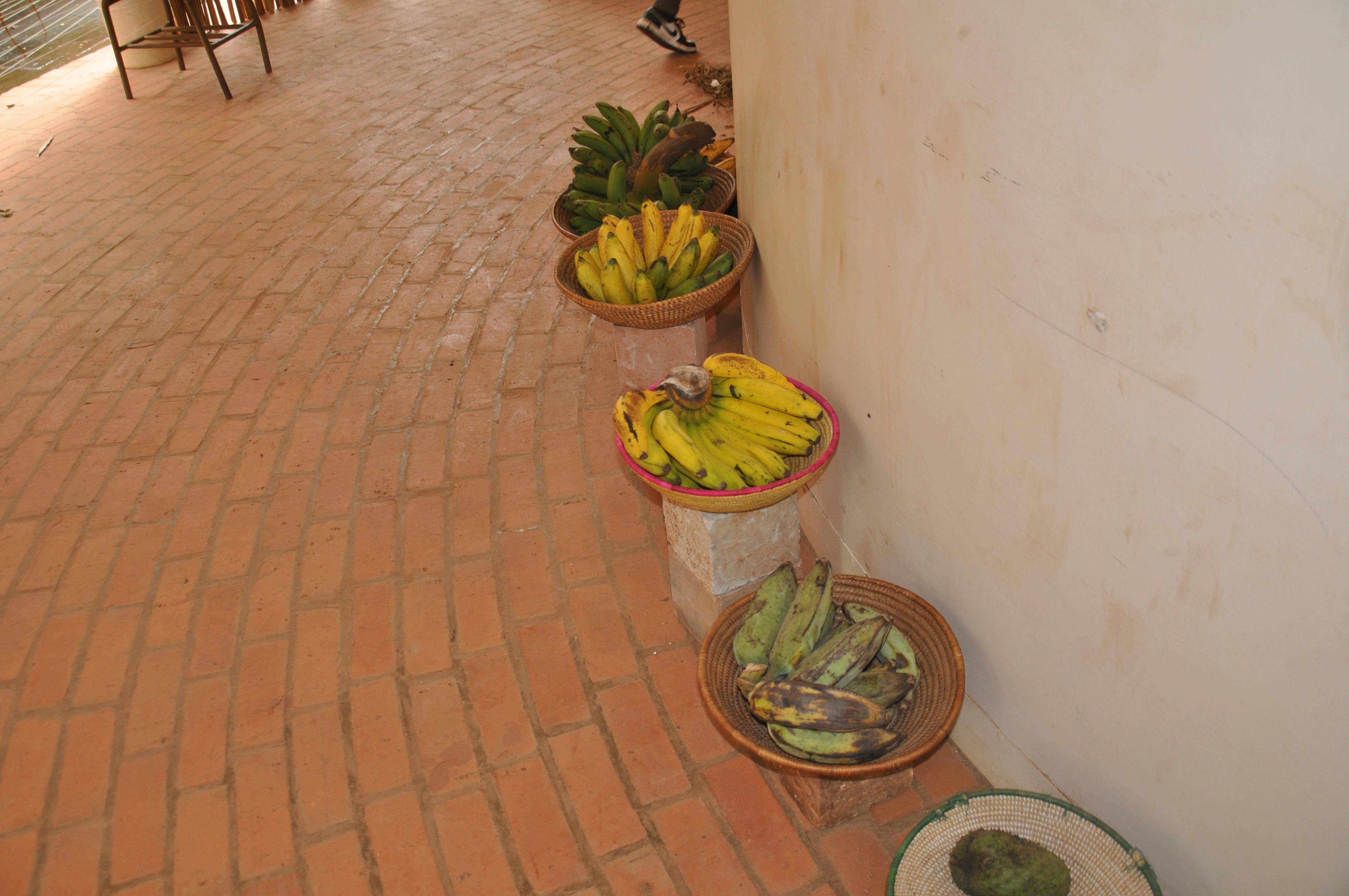
Beyond Sustenance: The Subtle Art of Being A vessel – by Rebecca Khamala
There is a Luganda saying: “Oluganda kulya, olugenda enjala teluda,” which translates to “Relationship [brotherhood] is eating, the one [relationship] that goes hungry does not return.” Beyond sustenance, food is a love language. It is revered. The source of fellowship with community, with family, and with self. Food is an intimate part of our cultural heritage, often a subject in folklore, embedded in proverbs and sayings, and at the centre of our material culture.

1. Construction detail of ekibbo coiled around with enjulu
In many of the communities in Uganda, food is a gift and baskets are the gift wrap. A basket is never merely a basket. It is a vessel: for serving millet, for sun drying mushrooms gathered in the morning dew, for yam carried home from the fields, for bride price gifted during okwanjula¹. They are instruments of everyday life. Just as art provides insight into culture, baskets offer a unique lens into food cultures in Uganda. Basket-making is a prominent and deeply rooted tradition in Uganda’s cultural heritage, part of a broader artistic heritage engrained in the material culture of Kenya, Tanzania, Rwanda, and Burundi, too. As in many other African cultures, artistic expression has been an integral part of the social and cultural fabric of communities in this region. East African art prioritised utilitarian objects over figurative ones—items crafted from materials in the immediate surroundings—reflecting a harmonious blend of function and artistry, drawing inspiration from the rhythms and necessities of daily life. To appreciate this rich cultural heritage, one has to look beyond the geopolitical boundaries that are a product of colonial enterprise and instead focus on the diverse cultures and social structures that predated colonisation. Uganda alone has 56 recognised tribes, each with their own language, customs, cuisine, and material culture. And while unique to individual groups, linguistic varieties and customs reflect deep historical, geographical and cultural connections among the different communities within and across national borders.
This piece begins with the basket, not because of its rarity or ornamentation, but precisely because it is ordinary. Baskets are part of a silent choreography of life: women winnowing grain, street vendors balancing baskets of bananas on their heads, and jjajjas² sitting by the veranda coiling obukeedo into tight spirals while recounting tales of times long gone. Baskets are everyday objects, quiet archives holding stories of the land, of labour, and of life. To follow their weave is to trace the delicate, ever-shifting relationships between people, ecosystems, and food cultures in Uganda and across East Africa. Over the years I have developed a practice somewhere between art and architecture. One fueled by a deep curiosity about people, culture, and the environment. My practice is focused on performing material culture and contemporary design, where I research traditional crafts through collaborating with local artisans, and adapt them to contemporary living. In my quest to find an African, Ugandan design identity, I landed on the mundane e kibbo n'omukeekka. Items that are found in nearly every properly adorned household in Uganda. When I began investigating the materiality and form of a basket, in the hope that I could pick from what's local to inform and inspire my own design and architectural work, I found that despite the fact that I've grown up with these items, I completely had no idea about their makeshift both in material and technique. So, I started to explore. First by deconstructing. The more I put apart, the more my ignorance is made apparent to me. I didn't realise there were so many different kinds of baskets: In Buganda³ for instance, the kikapu is a palm weaved tote-bag-like shopping basket for buying goods in the market, the kisero a deep and large basket for harvesting food from the fields and sometimes used for storing food, ekiyonjo a woven cage for carrying chicken and for sheltering chicks, ekiwewa/olugali a flat tray for winnowing grain, enzibo a woven trap for catching ensonzi , and ekibbo for storing, preparing, and serving food. These baskets and more are found throughout the country, with variations in designs, and materiality that reflect local foods, food systems, and surrounding ecosystems.
1. Cultivating Rhythms of Care Kla Art 24 Installation
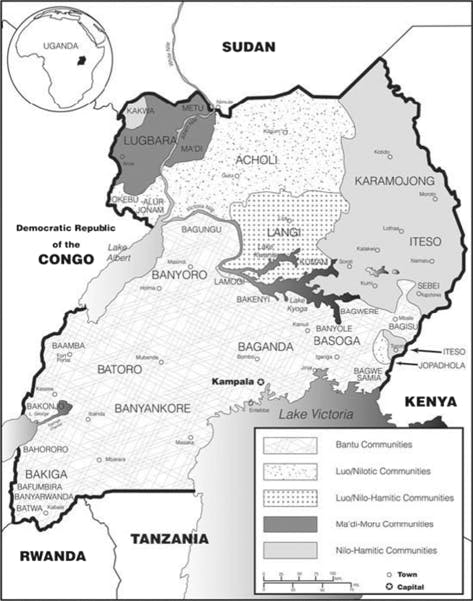
2. Main ethnic groups in Uganda 2001
The inquiry into baskets has also meant encountering the people that make them and interacting with the ecosystems from which their materials are acquired. Most of the baskets are traditionally woven by women: in their free time, in-between chores, alongside cultivation, and during food preparation. Traditional gender roles dictate a division of labour where women predominantly handle home chores and subsistence farming, while men focus on cash crop production and paid work. Therefore, decisions concerning food and nutrition were/are solely left to the woman and, by extension, the making of the vessels that carry the food. Baskets are woven from plants: banana fibre, papyrus, raffia, palm leaves and stalks, reeds and grasses, each chosen for its flexibility, texture, and local availability. The basket s production requires deep ecological knowledge: Knowing where a certain grass grows, when its stems are strongest, how to strip it into thread, and which plants yield colourfast dyes.
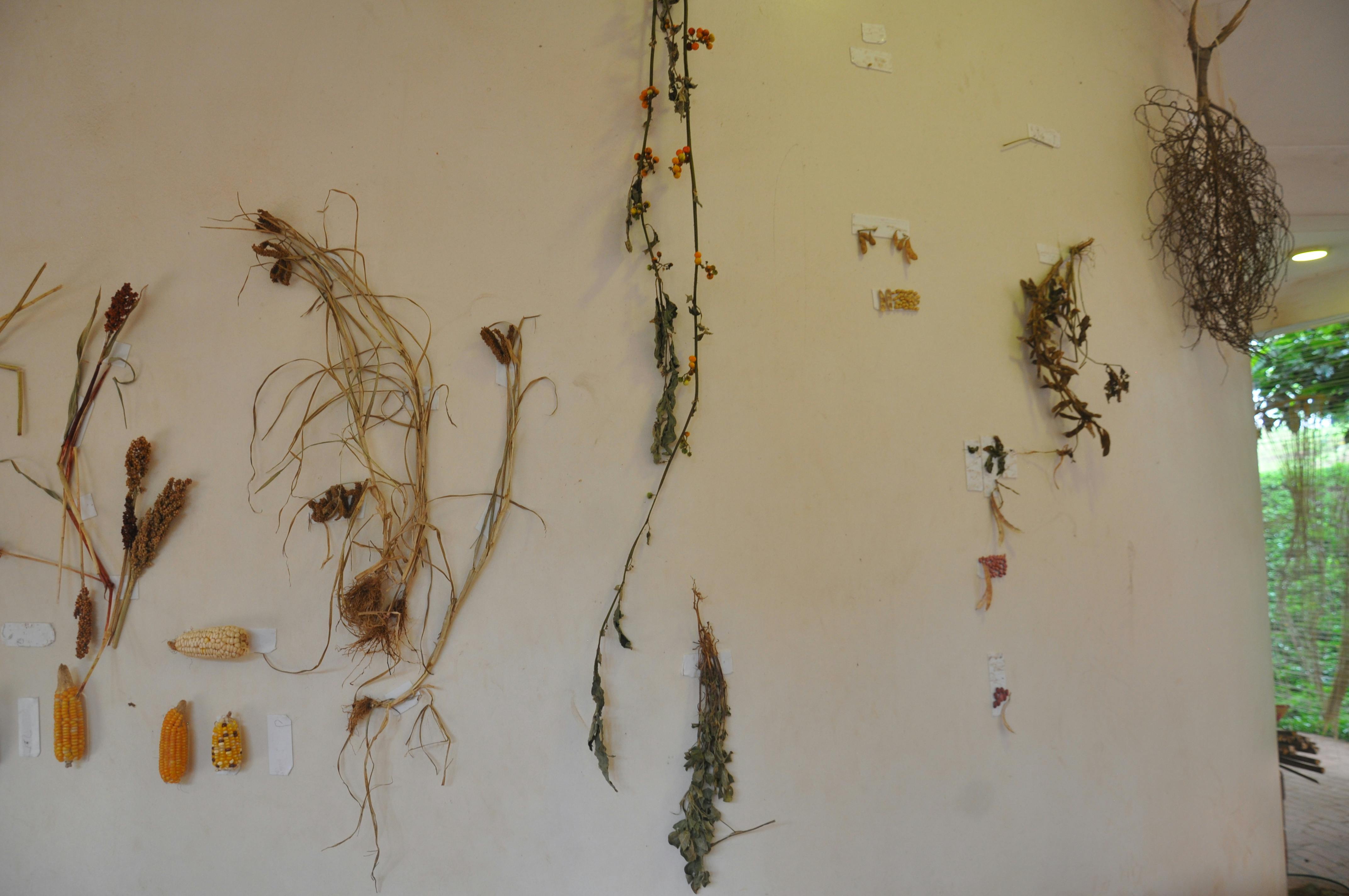
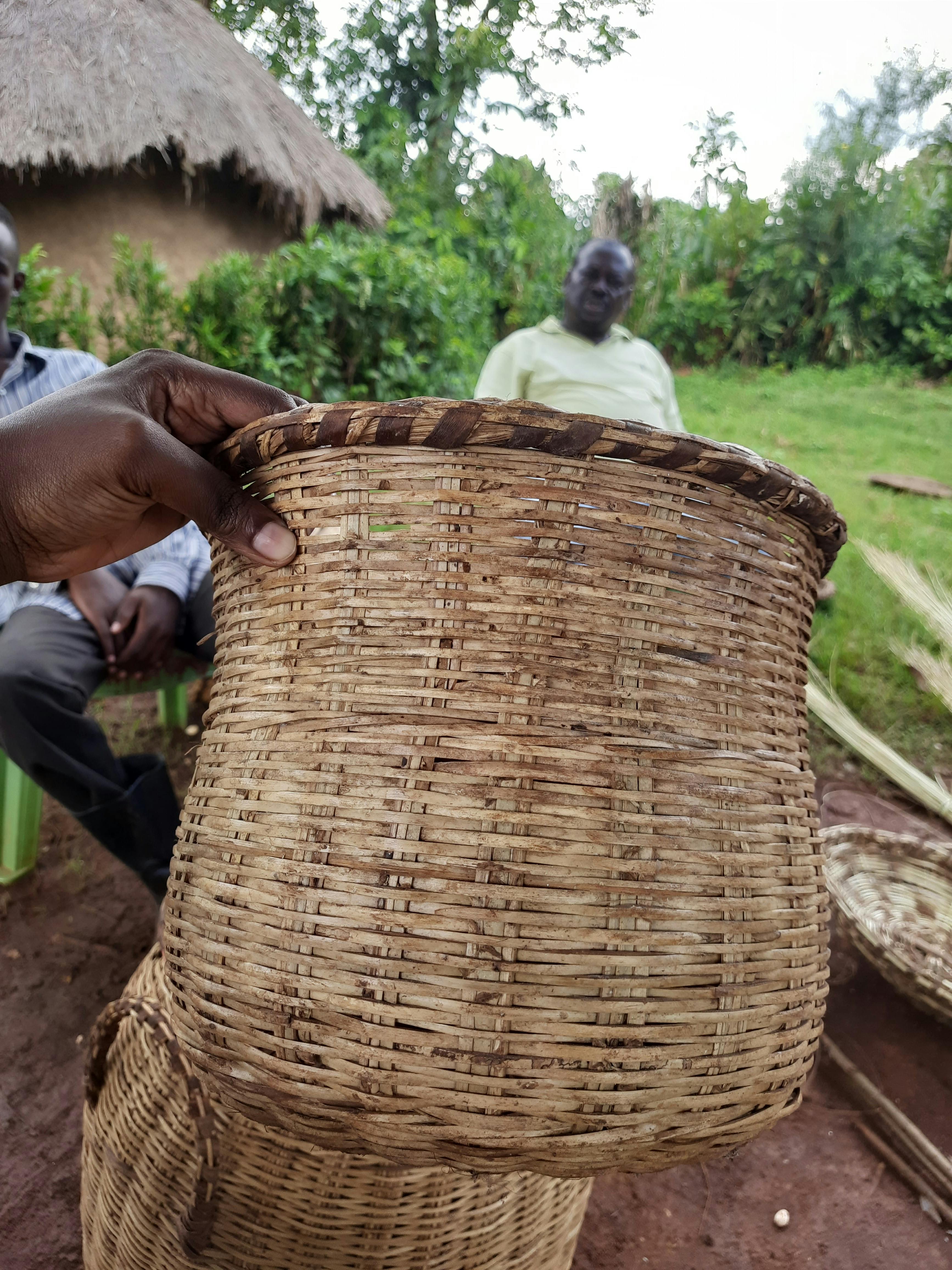
I was surprised to learn that the kibbo or ekibbo , one of the most common baskets in Uganda, is made from banana plants. It is made from obukeedo and coiled around with the outer layer of enjulu, a papyrus-like reed found in wetlands. The kibbo is primarily used for carrying food, storage, and in the preparation and serving of matooke. Matooke is a staple food in Central Uganda and is also largely consumed in Western Uganda, as well as in Rwanda and Tanzania. It is one of several indigenous varieties of the East African Highland bananas that developed in Uganda despite bananas not being native to the region itself. Matooke is prepared in a variety of ways, popularly as mashed matooke, steamed and mashed in banana leaves, a signature dish from Buganda. It is usually accompanied by a groundnut paste that can be made plainly or cooked with dried mushrooms, smoked meat, smoked fish, or malewa⁴. Matooke is also prepared as whole fingers in katogo⁵ . Bananas are also used to make omubisi⁶, made from a banana variety called embidde and which can then be fermented to make a banana brew. Other common varieties include bogoya, a dessert banana served and eaten as fruit, ndiizi, the shorter and sweeter dessert type which is normally used to make kabalagala⁷ ; gonja, plantain which is prominently roasted and sold at roadside markets, and lastly kivuuvu, a plantain variety which is fatter and slightly less sweet compared to gonja, which is usually steamed with its peelings and served alongside other carbs like yam, pumpkin, sweet potatoes, and cassava.
1.A display of different banana varieties from the Cultivating Rhythms of Care Kla Art 24 installation
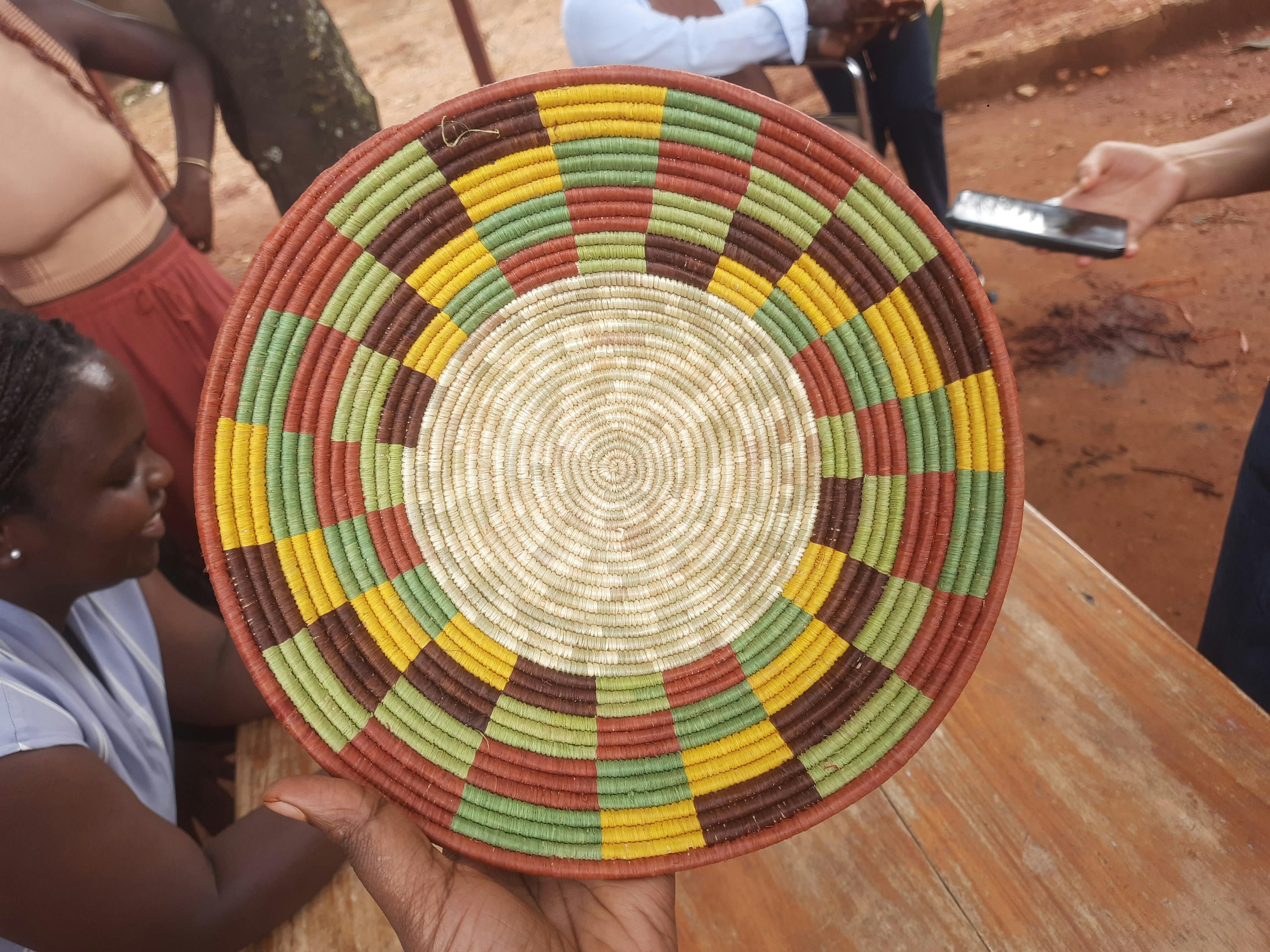
2. A decorative basket from Fort Portal by Mr. Akiiki one of the facilitators for the KLA Art 24 workshops
Another intriguing case is the endiiro. It is an open topped subtly cylindrical basket with a fitted lid, made for serving millet bread common among the Batooro, and also used by the Banyankole from the Ankole⁸ tribe. Endiiro is made from millet straw, a by-product of finger millet harvest. Other tribes within the wider Rwenzori region in Western Uganda also incorporate millet stalks or straws as the core of their basket construction, which is wound over using raffia that was coloured with plant dyes sourced from nearby highlands. Finger millet is a staple amongst the Nilotic, Nilo-Hamitic and Bantu ethnic communities in Northern, Eastern, and Western Uganda, a cereal native to East Africa, which is said to have originated in the highlands of Uganda and Ethiopia. Finger millet is a nutrient dense cereal that thrives in a variety of environments and conditions making it lucrative for famine prone areas. It occupies 50% of Uganda’s cereal area, and is an integral part of cultural functions across Uganda. Millet is served at weddings, naming ceremonies, and during festivals celebrating a new harvest. It is consumed in a variety of forms, as millet bread usually accompanied by malakwang⁹ in northern Uganda; eshabwe¹⁰ and Firinda in western Uganda amongst farming and cattle-keeping communities; roasted meat in north-eastern Uganda amongst the nomadic communities; and with smoked fish in the east amongst fishing communities. Finger millet is also eaten as porridge, as a fermented drink, bushera, and as brew. Different varieties are used for specific consumption, for example amongst the Itesots from the Teso tribe the variety called emoru is preferred for making ajon, a beer used in the new harvest celebrations.
The making of both the food and the baskets is a highly physical and intuitive process. For instance, in the act of okuyubuguluza olulagala, the removal of the banana leaf stalk carefully and in a flat manner apt for cooking, one must keep the stalk intact so it can be shredded into obukeedo to construct ekibbo. This embodied knowledge has long been passed down from generation to generation, from older women to younger ones, an informal education that is increasingly shaping my practice and consequently my life. For our KLA ART project in 2024, my collaborator Birungi Kawooya and I explored how our foremothers cared for their bodies, focusing on the tale of Njabala. In it, a married and spoilt girl is guided by her mother's ghost on how to cultivate abakazi balima bati¹¹, a tenet of Ugandan culture. We analysed the emphasis of cultivation in this folklore and asked: Why was this the thing Njabala needed to learn from her mother? What does it mean to cultivate?
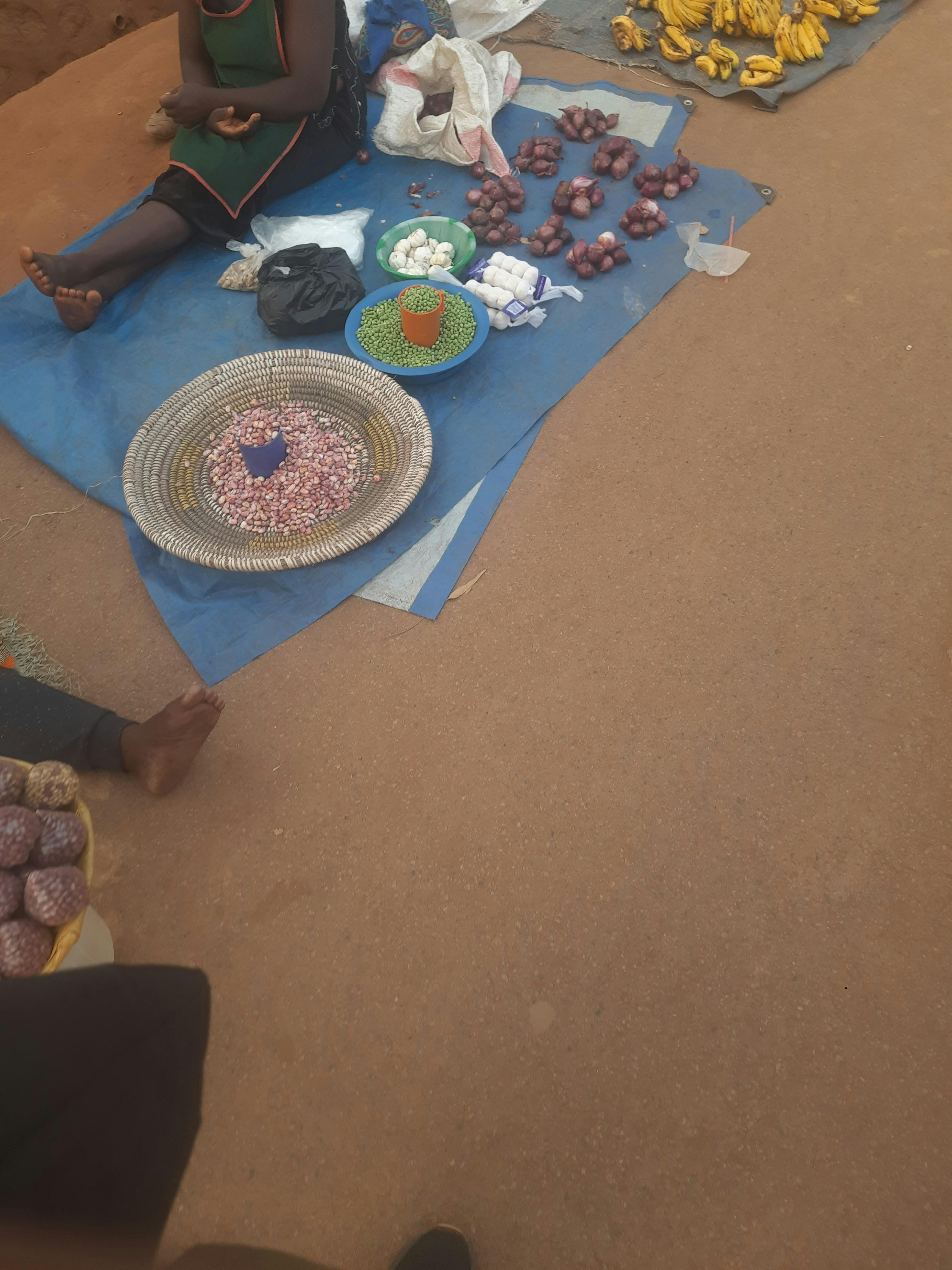
1. A street vendors selling beans in a variation of ekibbo
2. A variation of ekisero
Women have been custodians of invaluable nutritional and ecological knowledge for ages, understanding which foods thrive in each season, which vegetables boost iron levels, and how to nurture their bodies in alignment with their monthly cycles and the changing annual seasons. As a guide to track time, farmers observed the movement of the moon, marking the progress of months and seasons. Similarly, women often tracked their menstrual cycles using the phases of the moon. To tend to the land was to care for their own bodies. It was customary (especially in Buganda) to plant fruit trees around the home and for women to grow vegetables and prepare them daily, especially steamed in banana leaves on top of carbohydrates. That way, they ensured dietary diversity that supported their health. Growing medicinal plants around the home, especially those that support women's reproductive health, was and continues to be an essential practice. In some communities, such as among the Basoga, women were and still are forbidden from engaging in certain activities during menstruation, such as harvesting palm leaves for weaving, based on the belief that the tree could disappear. These taboos, though seemingly restrictive, were actually a form of self-care, encouraging rest and honouring the natural rhythm of the body. Through these practices our foremothers became not only stewards of the land, but guardians of its wisdom. By simultaneously attuning themselves to the natural rhythms of both land and body, they embodied a profound connection to a greater consciousness and became vessels through which its knowledge flowed.
A large portion of the vegetables in diets across East Africa are wild, and certain communities, e.g.,in the Teso-Karamoja region continue to rely on wild edible plants, especially during food scarcity periods. As our wild landscapes gradually urbanise, so too do our food systems evolve, along with the vessels that support them. We are witnessing material evolutions in traditional practices, where plastic is continuously replacing natural materials, for example the use of hard plastic strands in the production of bikapu¹² and plastic rope in place of raffia. Plastic found its way into food preparation too, notably as a covering in addition or as an alternative to ndagala¹³ used in steaming foods like matooke or maize to better preserve moisture.
This shift reflects a broader inclination toward convenience and durability, where a combination of a rapidly growing population, changing living patterns, and rapid urbanisation create opportunities for the development of food products such as matooke flour and matooke biscuits; private beverage companies increasingly taking up the commercialisation of products like bushera and mubisi. All the while industrial agriculture, deforestation and swamp reclamation destroy the natural habitats of plants that serve as source for basketry materials: Swamps are drained for construction, native grasses are vanishing under commercial agriculture, and simultaneously global food systems introduce packed imports and plastic packages dislodging the need for and knowledge of traditional basketry.
Decoding the basket has opened up for me avenues of dialogue and interaction with my family,especially with my parents, with friends, and with the environment that did not exist before. My practice is gently evolving into a conversation: between materials, traditions, people, and the environment. I no longer see baskets for the handmade decorative items they are typically reduced to, but as reflections of a resilient food system, an embodiment of care, adaptation, and restoration in the face of ecological and colonial disruption. From market stalls and home kitchens to ceremonial gatherings and gift exchanges, baskets—both archive and practice—remain an integral part of daily life across different cultures in the region. Each serving a purpose, carrying a form, and telling a story.
Being awakened to this birthed in me a renewed sense of purpose, one of taking a step back and allowing myself to flow to a rhythm of something larger than myself. Learning the subtle art of being a conduit; submitting to higher knowledge systems; letting place and material guide me; learning through participation, observation, and play—as I gradually become more cognisant with the cyclical and intricately interconnected relationships that shape our material cultures and food systems.
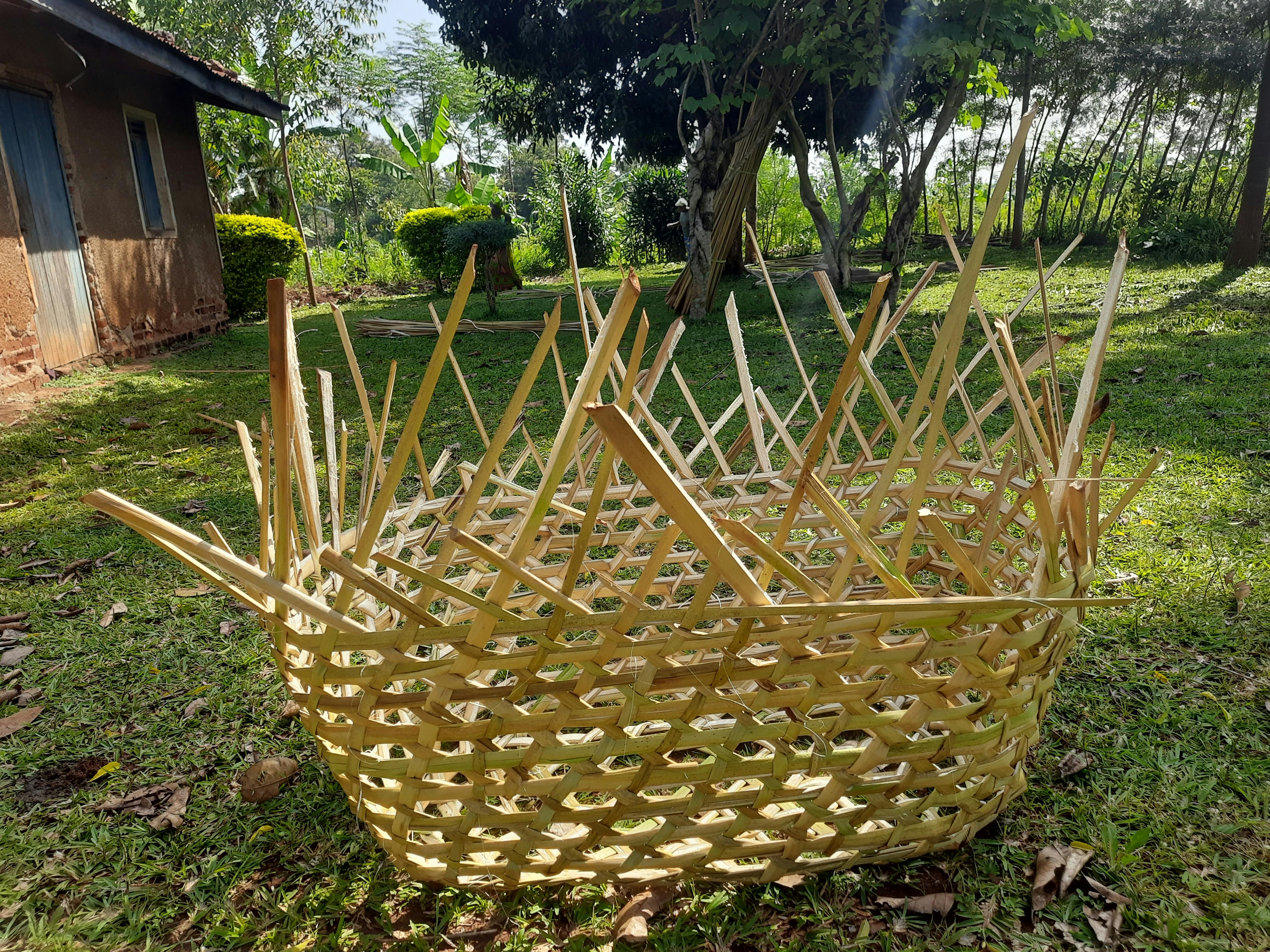
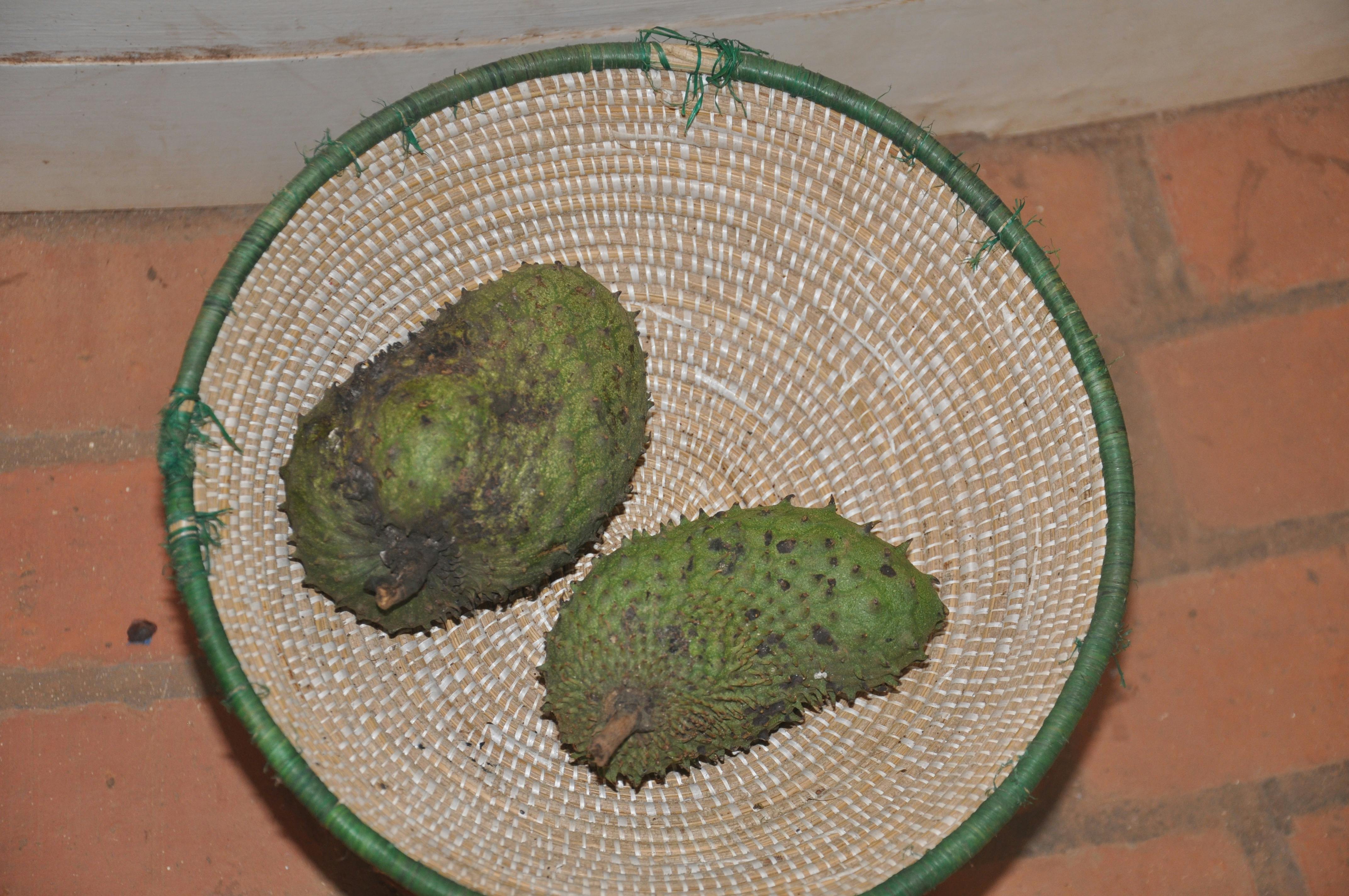
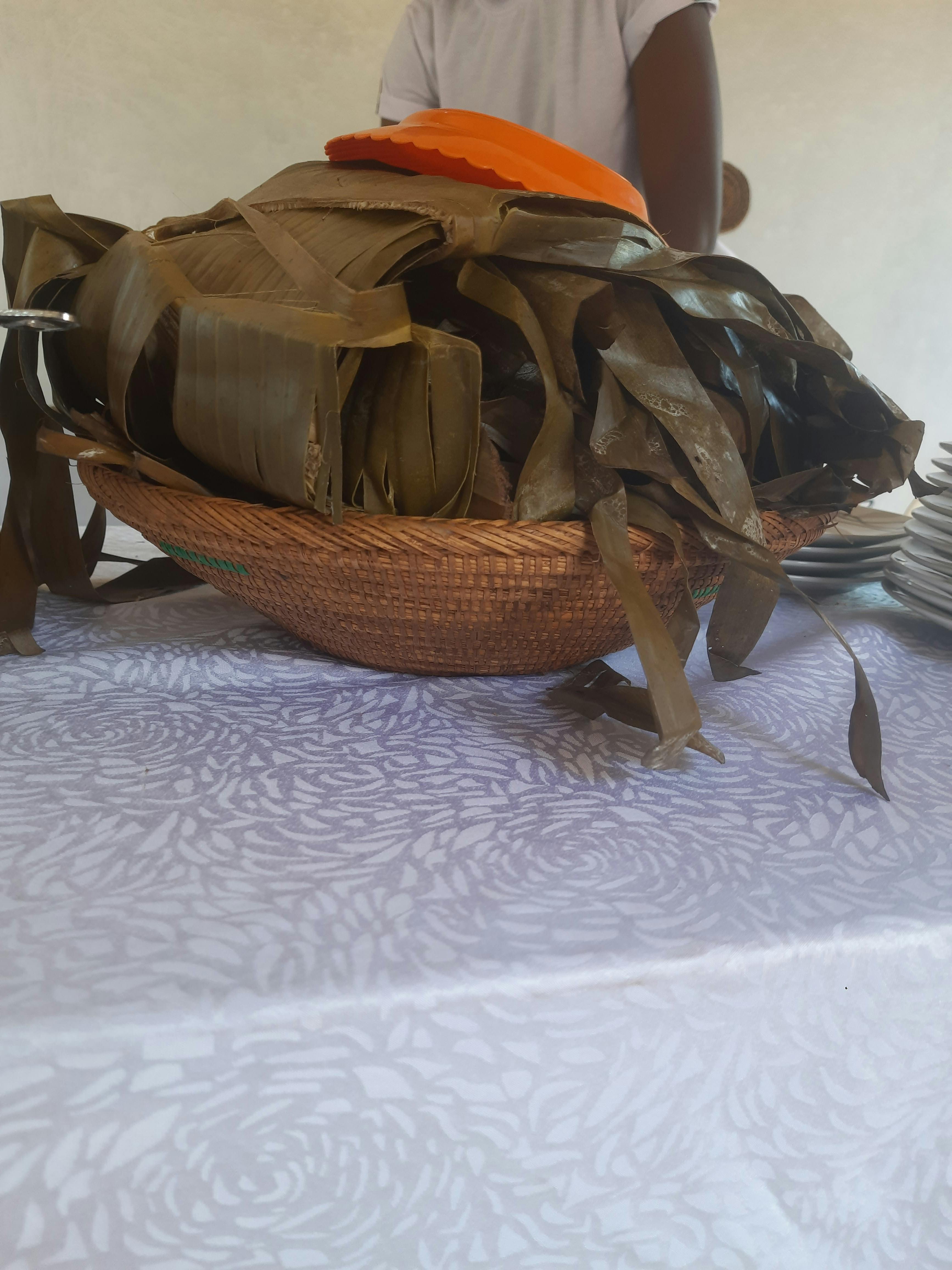
1. The construction of a papyrus basket for transporting fish, Busia Uganda
2. Ekitaferi ( luganda for soursop) in ekibbo coiled around with plastic strands in plave of enjulu or raffia
3. Matooke served in ekibbo
Rebecca Khamala (UG) is a multidisciplinary designer, artist, and writer with a background in architecture. Her practice centres on working in harmony with nature and place, fueled by a deep curiosity about people, culture, and the environment. With a focus on regenerative practices, local materials, and technologies, she collaborates with artisans to explore and adapt traditional crafts to contemporary design. Her research delves into the intricate relationships between material cultures, food cultures, and local ecosystems.
In parallel, Rebecca is engaged in an ongoing exploration of public spaces in Kampala, investigating how these environments can foster community engagement and play. She is particularly interested in how play can serve as a tool for reconnecting people not only with each other but also with the natural environment, restoring a sense of belonging and stewardship within urban settings. This research extends to questions of cultural connection to nature, exploring how traditional knowledge systems and cultural practices can inform the design and revitalisation of urban spaces, transforming them into areas of connection, vitality, and ecological awareness.
Poetry is integral to her creative process, often serving as the foundation that she translates into visual, spatial, and tactile forms. Working across mediums—poetry, film, performance, and design—Rebecca tells uplifting, place-based stories that honour both community and context, envisioning a more connected and regenerative relationship between people, culture, and the natural world.
[1] Traditional marriage ceremony in Buganda, a Kingdom in Uganda.
[2] Grandparents
[3] The largest Bantu ethnic community in Uganda who occupy the Central Region, synonymous with the Kingdom
[4] Smoked bamboo shoots, a traditional dish of the Bagisu, a Bantu ethnic group who occupy the Mt. Elgon region in Eastern Uganda.
[5] A one pot dish where food is cooked with the sauce.
[6] Banana juice
[7] An Ugandan pancake made from cassava flour, ripe dessert bananas and a pinch of baking soda.
[8] A Bantu ethnic group in Western Uganda.
[9] a groundnut and simsim paste with vegetables sauce.
[10] Ghee sauce
[11] “This is how women cultivate”
[12] Plural for of kikapu
[13] Banana leaves
Beyond Sustenance: The Subtle Art of Being A vessel – by Rebecca Khamala
There is a Luganda saying: “Oluganda kulya, olugenda enjala teluda,” which translates to “Relationship [brotherhood] is eating, the one [relationship] that goes hungry does not return.” Beyond sustenance, food is a love language. It is revered. The source of fellowship with community, with family, and with self. Food is an intimate part of our cultural heritage, often a subject in folklore, embedded in proverbs and sayings, and at the centre of our material culture.
1. Construction detail of ekibbo coiled around with enjulu
In many of the communities in Uganda, food is a gift and baskets are the gift wrap. A basket is never merely a basket. It is a vessel: for serving millet, for sun drying mushrooms gathered in the morning dew, for yam carried home from the fields, for bride price gifted during okwanjula¹. They are instruments of everyday life. Just as art provides insight into culture, baskets offer a unique lens into food cultures in Uganda. Basket-making is a prominent and deeply rooted tradition in Uganda’s cultural heritage, part of a broader artistic heritage engrained in the material culture of Kenya, Tanzania, Rwanda, and Burundi, too. As in many other African cultures, artistic expression has been an integral part of the social and cultural fabric of communities in this region. East African art prioritised utilitarian objects over figurative ones—items crafted from materials in the immediate surroundings—reflecting a harmonious blend of function and artistry, drawing inspiration from the rhythms and necessities of daily life. To appreciate this rich cultural heritage, one has to look beyond the geopolitical boundaries that are a product of colonial enterprise and instead focus on the diverse cultures and social structures that predated colonisation. Uganda alone has 56 recognised tribes, each with their own language, customs, cuisine, and material culture. And while unique to individual groups, linguistic varieties and customs reflect deep historical, geographical and cultural connections among the different communities within and across national borders.
This piece begins with the basket, not because of its rarity or ornamentation, but precisely because it is ordinary. Baskets are part of a silent choreography of life: women winnowing grain, street vendors balancing baskets of bananas on their heads, and jjajjas² sitting by the veranda coiling obukeedo into tight spirals while recounting tales of times long gone. Baskets are everyday objects, quiet archives holding stories of the land, of labour, and of life. To follow their weave is to trace the delicate, ever-shifting relationships between people, ecosystems, and food cultures in Uganda and across East Africa. Over the years I have developed a practice somewhere between art and architecture. One fueled by a deep curiosity about people, culture, and the environment. My practice is focused on performing material culture and contemporary design, where I research traditional crafts through collaborating with local artisans, and adapt them to contemporary living. In my quest to find an African, Ugandan design identity, I landed on the mundane e kibbo n'omukeekka. Items that are found in nearly every properly adorned household in Uganda. When I began investigating the materiality and form of a basket, in the hope that I could pick from what's local to inform and inspire my own design and architectural work, I found that despite the fact that I've grown up with these items, I completely had no idea about their makeshift both in material and technique. So, I started to explore. First by deconstructing. The more I put apart, the more my ignorance is made apparent to me. I didn't realise there were so many different kinds of baskets: In Buganda³ for instance, the kikapu is a palm weaved tote-bag-like shopping basket for buying goods in the market, the kisero a deep and large basket for harvesting food from the fields and sometimes used for storing food, ekiyonjo a woven cage for carrying chicken and for sheltering chicks, ekiwewa/olugali a flat tray for winnowing grain, enzibo a woven trap for catching ensonzi , and ekibbo for storing, preparing, and serving food. These baskets and more are found throughout the country, with variations in designs, and materiality that reflect local foods, food systems, and surrounding ecosystems.
1. Cultivating Rhythms of Care Kla Art 24 Installation
2. Main ethnic groups in Uganda 2001
The inquiry into baskets has also meant encountering the people that make them and interacting with the ecosystems from which their materials are acquired. Most of the baskets are traditionally woven by women: in their free time, in-between chores, alongside cultivation, and during food preparation. Traditional gender roles dictate a division of labour where women predominantly handle home chores and subsistence farming, while men focus on cash crop production and paid work. Therefore, decisions concerning food and nutrition were/are solely left to the woman and, by extension, the making of the vessels that carry the food. Baskets are woven from plants: banana fibre, papyrus, raffia, palm leaves and stalks, reeds and grasses, each chosen for its flexibility, texture, and local availability. The basket s production requires deep ecological knowledge: Knowing where a certain grass grows, when its stems are strongest, how to strip it into thread, and which plants yield colourfast dyes.
I was surprised to learn that the kibbo or ekibbo , one of the most common baskets in Uganda, is made from banana plants. It is made from obukeedo and coiled around with the outer layer of enjulu, a papyrus-like reed found in wetlands. The kibbo is primarily used for carrying food, storage, and in the preparation and serving of matooke. Matooke is a staple food in Central Uganda and is also largely consumed in Western Uganda, as well as in Rwanda and Tanzania. It is one of several indigenous varieties of the East African Highland bananas that developed in Uganda despite bananas not being native to the region itself. Matooke is prepared in a variety of ways, popularly as mashed matooke, steamed and mashed in banana leaves, a signature dish from Buganda. It is usually accompanied by a groundnut paste that can be made plainly or cooked with dried mushrooms, smoked meat, smoked fish, or malewa⁴. Matooke is also prepared as whole fingers in katogo⁵ . Bananas are also used to make omubisi⁶, made from a banana variety called embidde and which can then be fermented to make a banana brew. Other common varieties include bogoya, a dessert banana served and eaten as fruit, ndiizi, the shorter and sweeter dessert type which is normally used to make kabalagala⁷ ; gonja, plantain which is prominently roasted and sold at roadside markets, and lastly kivuuvu, a plantain variety which is fatter and slightly less sweet compared to gonja, which is usually steamed with its peelings and served alongside other carbs like yam, pumpkin, sweet potatoes, and cassava.
1.A display of different banana varieties from the Cultivating Rhythms of Care Kla Art 24 installation
2. A decorative basket from Fort Portal by Mr. Akiiki one of the facilitators for the KLA Art 24 workshops
Another intriguing case is the endiiro. It is an open topped subtly cylindrical basket with a fitted lid, made for serving millet bread common among the Batooro, and also used by the Banyankole from the Ankole⁸ tribe. Endiiro is made from millet straw, a by-product of finger millet harvest. Other tribes within the wider Rwenzori region in Western Uganda also incorporate millet stalks or straws as the core of their basket construction, which is wound over using raffia that was coloured with plant dyes sourced from nearby highlands. Finger millet is a staple amongst the Nilotic, Nilo-Hamitic and Bantu ethnic communities in Northern, Eastern, and Western Uganda, a cereal native to East Africa, which is said to have originated in the highlands of Uganda and Ethiopia. Finger millet is a nutrient dense cereal that thrives in a variety of environments and conditions making it lucrative for famine prone areas. It occupies 50% of Uganda’s cereal area, and is an integral part of cultural functions across Uganda. Millet is served at weddings, naming ceremonies, and during festivals celebrating a new harvest. It is consumed in a variety of forms, as millet bread usually accompanied by malakwang⁹ in northern Uganda; eshabwe¹⁰ and Firinda in western Uganda amongst farming and cattle-keeping communities; roasted meat in north-eastern Uganda amongst the nomadic communities; and with smoked fish in the east amongst fishing communities. Finger millet is also eaten as porridge, as a fermented drink, bushera, and as brew. Different varieties are used for specific consumption, for example amongst the Itesots from the Teso tribe the variety called emoru is preferred for making ajon, a beer used in the new harvest celebrations.
The making of both the food and the baskets is a highly physical and intuitive process. For instance, in the act of okuyubuguluza olulagala, the removal of the banana leaf stalk carefully and in a flat manner apt for cooking, one must keep the stalk intact so it can be shredded into obukeedo to construct ekibbo. This embodied knowledge has long been passed down from generation to generation, from older women to younger ones, an informal education that is increasingly shaping my practice and consequently my life. For our KLA ART project in 2024, my collaborator Birungi Kawooya and I explored how our foremothers cared for their bodies, focusing on the tale of Njabala. In it, a married and spoilt girl is guided by her mother's ghost on how to cultivate abakazi balima bati¹¹, a tenet of Ugandan culture. We analysed the emphasis of cultivation in this folklore and asked: Why was this the thing Njabala needed to learn from her mother? What does it mean to cultivate?
1. A street vendors selling beans in a variation of ekibbo
2. A variation of ekisero
Women have been custodians of invaluable nutritional and ecological knowledge for ages, understanding which foods thrive in each season, which vegetables boost iron levels, and how to nurture their bodies in alignment with their monthly cycles and the changing annual seasons. As a guide to track time, farmers observed the movement of the moon, marking the progress of months and seasons. Similarly, women often tracked their menstrual cycles using the phases of the moon. To tend to the land was to care for their own bodies. It was customary (especially in Buganda) to plant fruit trees around the home and for women to grow vegetables and prepare them daily, especially steamed in banana leaves on top of carbohydrates. That way, they ensured dietary diversity that supported their health. Growing medicinal plants around the home, especially those that support women's reproductive health, was and continues to be an essential practice. In some communities, such as among the Basoga, women were and still are forbidden from engaging in certain activities during menstruation, such as harvesting palm leaves for weaving, based on the belief that the tree could disappear. These taboos, though seemingly restrictive, were actually a form of self-care, encouraging rest and honouring the natural rhythm of the body. Through these practices our foremothers became not only stewards of the land, but guardians of its wisdom. By simultaneously attuning themselves to the natural rhythms of both land and body, they embodied a profound connection to a greater consciousness and became vessels through which its knowledge flowed.
A large portion of the vegetables in diets across East Africa are wild, and certain communities, e.g.,in the Teso-Karamoja region continue to rely on wild edible plants, especially during food scarcity periods. As our wild landscapes gradually urbanise, so too do our food systems evolve, along with the vessels that support them. We are witnessing material evolutions in traditional practices, where plastic is continuously replacing natural materials, for example the use of hard plastic strands in the production of bikapu¹² and plastic rope in place of raffia. Plastic found its way into food preparation too, notably as a covering in addition or as an alternative to ndagala¹³ used in steaming foods like matooke or maize to better preserve moisture.
This shift reflects a broader inclination toward convenience and durability, where a combination of a rapidly growing population, changing living patterns, and rapid urbanisation create opportunities for the development of food products such as matooke flour and matooke biscuits; private beverage companies increasingly taking up the commercialisation of products like bushera and mubisi. All the while industrial agriculture, deforestation and swamp reclamation destroy the natural habitats of plants that serve as source for basketry materials: Swamps are drained for construction, native grasses are vanishing under commercial agriculture, and simultaneously global food systems introduce packed imports and plastic packages dislodging the need for and knowledge of traditional basketry.
Decoding the basket has opened up for me avenues of dialogue and interaction with my family,especially with my parents, with friends, and with the environment that did not exist before. My practice is gently evolving into a conversation: between materials, traditions, people, and the environment. I no longer see baskets for the handmade decorative items they are typically reduced to, but as reflections of a resilient food system, an embodiment of care, adaptation, and restoration in the face of ecological and colonial disruption. From market stalls and home kitchens to ceremonial gatherings and gift exchanges, baskets—both archive and practice—remain an integral part of daily life across different cultures in the region. Each serving a purpose, carrying a form, and telling a story.
Being awakened to this birthed in me a renewed sense of purpose, one of taking a step back and allowing myself to flow to a rhythm of something larger than myself. Learning the subtle art of being a conduit; submitting to higher knowledge systems; letting place and material guide me; learning through participation, observation, and play—as I gradually become more cognisant with the cyclical and intricately interconnected relationships that shape our material cultures and food systems.
1. The construction of a papyrus basket for transporting fish, Busia Uganda
2. Ekitaferi ( luganda for soursop) in ekibbo coiled around with plastic strands in plave of enjulu or raffia
3. Matooke served in ekibbo
Rebecca Khamala (UG) is a multidisciplinary designer, artist, and writer with a background in architecture. Her practice centres on working in harmony with nature and place, fueled by a deep curiosity about people, culture, and the environment. With a focus on regenerative practices, local materials, and technologies, she collaborates with artisans to explore and adapt traditional crafts to contemporary design. Her research delves into the intricate relationships between material cultures, food cultures, and local ecosystems.
In parallel, Rebecca is engaged in an ongoing exploration of public spaces in Kampala, investigating how these environments can foster community engagement and play. She is particularly interested in how play can serve as a tool for reconnecting people not only with each other but also with the natural environment, restoring a sense of belonging and stewardship within urban settings. This research extends to questions of cultural connection to nature, exploring how traditional knowledge systems and cultural practices can inform the design and revitalisation of urban spaces, transforming them into areas of connection, vitality, and ecological awareness.
Poetry is integral to her creative process, often serving as the foundation that she translates into visual, spatial, and tactile forms. Working across mediums—poetry, film, performance, and design—Rebecca tells uplifting, place-based stories that honour both community and context, envisioning a more connected and regenerative relationship between people, culture, and the natural world.
[1] Traditional marriage ceremony in Buganda, a Kingdom in Uganda.
[2] Grandparents
[3] The largest Bantu ethnic community in Uganda who occupy the Central Region, synonymous with the Kingdom
[4] Smoked bamboo shoots, a traditional dish of the Bagisu, a Bantu ethnic group who occupy the Mt. Elgon region in Eastern Uganda.
[5] A one pot dish where food is cooked with the sauce.
[6] Banana juice
[7] An Ugandan pancake made from cassava flour, ripe dessert bananas and a pinch of baking soda.
[8] A Bantu ethnic group in Western Uganda.
[9] a groundnut and simsim paste with vegetables sauce.
[10] Ghee sauce
[11] “This is how women cultivate”
[12] Plural for of kikapu
[13] Banana leaves
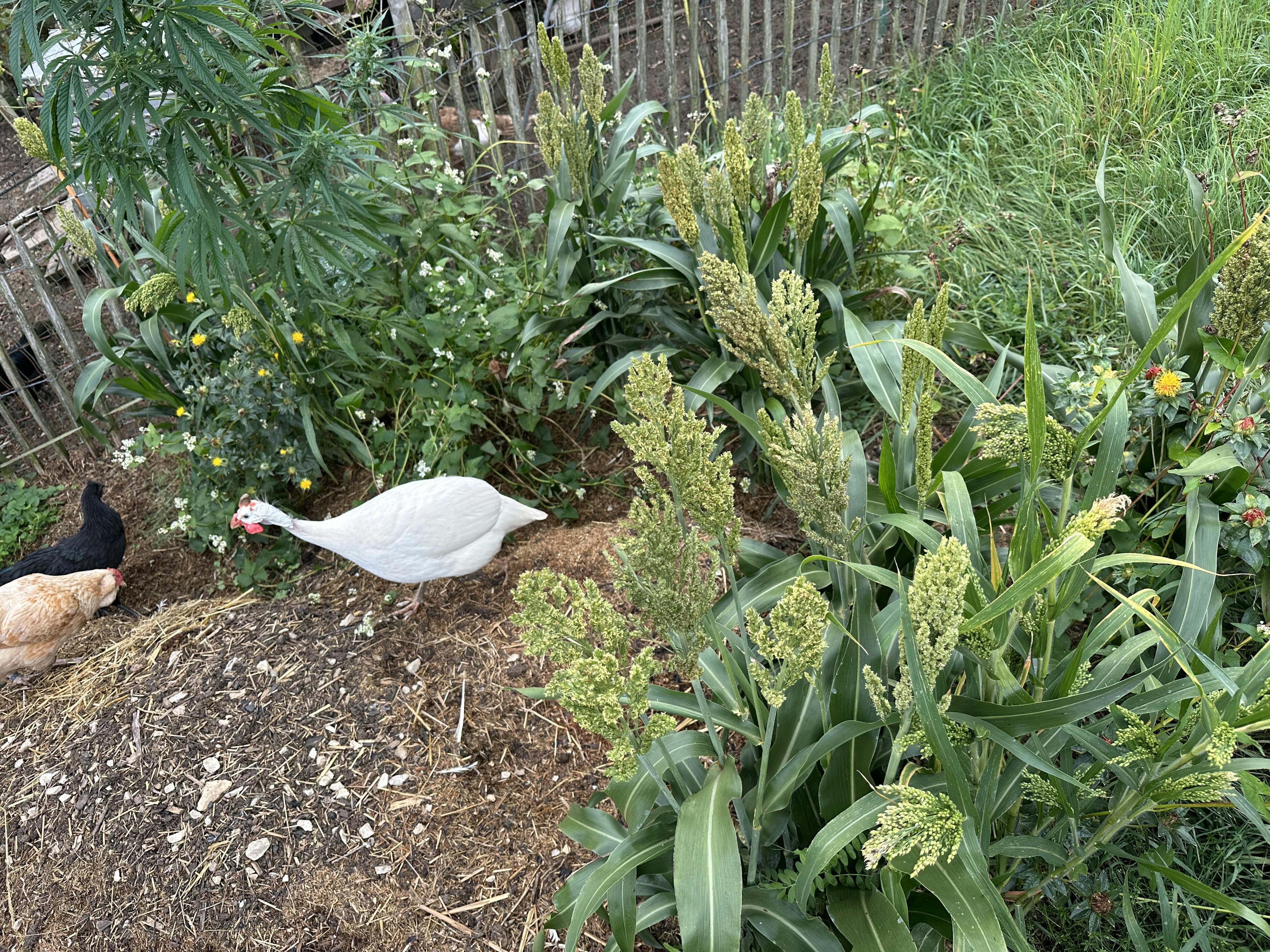
Fwd: Email (Re send) – By Brogan Aaron Mwesigwa, Sandra Knecht
From: Brogan Aaron Mwesigwa
To: Sandra Knecht
Wednesday, 13. Aug., 13:35
Dear Sandra,
I hope you're well. It was nice to e-meet you.
To answer the question,
I first began to notice this relation, through my research on traditional Ugandan food in my Kumanyagana¹ project for KLA ART Festival. In Uganda, our meals are deeply seasonal, following seasons of planting and harvesting. We have two planting seasons, March and August–September, and two harvesting seasons, June–July and December–January. As a child I remember certain foods appearing in the market during certain periods of the year. Like the many trucks of Matooke² at the Market in Nakulabye in June and in December. Matooke is one of Uganda's most important food crops.
I never grew up on a farm nor participated in any long-term farming activity except taking care of my Auntie’s chickens one holiday in 2013. I was raised in the concrete jungle of Kampala, the capital city of Uganda, where we are mostly consumers and not producers. Fortunately, during some of my visits to the village, I did observe my grandmother observing the clouds, and certain weather conditions to tell when the rains would start. As I speak, these signs have become less reliable. I spoke to her recently and she told me how they hadn't received a drop of rain in over six months. Climate warming has shifted the seasons. Sometimes they come in too late or too heavy or not at all. This has disrupted planting seasons, food availability and to a great extent, even community gatherings tied to harvest seasons.
Looking forward to your reflections,
Warm regards, Brogan.
From: Sandra Knecht
To: Brogan Aaron Mwesigwa
Saturday, 23. Aug., 13:1
Dear Brogan
Sorry for not getting back to you sooner. I had an accident in the meantime. Everything is fine now. I am writing to you here about how I grew up in the 1970s and 1980s.
When I was a child, global warming did not yet exist in this sense. Everything seemed possible, everything seemed achievable if you just tried hard enough. Racism and classism were not issues in the society I grew up in. Nor was the destruction of natural resources. Famine took place elsewhere, in Biafra for example. Nelson Mandela and Mahatma Gandhi were role models who were also far away. There was no digitalization, no internet; we made phone calls using a wall-mounted rotary dial telephone. So, we were all dependent on what was written in books and what we were told about the outside world through newspapers and television.
I grew up 1,200 meters above sea level in a small cow town. Every day, I rode my bike to school in the nearest town. At lunchtime, I rode up the mountain to go home and then back down into the valley. I hated school; I wanted to conquer the world on horseback. I rode my bike hundreds of kilometers around the hilly mountain region of my homeland; that was my way of travelling. I spent three hours every day on horseback, galloping through forests and meadows.
I started working at a very early age. My family was poor. At the age of 13, I helped out at the village butcher's shop and worked for farmers in the mountains during the school holidays. That's where I learned to cook. Traditional dishes such as Rösti³, bread baking, making your own pasta, etc. The famous Älplermaggaronen⁴ with apple sauce and salad were ubiquitous, and I still love this dish today. For me, this is tradition, like wrestling and yodeling or playing the accordion.
Our food was and still is dependent on where we shop and what we grow. I eat almost exclusively meat from our own animals, i.e., rooster and ram. In summer, I eat vegetables that grow in our garden.
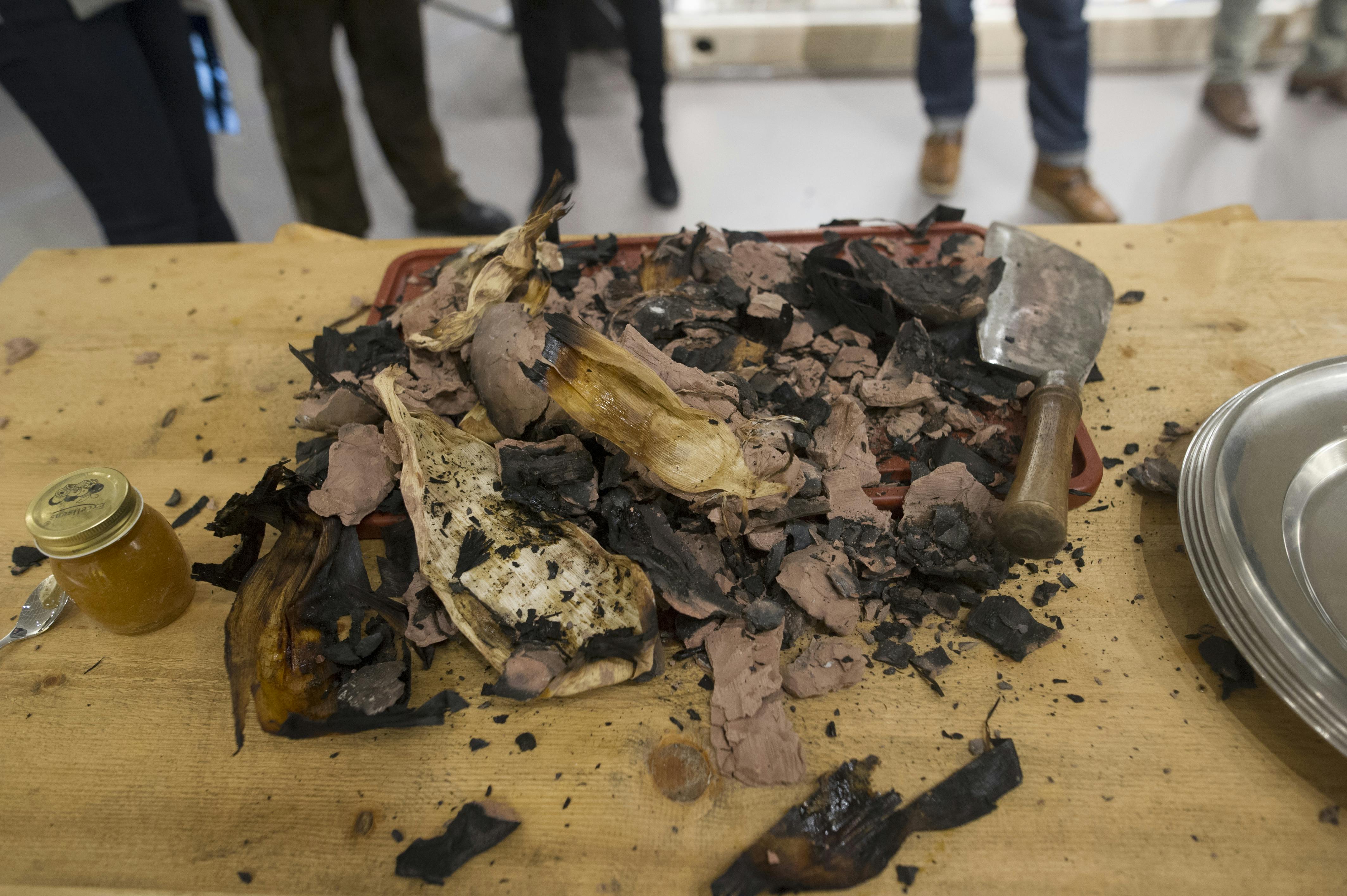
Photo: Sandra Knecht
I was in Mexico a year ago, and since then I've been eating more corn, pineapple and avocado. Even though I know that both fruits are harmful to the environment and water supply when grown, I now buy them about once a month. I loved getting to know the culture in Mexico, which was previously unknown to me. Since then, I have enjoyed travelling very much, even though I am older now and do not speak any language other than our own well.
I hope you are well. All the best Sandra
From: Brogan Aaron Mwesigwa
To: Sandra Knecht
Monday, 25. Aug., 17:49
Dear Sandra,
I am very well, thank you. I am so sorry to hear about your accident, but am happy that you're doing well.
Unlike the 70's and 90's, my own memories begin in the early 2000s. I grew up in Bukesa, a small town in Kampala, in a humble home where we had just enough to get by. It was a developing neighborhood with flats rising above us, and multiple bungalows tucked in lanes. A few families who owned their own homes had small plots of land where they mostly grew matooke and vegetables. We planted some in our front yard. During school holidays, I loved planting sugarcanes. It grew so quickly that I could hardly wait, often harvesting it as soon as the first stalks broke through the soil. Riding a horse, though, for me is one of my dreams.
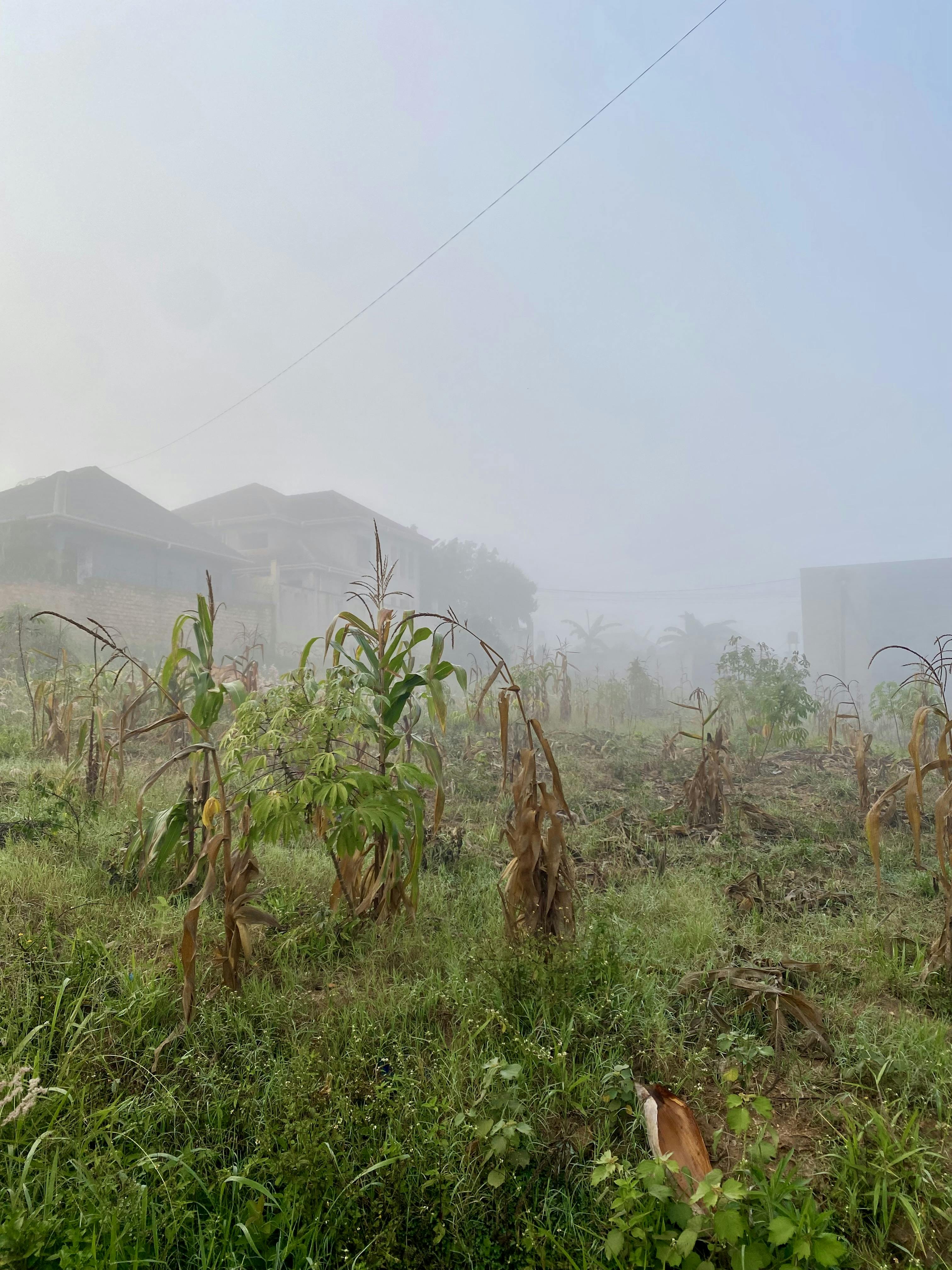
Maize Plantation after Harvest, Photo: Brogan Mwesigwa
Being a city child, visiting the village always felt like an adventure. I was allowed to go to the garden but, as the beloved ''visitor", I was excused from digging and planting. Still, I do remember planting a tree with my cousins. Last time I saw it, it had reached high into the skies. Sadly, we left that home behind.
Bukesa was also a place of many cultures. Our neighborhood included migrants from across East Africa and Indian families from Asia. Their shops were always filled with spices and grains. Ugandans are quick to adapt to other cultures but when it comes to food, we draw the line. So, my first taste of foreign dishes came only when I visited my Indian and Eritrean friends. They loved hot chili! I especially enjoyed Injera, the traditional Ethiopian and Eritrean flatbread made from teff flour. It has a spongy and slightly sour taste and it's eaten with all kinds of stew, with bean stew being my favorite.
Speaking of favorite, my favorite dish is rice (any kind) and bean stew, a meal I know how to prepare very well. Cooking is a part of many homes in Uganda. The majority cooks their own meals and the marketplaces have a variety of natural foods like Matooke, rice, maize flour, cassava, yams, Irish and sweet potatoes, pumpkins and plenty of fruits like pineapple, oranges, avocado; I love avocado and I eat one many times a week, jackfruits, mangoes and so many more. All these can be found all over the country but to serve the growing demand, some foods are imported from our neighboring countries like Kenya and Tanzania.
Bukesa had so few trees, that when it was hot, the heat could be unbearable. In 2009, at the age of 12, we had to leave due to gentrification, which swept away the place I once called home.
I have not travelled that much but my recent trip to Kenya saw me eat a lot of Ugali⁴ . Its taste is so different from ours in Uganda. They don't mix food with stew on the same plate. and here we do the mix whole heartedly.
What was it like, working as a public servant, and with refugees for 20 years?
When did you first discover that you're an artist? Was it from a young age or years later?
Best, Brogan
From: Brogan Aaron Mwesigwa
To: Sandra Knecht
Thursday, 4. Sept., 13:34
It's interesting that you haven't travelled much either. For me, it only started recently with art exhibitions and residencies. Because I have animals and a garden, it's difficult to find someone who can look after them properly when I'm away.
Photo: Sandra Knecht
I once lived with Ethiopian people. That's why I eat a lot of traditional food from there. I love legumes, rice and injera. I love eating with my hands and dipping bread in the sauces. The spoon is my favorite piece of cutlery. I cook often, so that's all I need to eat.
Since I was in Mexico, I've been eating a lot more different tropical fruits like pineapple, bananas, mango and avocados. They're good for my body. But I also feel guilty about the climate, so I'm cutting down on them. We also have lots of great fruits here like plums, cherries, apples, pears and all kinds of berries.
I eat as many different plants as possible, at least 33 per week. Grains, beans, herbs, and right now lots of tomatillos, tomatoes, cucumbers, courgettes and various green vegetables from the garden. Every day we have salsas and homemade bread with eggs from our chickens. I believe this abundance is worth the hardships of living in the countryside.
I have been often to big cities in recent years, and I have always been overwhelmed and overstimulated. Most of the time, I sit at home alone and don't see or talk to many people. When I am in the city, I soak up everything I encounter, especially at markets, where I get to know the local culture.
I would love to travel to South Africa. I've only been to the north: Morocco, Algeria, Tunisia. As I don't tolerate heat very well, I'm not sure if there is ever a time when the temperature is below 30 degrees Celsius.
African food is what I know least about. There are so many different countries and cultures on this huge continent. I cook a lot with sumac. A friend of mine who lives in Mali always brings me some from her village. Its chocolatey, fermented flavor gives dishes that need to be cooked for a long time the necessary depth of flavor. I think that it's a shame that this wonderful spice is increasingly being replaced by Maggi⁵. I used to be very interested in the gentrification of taste by corporations such as Nestlé. It's a kind of colonization that robs people of their identity and makes them dependent on corporations that devour everything they can get their hands on.
I've never eaten matooke. I love yams and manioc. They remind me of root vegetables like our parsnips, but they're more neutral and have a completely different consistency. I could eat neutral- tasting porridge with a hot, spicy stew every day.
Do you eat meat? If so, what kind? How do you prepare it?
As a child, I loved museums. My mother had to take me there from a very early age. I was 8 years old when I first visited the Old Masters in the museum in Zurich. I think I would have liked to have done art even at a young age. But I didn't get any encouragement in that regard. So, I worked with refugees from Somalia, Lebanon, Brazil, Iran, Afghanistan, etc. I cooked with them and talked about the lives they had before they were taken in here in Switzerland.
I noticed that people who came from the countryside had enormous difficulty integrating into city life, and people who came from cities did not understand the countryside and its customs at all. So, I made this a special feature of my work. After that, I was able to connect much more by focusing on their cuisine and music. I think it would make things much easier if people from the countryside could live in the countryside and people from the city could live in cities. That would certainly lessen the shock, among other things.
Best regards, Sandra
From: Brogan Aaron Mwesigwa
To: Sandra Knecht
Monday, 8. Sept 18:28
Dear Sandra,
Here in Uganda, an interesting fact about our food is that it usually takes a long time to cook. The traditional process is even slower. Food is often wrapped in banana leaves and left to simmer for hours, resulting in soft dishes rich in flavor. Speaking of gentrification of taste: fast food chains are taking over here, especially in urban areas where the young people seem to loathe cooking. The high demand for chicken means that we're often eating three-week-old broilers, which is why I prefer local free-range chicken that is now priced highly. I eat it less often now.
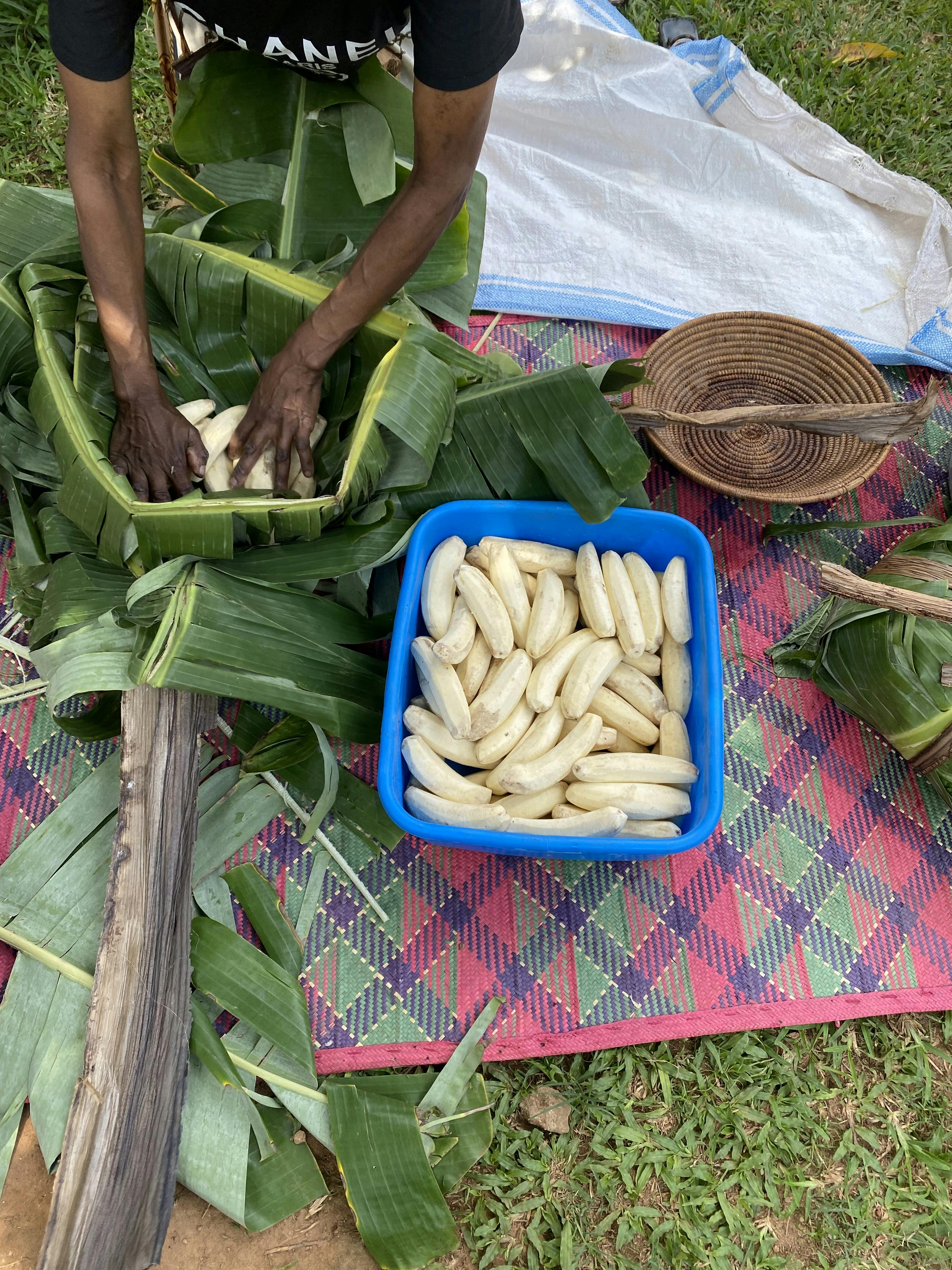
Peeled Matooke, Photo: Brogan Mwesigwa
You should try Matooke one day. It's even better when eaten with groundnut paste. I do eat a variety of meats; beef, pork, chicken, and goat. I have tasted mutton but I have never eaten rabbit. They are just too adorable for me to eat. When I prepare meat, I usually start by roasting it over fire with banana peelings for extra flavor. Then I boil it for a few minutes, drain the water, and let it dry a bit. Next, I fry the meat with vegetable cooking oil and onions, then add tomatoes, carrots, garlic and green paper on high heat. Once everything is soft and tender, I add spices like black pepper, paprika, and turmeric, then some water. I let it boil for 15 minutes, add a thickener like Royco⁷ and some salt, and let it simmer for another 20 minutes. The result is a thick, flavorful beef stew. You mention a lot of plant-based foods. Are you a vegetarian?
What kind of porridge do you like? I enjoy a mix of oats, soybean flour and milk, usually with a pancake made from wheat flour, bananas and two eggs, which I have for breakfast thrice a week. I love eating "Rolex"...not the watch! It's basically an omelet rolled inside a chapati, a soft thin, round flatbread made from wheat flour, water, and a bit of oil. It has a crispy surface. I like mine with raw tomatoes, cabbage, onions and avocado. Fun fact: the name comes from "rolled eggs", which quickly became "Rolex".
I haven't visited any art museums yet, but I would love to see the works of the masters in person. Claude Monet, Auguste Renoir, Rembrandt. I also can't forget Michelangelo and my favorite William-Adolphe Bouguereau.
Recently, I hosted a workshop with Congolese refugees. We ate Sombe, Ugali, and Kwanga – Congolese traditional foo – and talked about their lives in Uganda and how they came here. I live in a small town just outside the city Kampala. A decade ago, it was a village, but its identity has changed with urban development, migration, and social transition. There is a lot of construction as the city expands, and some of this transformation has become a key feature in my paintings, exploring how humans and nature navigate such changes.
Living in the countryside, how does the landscape influence your artistic practice and your exploration of ecological themes?
When I am older, I hope to live in the countryside. I am thinking about Kisoro district in the Kigezi region, often called the Switzerland of Uganda. It has beautiful, untouched landscapes with lush green hills and terraced fields similar to those in Switzerland, and I would love to be a farmer there too.
Warm regards, Brogan
From: Sandra Knecht
To: Brogan Aaron Mwesigwa
Tuesday, 30. Sept., 15:34
Dear Brogan
So sorry. I am fine again, thank you for asking.
In Switzerland, we also have small houses with gardens and small stables. In the past, these were home to the families of factory workers. I grew up in a house like this. I always had to help out in the garden, which I didn't like at all as a child.
I have never eaten sugar directly from sugar cane. It certainly tastes very different from the sugar cubes you can buy at the market.
There are dreams that should be fulfilled and others that must remain dreams because they are much more beautiful than reality.
Why did you have to give up this home with your planted tree?
I lived with Ethiopians when I was young. They cooked at least twice a week, and they always served this wonderful bread made from teff flour. I really like eating with my hands. My favorite cutlery is the spoon. I love stews, vegetables, beans and rice. All ideal for eating with a spoon.
Cooking is also essential for me, I do it every day. I love the many different types of vegetables, as well as meat and fish. I would love to know more about cooking yams, manioc and jackfruit. I only know the taste of yams because I have made chips from them before and they also grow here.
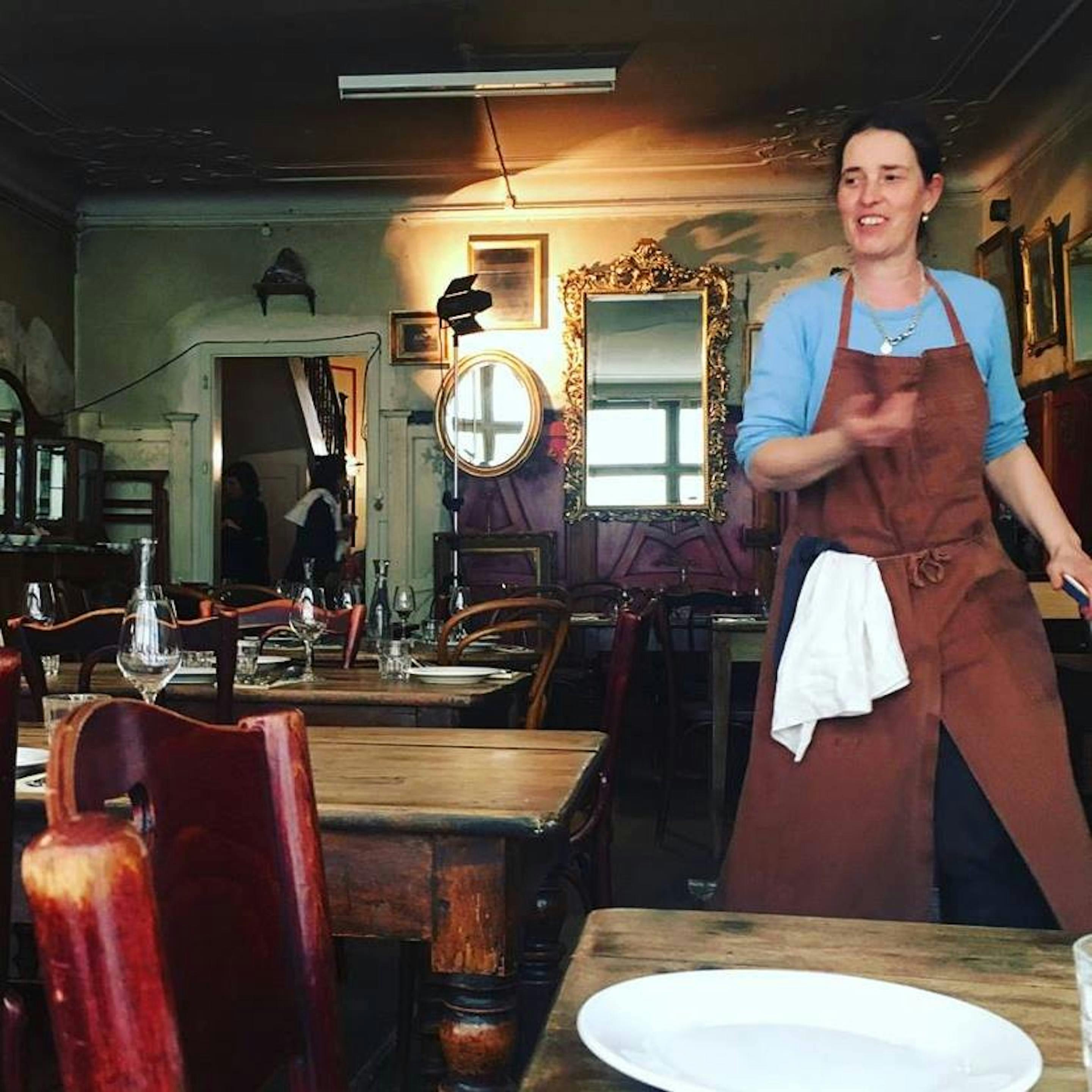
Photo: Sandra Knecht
For me, working with refugees and drug-addicted young people was very interesting and challenging. I loved dealing with so many different cultures and families, learning from them and accompanying them.
I started making art very late in life. I didn't plan to become an artist. When the Arab Spring began in 2010/2011, I wanted to take a break and decided to learn something that I didn't know much about but was interested in. That's how I ended up doing a master's degree in art. It's stayed that way until now. But I'm not sure if the art market is so good for my mental health. The pressure is enormous, especially since I make a living from it and don't have any other work. How are you doing with that?
All the best for you. Sandra
From: Brogan Aaron Mwesigwa
To: Sandra Knecht
Wednesday, 1. Okt., 15:13
Dear Sandra,
Warm greetings. I hope October has started off beautifully for you.
The sugar cane used to make sugar is quite different from the one used to make juice and for snacking. It is much slenderer and harder. Commercial sugarcane planting for sugar carries a sad story since it comes with displacement of communities and large-scale deforestation. We actually have different varieties with Goa being my favorite. It is light green, soft and quite rare these days.
I planted an Indian Must tree in my home, but it’s been struggling because of the change in climate. Kamuli, in Eastern Uganda has been experiencing long dry spells, which has also greatly affected farming. The land is dry, and crops like beans, maize, groundnuts, and sweet potatoes have had very low yields.
I only begun cooking as an adult. Growing up, that was considered women’s work, while the boys like me were assigned the heavier tasks of fetching water from the well about 400m away, washing dishes and anything requiring more physical effort.
I loved what you said about dreams. I completely agree. What was your dream growing up?
By the way, jack fruit is called Ffene here, and it’s a popular dessert. I remember back in primary school, around the age of 8, our school compound had so many jackfruit trees. During ripening season, we’d climb up and eat them in secret, since harvesting was forbidden. But we were stubborn kids, and it was the same story for carrots and cucumbers. This got us in a lot of trouble!
Me on the other end, I always wanted to be an artist since around 2011, when you were also trying something new. I was told by my art teacher that one could pursue a career in art which I never knew. I never looked back since. The art world does carry its pressure but as an emerging artist, I keep my focus on growth rather than premature success. What is even success anyway? To me, it’s simply having the peace and security to keep making art. My faith keeps me anchored.
How about you? What is your definition of success as an artist?
Working with refugees has also helped me deeply. It has given me a heart of empathy and compassion for displaced people, especially those forced to leave their homes. Listening to their stories, I realize how fragile life is. Today it’s them, tomorrow it could be me. Sharing meals with them has made me appreciate how food carries memory, and how much culture is tied to it.
I love dogs. Do you have pets?
Best, Brogan
From: Sandra Knecht
To: Brogan Aaron Mwesigwa
Monday, 13. Okt., 15:19
Dear Brogan,
It's been a while since we last wrote to each other. I hope you are well. I would be delighted if you could visit Switzerland sometime.
In two days, I will be travelling to Berlin with my two little dogs to work for the foreseeable future. Therefore, I will not have any time to write to you again until December.
In any case, I wish you all the best and much success with all your projects.
All the best for you! Sandra
From: Brogan Aaron Mwesigwa
To: Sandra Knecht
Monday, 13. Okt., 17:49
Dear Sandra,
I am well. Thanks for asking. I hope you are well too.
I will visit Switzerland sometime. Am delighted to know about you and your practice and I wish you safe travels to Berlin.
Greetings to your two little dogs and I wish you all the best and much success too. Looking forward to the publication.
Sincerely, Brogan
Brogan Aaron Mwesigwa (UG) (1997, Jinja) is a Ugandan painter whose work explores life in post -colonial Africa through figurative expression and participatory practice. Working primarily with oil paint on recycled paper, he transforms discarded paper into expressive surfaces that carry stories of memory, identity, transformation and community. His compositions blend imagination with acute societal observation, to create serene yet profound allegories of contemporary experiences.
Mwesigwa’s participatory project Kumanyagana further extends inquiry in these themes into the social sphere, drawing from Ugandan traditions of hospitality and food sharing, using communal gatherings as both subject and method.
He holds a BA in Industrial & Fine Art from Makerere University. He has exhibited in KLAART ‘24, Art Salon 2021, East African Artist Connect (2nd edition)2021, and his debut solo in 2021. He was a semi- finalist for Tilga Art Fund and Mukumbya Musoke Art Prize. His work has been featured in The Guardian.
@broganmwesigwa
Sandra Knecht (CH) (1968, Zurich) holds a Master of Fine Arts from ZHdK and is an artist who uses cooking as a central element of her artistic practice. With her food happenings and installations, she has participated in various biennials and exhibited in art museums both in Switzerland and abroad, including KBH. Geiger Basel, Social Club Basel, the Venice Biennale, Fundació Joan Miró Museum in Barcelona, Museum Tinguely Basel, Kunsthaus Zurich, Kunstmuseum Basel, Kunsthaus Baselland, FRAC Alsace, the Istria Biennial in Croatia, and the Locarno Film Festival. She has received several awards, including the Swiss Art Award 2022, the Basel Work Grant in 2015 and 2023, the Werkbund Label Baden-Württemberg in 2016, and the ADC Award in 2017.
https://www.sandraknecht.ch/
@chnaechtspaecht
[1] Getting to know each other
[2] A banana variety popular in East Africa
[3] A potato dish in shape of a pancake
[4] A stew made from pasta, potatoes, onions, leftover meat, sausage, cream and cheese
[5] Maize flour
[6] A Swiss spice mix
[7] An East-African spice mix
Fwd: Email (Re send) – By Brogan Aaron Mwesigwa, Sandra Knecht
From: Brogan Aaron Mwesigwa
To: Sandra Knecht
Wednesday, 13. Aug., 13:35
Dear Sandra,
I hope you're well. It was nice to e-meet you.
To answer the question,
I first began to notice this relation, through my research on traditional Ugandan food in my Kumanyagana¹ project for KLA ART Festival. In Uganda, our meals are deeply seasonal, following seasons of planting and harvesting. We have two planting seasons, March and August–September, and two harvesting seasons, June–July and December–January. As a child I remember certain foods appearing in the market during certain periods of the year. Like the many trucks of Matooke² at the Market in Nakulabye in June and in December. Matooke is one of Uganda's most important food crops.
I never grew up on a farm nor participated in any long-term farming activity except taking care of my Auntie’s chickens one holiday in 2013. I was raised in the concrete jungle of Kampala, the capital city of Uganda, where we are mostly consumers and not producers. Fortunately, during some of my visits to the village, I did observe my grandmother observing the clouds, and certain weather conditions to tell when the rains would start. As I speak, these signs have become less reliable. I spoke to her recently and she told me how they hadn't received a drop of rain in over six months. Climate warming has shifted the seasons. Sometimes they come in too late or too heavy or not at all. This has disrupted planting seasons, food availability and to a great extent, even community gatherings tied to harvest seasons.
Looking forward to your reflections,
Warm regards, Brogan.
From: Sandra Knecht
To: Brogan Aaron Mwesigwa
Saturday, 23. Aug., 13:1
Dear Brogan
Sorry for not getting back to you sooner. I had an accident in the meantime. Everything is fine now. I am writing to you here about how I grew up in the 1970s and 1980s.
When I was a child, global warming did not yet exist in this sense. Everything seemed possible, everything seemed achievable if you just tried hard enough. Racism and classism were not issues in the society I grew up in. Nor was the destruction of natural resources. Famine took place elsewhere, in Biafra for example. Nelson Mandela and Mahatma Gandhi were role models who were also far away. There was no digitalization, no internet; we made phone calls using a wall-mounted rotary dial telephone. So, we were all dependent on what was written in books and what we were told about the outside world through newspapers and television.
I grew up 1,200 meters above sea level in a small cow town. Every day, I rode my bike to school in the nearest town. At lunchtime, I rode up the mountain to go home and then back down into the valley. I hated school; I wanted to conquer the world on horseback. I rode my bike hundreds of kilometers around the hilly mountain region of my homeland; that was my way of travelling. I spent three hours every day on horseback, galloping through forests and meadows.
I started working at a very early age. My family was poor. At the age of 13, I helped out at the village butcher's shop and worked for farmers in the mountains during the school holidays. That's where I learned to cook. Traditional dishes such as Rösti³, bread baking, making your own pasta, etc. The famous Älplermaggaronen⁴ with apple sauce and salad were ubiquitous, and I still love this dish today. For me, this is tradition, like wrestling and yodeling or playing the accordion.
Our food was and still is dependent on where we shop and what we grow. I eat almost exclusively meat from our own animals, i.e., rooster and ram. In summer, I eat vegetables that grow in our garden.
Photo: Sandra Knecht
I was in Mexico a year ago, and since then I've been eating more corn, pineapple and avocado. Even though I know that both fruits are harmful to the environment and water supply when grown, I now buy them about once a month. I loved getting to know the culture in Mexico, which was previously unknown to me. Since then, I have enjoyed travelling very much, even though I am older now and do not speak any language other than our own well.
I hope you are well. All the best Sandra
From: Brogan Aaron Mwesigwa
To: Sandra Knecht
Monday, 25. Aug., 17:49
Dear Sandra,
I am very well, thank you. I am so sorry to hear about your accident, but am happy that you're doing well.
Unlike the 70's and 90's, my own memories begin in the early 2000s. I grew up in Bukesa, a small town in Kampala, in a humble home where we had just enough to get by. It was a developing neighborhood with flats rising above us, and multiple bungalows tucked in lanes. A few families who owned their own homes had small plots of land where they mostly grew matooke and vegetables. We planted some in our front yard. During school holidays, I loved planting sugarcanes. It grew so quickly that I could hardly wait, often harvesting it as soon as the first stalks broke through the soil. Riding a horse, though, for me is one of my dreams.
Maize Plantation after Harvest, Photo: Brogan Mwesigwa
Being a city child, visiting the village always felt like an adventure. I was allowed to go to the garden but, as the beloved ''visitor", I was excused from digging and planting. Still, I do remember planting a tree with my cousins. Last time I saw it, it had reached high into the skies. Sadly, we left that home behind.
Bukesa was also a place of many cultures. Our neighborhood included migrants from across East Africa and Indian families from Asia. Their shops were always filled with spices and grains. Ugandans are quick to adapt to other cultures but when it comes to food, we draw the line. So, my first taste of foreign dishes came only when I visited my Indian and Eritrean friends. They loved hot chili! I especially enjoyed Injera, the traditional Ethiopian and Eritrean flatbread made from teff flour. It has a spongy and slightly sour taste and it's eaten with all kinds of stew, with bean stew being my favorite.
Speaking of favorite, my favorite dish is rice (any kind) and bean stew, a meal I know how to prepare very well. Cooking is a part of many homes in Uganda. The majority cooks their own meals and the marketplaces have a variety of natural foods like Matooke, rice, maize flour, cassava, yams, Irish and sweet potatoes, pumpkins and plenty of fruits like pineapple, oranges, avocado; I love avocado and I eat one many times a week, jackfruits, mangoes and so many more. All these can be found all over the country but to serve the growing demand, some foods are imported from our neighboring countries like Kenya and Tanzania.
Bukesa had so few trees, that when it was hot, the heat could be unbearable. In 2009, at the age of 12, we had to leave due to gentrification, which swept away the place I once called home.
I have not travelled that much but my recent trip to Kenya saw me eat a lot of Ugali⁴ . Its taste is so different from ours in Uganda. They don't mix food with stew on the same plate. and here we do the mix whole heartedly.
What was it like, working as a public servant, and with refugees for 20 years?
When did you first discover that you're an artist? Was it from a young age or years later?
Best, Brogan
From: Brogan Aaron Mwesigwa
To: Sandra Knecht
Thursday, 4. Sept., 13:34
It's interesting that you haven't travelled much either. For me, it only started recently with art exhibitions and residencies. Because I have animals and a garden, it's difficult to find someone who can look after them properly when I'm away.
Photo: Sandra Knecht
I once lived with Ethiopian people. That's why I eat a lot of traditional food from there. I love legumes, rice and injera. I love eating with my hands and dipping bread in the sauces. The spoon is my favorite piece of cutlery. I cook often, so that's all I need to eat.
Since I was in Mexico, I've been eating a lot more different tropical fruits like pineapple, bananas, mango and avocados. They're good for my body. But I also feel guilty about the climate, so I'm cutting down on them. We also have lots of great fruits here like plums, cherries, apples, pears and all kinds of berries.
I eat as many different plants as possible, at least 33 per week. Grains, beans, herbs, and right now lots of tomatillos, tomatoes, cucumbers, courgettes and various green vegetables from the garden. Every day we have salsas and homemade bread with eggs from our chickens. I believe this abundance is worth the hardships of living in the countryside.
I have been often to big cities in recent years, and I have always been overwhelmed and overstimulated. Most of the time, I sit at home alone and don't see or talk to many people. When I am in the city, I soak up everything I encounter, especially at markets, where I get to know the local culture.
I would love to travel to South Africa. I've only been to the north: Morocco, Algeria, Tunisia. As I don't tolerate heat very well, I'm not sure if there is ever a time when the temperature is below 30 degrees Celsius.
African food is what I know least about. There are so many different countries and cultures on this huge continent. I cook a lot with sumac. A friend of mine who lives in Mali always brings me some from her village. Its chocolatey, fermented flavor gives dishes that need to be cooked for a long time the necessary depth of flavor. I think that it's a shame that this wonderful spice is increasingly being replaced by Maggi⁵. I used to be very interested in the gentrification of taste by corporations such as Nestlé. It's a kind of colonization that robs people of their identity and makes them dependent on corporations that devour everything they can get their hands on.
I've never eaten matooke. I love yams and manioc. They remind me of root vegetables like our parsnips, but they're more neutral and have a completely different consistency. I could eat neutral- tasting porridge with a hot, spicy stew every day.
Do you eat meat? If so, what kind? How do you prepare it?
As a child, I loved museums. My mother had to take me there from a very early age. I was 8 years old when I first visited the Old Masters in the museum in Zurich. I think I would have liked to have done art even at a young age. But I didn't get any encouragement in that regard. So, I worked with refugees from Somalia, Lebanon, Brazil, Iran, Afghanistan, etc. I cooked with them and talked about the lives they had before they were taken in here in Switzerland.
I noticed that people who came from the countryside had enormous difficulty integrating into city life, and people who came from cities did not understand the countryside and its customs at all. So, I made this a special feature of my work. After that, I was able to connect much more by focusing on their cuisine and music. I think it would make things much easier if people from the countryside could live in the countryside and people from the city could live in cities. That would certainly lessen the shock, among other things.
Best regards, Sandra
From: Brogan Aaron Mwesigwa
To: Sandra Knecht
Monday, 8. Sept 18:28
Dear Sandra,
Here in Uganda, an interesting fact about our food is that it usually takes a long time to cook. The traditional process is even slower. Food is often wrapped in banana leaves and left to simmer for hours, resulting in soft dishes rich in flavor. Speaking of gentrification of taste: fast food chains are taking over here, especially in urban areas where the young people seem to loathe cooking. The high demand for chicken means that we're often eating three-week-old broilers, which is why I prefer local free-range chicken that is now priced highly. I eat it less often now.
Peeled Matooke, Photo: Brogan Mwesigwa
You should try Matooke one day. It's even better when eaten with groundnut paste. I do eat a variety of meats; beef, pork, chicken, and goat. I have tasted mutton but I have never eaten rabbit. They are just too adorable for me to eat. When I prepare meat, I usually start by roasting it over fire with banana peelings for extra flavor. Then I boil it for a few minutes, drain the water, and let it dry a bit. Next, I fry the meat with vegetable cooking oil and onions, then add tomatoes, carrots, garlic and green paper on high heat. Once everything is soft and tender, I add spices like black pepper, paprika, and turmeric, then some water. I let it boil for 15 minutes, add a thickener like Royco⁷ and some salt, and let it simmer for another 20 minutes. The result is a thick, flavorful beef stew. You mention a lot of plant-based foods. Are you a vegetarian?
What kind of porridge do you like? I enjoy a mix of oats, soybean flour and milk, usually with a pancake made from wheat flour, bananas and two eggs, which I have for breakfast thrice a week. I love eating "Rolex"...not the watch! It's basically an omelet rolled inside a chapati, a soft thin, round flatbread made from wheat flour, water, and a bit of oil. It has a crispy surface. I like mine with raw tomatoes, cabbage, onions and avocado. Fun fact: the name comes from "rolled eggs", which quickly became "Rolex".
I haven't visited any art museums yet, but I would love to see the works of the masters in person. Claude Monet, Auguste Renoir, Rembrandt. I also can't forget Michelangelo and my favorite William-Adolphe Bouguereau.
Recently, I hosted a workshop with Congolese refugees. We ate Sombe, Ugali, and Kwanga – Congolese traditional foo – and talked about their lives in Uganda and how they came here. I live in a small town just outside the city Kampala. A decade ago, it was a village, but its identity has changed with urban development, migration, and social transition. There is a lot of construction as the city expands, and some of this transformation has become a key feature in my paintings, exploring how humans and nature navigate such changes.
Living in the countryside, how does the landscape influence your artistic practice and your exploration of ecological themes?
When I am older, I hope to live in the countryside. I am thinking about Kisoro district in the Kigezi region, often called the Switzerland of Uganda. It has beautiful, untouched landscapes with lush green hills and terraced fields similar to those in Switzerland, and I would love to be a farmer there too.
Warm regards, Brogan
From: Sandra Knecht
To: Brogan Aaron Mwesigwa
Tuesday, 30. Sept., 15:34
Dear Brogan
So sorry. I am fine again, thank you for asking.
In Switzerland, we also have small houses with gardens and small stables. In the past, these were home to the families of factory workers. I grew up in a house like this. I always had to help out in the garden, which I didn't like at all as a child.
I have never eaten sugar directly from sugar cane. It certainly tastes very different from the sugar cubes you can buy at the market.
There are dreams that should be fulfilled and others that must remain dreams because they are much more beautiful than reality.
Why did you have to give up this home with your planted tree?
I lived with Ethiopians when I was young. They cooked at least twice a week, and they always served this wonderful bread made from teff flour. I really like eating with my hands. My favorite cutlery is the spoon. I love stews, vegetables, beans and rice. All ideal for eating with a spoon.
Cooking is also essential for me, I do it every day. I love the many different types of vegetables, as well as meat and fish. I would love to know more about cooking yams, manioc and jackfruit. I only know the taste of yams because I have made chips from them before and they also grow here.
Photo: Sandra Knecht
For me, working with refugees and drug-addicted young people was very interesting and challenging. I loved dealing with so many different cultures and families, learning from them and accompanying them.
I started making art very late in life. I didn't plan to become an artist. When the Arab Spring began in 2010/2011, I wanted to take a break and decided to learn something that I didn't know much about but was interested in. That's how I ended up doing a master's degree in art. It's stayed that way until now. But I'm not sure if the art market is so good for my mental health. The pressure is enormous, especially since I make a living from it and don't have any other work. How are you doing with that?
All the best for you. Sandra
From: Brogan Aaron Mwesigwa
To: Sandra Knecht
Wednesday, 1. Okt., 15:13
Dear Sandra,
Warm greetings. I hope October has started off beautifully for you.
The sugar cane used to make sugar is quite different from the one used to make juice and for snacking. It is much slenderer and harder. Commercial sugarcane planting for sugar carries a sad story since it comes with displacement of communities and large-scale deforestation. We actually have different varieties with Goa being my favorite. It is light green, soft and quite rare these days.
I planted an Indian Must tree in my home, but it’s been struggling because of the change in climate. Kamuli, in Eastern Uganda has been experiencing long dry spells, which has also greatly affected farming. The land is dry, and crops like beans, maize, groundnuts, and sweet potatoes have had very low yields.
I only begun cooking as an adult. Growing up, that was considered women’s work, while the boys like me were assigned the heavier tasks of fetching water from the well about 400m away, washing dishes and anything requiring more physical effort.
I loved what you said about dreams. I completely agree. What was your dream growing up?
By the way, jack fruit is called Ffene here, and it’s a popular dessert. I remember back in primary school, around the age of 8, our school compound had so many jackfruit trees. During ripening season, we’d climb up and eat them in secret, since harvesting was forbidden. But we were stubborn kids, and it was the same story for carrots and cucumbers. This got us in a lot of trouble!
Me on the other end, I always wanted to be an artist since around 2011, when you were also trying something new. I was told by my art teacher that one could pursue a career in art which I never knew. I never looked back since. The art world does carry its pressure but as an emerging artist, I keep my focus on growth rather than premature success. What is even success anyway? To me, it’s simply having the peace and security to keep making art. My faith keeps me anchored.
How about you? What is your definition of success as an artist?
Working with refugees has also helped me deeply. It has given me a heart of empathy and compassion for displaced people, especially those forced to leave their homes. Listening to their stories, I realize how fragile life is. Today it’s them, tomorrow it could be me. Sharing meals with them has made me appreciate how food carries memory, and how much culture is tied to it.
I love dogs. Do you have pets?
Best, Brogan
From: Sandra Knecht
To: Brogan Aaron Mwesigwa
Monday, 13. Okt., 15:19
Dear Brogan,
It's been a while since we last wrote to each other. I hope you are well. I would be delighted if you could visit Switzerland sometime.
In two days, I will be travelling to Berlin with my two little dogs to work for the foreseeable future. Therefore, I will not have any time to write to you again until December.
In any case, I wish you all the best and much success with all your projects.
All the best for you! Sandra
From: Brogan Aaron Mwesigwa
To: Sandra Knecht
Monday, 13. Okt., 17:49
Dear Sandra,
I am well. Thanks for asking. I hope you are well too.
I will visit Switzerland sometime. Am delighted to know about you and your practice and I wish you safe travels to Berlin.
Greetings to your two little dogs and I wish you all the best and much success too. Looking forward to the publication.
Sincerely, Brogan
Brogan Aaron Mwesigwa (UG) (1997, Jinja) is a Ugandan painter whose work explores life in post -colonial Africa through figurative expression and participatory practice. Working primarily with oil paint on recycled paper, he transforms discarded paper into expressive surfaces that carry stories of memory, identity, transformation and community. His compositions blend imagination with acute societal observation, to create serene yet profound allegories of contemporary experiences.
Mwesigwa’s participatory project Kumanyagana further extends inquiry in these themes into the social sphere, drawing from Ugandan traditions of hospitality and food sharing, using communal gatherings as both subject and method.
He holds a BA in Industrial & Fine Art from Makerere University. He has exhibited in KLAART ‘24, Art Salon 2021, East African Artist Connect (2nd edition)2021, and his debut solo in 2021. He was a semi- finalist for Tilga Art Fund and Mukumbya Musoke Art Prize. His work has been featured in The Guardian.
@broganmwesigwa
Sandra Knecht (CH) (1968, Zurich) holds a Master of Fine Arts from ZHdK and is an artist who uses cooking as a central element of her artistic practice. With her food happenings and installations, she has participated in various biennials and exhibited in art museums both in Switzerland and abroad, including KBH. Geiger Basel, Social Club Basel, the Venice Biennale, Fundació Joan Miró Museum in Barcelona, Museum Tinguely Basel, Kunsthaus Zurich, Kunstmuseum Basel, Kunsthaus Baselland, FRAC Alsace, the Istria Biennial in Croatia, and the Locarno Film Festival. She has received several awards, including the Swiss Art Award 2022, the Basel Work Grant in 2015 and 2023, the Werkbund Label Baden-Württemberg in 2016, and the ADC Award in 2017.
https://www.sandraknecht.ch/
@chnaechtspaecht
[1] Getting to know each other
[2] A banana variety popular in East Africa
[3] A potato dish in shape of a pancake
[4] A stew made from pasta, potatoes, onions, leftover meat, sausage, cream and cheese
[5] Maize flour
[6] A Swiss spice mix
[7] An East-African spice mix